

CHUBBUCK — As Nadine Rasmussen closes her eyes in bed each night, warm fluid begins to fill her abdomen. Toxins will leave her body as she sleeps and tomorrow she will call a daughter or grandchild. Failing kidneys have not robbed Nadine of her love of life and a chance to live it more fully.
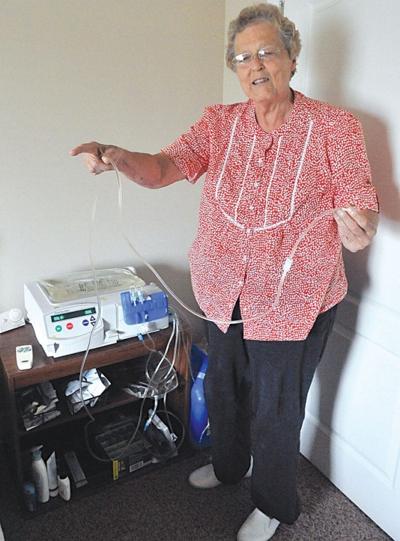
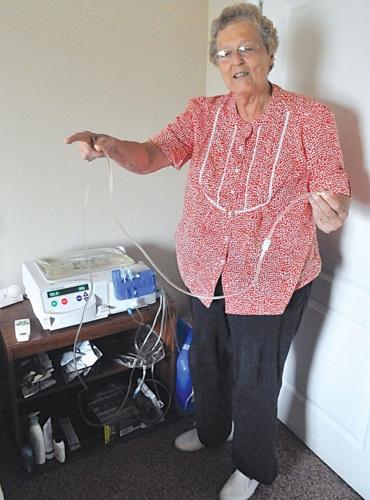
Each evening, Rasmussen follows the same strict routine that will tie her to a nearby machine for nine hours. Her life depends on a humming electronic device no larger than a computer printer and she knows it. She also knows she is lucky.
Although staying alive requires a daily regimen, it has allowed her the freedom to travel to see family in Utah, Oregon and even Hawaii. Those are trips she wouldn’t have experienced if she had been tied to the standard hemodialysis many people with kidney failure have to use.
She owes her relative freedom to peritoneal dialysis, a treatment made possible by Liberty Dialysis and the Idaho Kidney Center in Pocatello.
“I feel really grateful,” Rasmussen said.
After retiring from AMI, which is now ON Semiconductor, after 20 years on the job there, Rasmussen began to feel ill about three years ago. She was 70 and initially shrugged it off as just the symptoms of growing older.
Rasmussen had nausea and suffered from a loss of appetite. Although the fact her urine foamed, she dismissed it.
“You just itch everywhere,” she said. “I was tired and losing weight. I was really sick and didn’t know what was wrong.”
Her failing health finally sent her to the hospital in an ambulance. Doctors told her the grim news that her kidneys had failed and if she didn’t get dialysis immediately, she would be dead in five days.
The mother and grandmother is honest about her thoughts at the time. She said a part of her just wanted to give up — and then she thought about her family. With six daughters and 20 grandchildren she decided she owed them the good fight. After all, she had raised her girls as a divorced mother and was no stranger to challenges.
“It didn’t seem like I had a choice,” Rasmussen said.
Initially Rasmussen had to rely on a short-term shunt that her doctors put in her neck to begin standard hemodialysis. The process draws all the blood from a patient with kidney failure and cleanses the impurities before recirculating it back into the body. The process must be done in a clinic or hospital and it requires about five hours, three days a week. And it leaves patients exhausted.
“You’re pretty much wiped out,” Rasmussen said.
After being on hemodialysis for several months, Rasmussen said she was struggling with the idea of accepting she would never be able to leave her home in Chubbuck to take trips again in her life. Then her doctors, Dr. Fahim Rahim, Dr. Naeem Rahim and Dr. Michael Haderlie talked to her about a new type of therapy – peritoneal dialysis or PD.
“I was frightened to make the switch,” Rasmussen said about her initial reaction.
But the lure of more independence and assurances that she would be well supported in her new treatment made Rasmussen decide to commit. He family supported the decision.
“I really don’t think I could have done it without their support,” she said about family and the medical community. “I have such supportive children.”
He oldest daughter, Tonda Cody, is a Registered Nurse and she lives within walking distance.
Training on how to use the PD device and follow strict protocols followed. The machine and numerous supplies came next. The process requires the transfer of a large volume of special fluid and the first 30-day supply arrived and forced Rasmussen to clear out an entire closet to make room for it.
When the first day to make the switch to PD came, Rasmussen was ready.
Each night in her bedroom, she connects the portable PD device to a shunt in her abdomen. Fluid bags heated to body temperature then begin to empty into her abdominal cavity where osmosis carries contaminants from her body through the peritoneal lining into the fluid which is then flushed from her system. The cycle is repeated through the night three times while she sleeps.
“I’ve learned to sleep with it pretty good,” Rasmussen said. “I get up in the morning and I feel fine.”
In addition to the treatment she follows a strict diet and cannot eat several types of fruits and vegetables. However, she has to load up on protein because it is depleted in the PD process.
Rasmussen has become skilled at this self-treatment and it is portable so she can pack the machine and supplies with her on trips or make arrangements to have Liberty Dialysis deliver the needed fluid to another location — a location like a hotel in Hawaii.
“Last July I got to go to my granddaughter’s reception in Hawaii,” Rasmussen says with a big grin. “They had a luau and I’ve never seen anything like it.”
She walked on the beach and even took a submarine ride with a grandson.
“I could do everything anyone else could,” Rasmussen said.
And more trips are on the planner for Rasmussen.
“I feel like a real person,” she said.

(0) comments
Welcome to the discussion.
Log In