

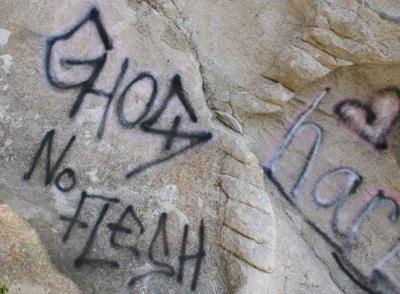
ALMO — Vandals have desecrated a historic landmark within City of Rocks National Reserve bearing signatures written in axle grease by early pioneers traveling the California Trail.
The landmark, called Camp Rock, was tagged with graffiti some time between Friday night and 1 p.m. Sunday, said Wallace Keck, the park’s superintendent.
Since posting about the vandalism on social media, Keck said he’s been flooded with tips and is compiling evidence to turn over to federal investigators.
“Even though they’re from random people, we’re starting to put the puzzle together,” Keck said. “Some pieces are fitting perfectly with what we know and are adding to our understanding.”
Keck said tips have helped him refine the timeline of when the vandalism occurred. He’s also received tips about a suspicious vehicle that was in the vicinity during the time window in which the vandalism apparently occurred, as well as tips about where similar graffiti has appeared in the community.
Keck said federal law enforcement will investigate the matter because it occurred on federal property. He said the vandalism constitutes a violation of the Archeological Resources Protection Act, and penalties will be stiff if the perpetrators are identified and convicted.
“In five minutes they’ve ruined what has been recognized as nationally significant for over 175 years,” Keck said.
Keck said one of the tips he received came from a person whose great-grandfather signed the rock. He believes the fact that his social media posts have been viewed thousands of times and shared hundreds of times demonstrates the level of public outrage about the vandalism.
Keck said the National Park Service has experts and private contractors at its disposal who will be called in to remove the graffiti. They will use a special chemical that will remove the paint without damaging the underlying signatures. However, Keck said the process is time consuming and costly, and it isn’t perfect. A faint impression of the graffiti will likely remain visible where the rock was worked, he said.
“It ruins the story. It degrades the value of what we’re trying to communicate there,” Keck said.
City of Rocks, located in Cassia County just north of Idaho’s south-central border with Utah, and nearby Castle Rocks State Park draw a combined quarter million visitors per year, Keck said.
Keck explained Camp Rock was a popular camping spot for wagon trains when they first arrived in the scenic Circle Creek Valley. Pioneers headed to California between 1843 and 1882 would sign their names in axle grease on the rock. Keck said diaries and records of the pioneers who signed the rock have been thoroughly researched.
“We’re able to tell their entire story,” Keck said.
Keck said leaders with the Shoshone-Bannock Tribes have also identified some markings on Camp Rock that are likely prehistoric.
A third set of reddish markings on the rock were made during the 1930s. Keck explained those more recent markings were faked pioneer signatures made by advocates for establishing City of Rocks as a national park. He said they forged signatures in hopes of bolstering sentiments about the significance of the area among leaders in Washington, D.C.
Keck said the forgeries have also become part of the rock’s protected history. He said most of the graffiti was painted over those faked signatures.
“Fortunately the vandals didn’t write over the best signatures,” Keck said.
Anyone with additional information about the vandalism should call Keck at 208-824-5911.


(0) comments
Welcome to the discussion.
Log In