

JACKSON HOLE, Wyo. — Highlining is not a new concept, or sport — in 1974 Frenchman Philippe Petit walked illegally between the twin towers of the World Trade Center in New York — at a 110 stories, he called the feat, “le coup.” It took six years to plan the performance.
Peter Hudnut of Jackson Hole, Wyo., is also one of the brave few who love the sport. He said there are about five Highliners in the Greater Yellowstone area.
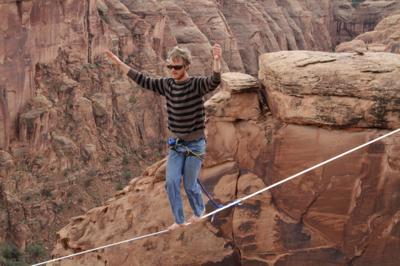
Hudnut’s highest walk was in Moab, Utah, where he traversed a one inch strap 500 feet off the ground.
Barefoot and clad in blue jeans and a safety harness, Hudnut looks comfortable on the 1-inch-wide nylon climbing webbing, and he said highlining is about being mentally and physically prepared.
“It’s a breathing and mental exercise,” Hudnut said. “Keeping focused and composed is difficult.”
Bingham and Power counties are popular spots for highlining — but Hudnut preferred to not disclose the exact locations.
Hudnut said the sport of highlining is legal on public lands, but not in national parks.
“The rule is that you leave it the way you found it — you can’t cause damage to the area,” he said.
Rigging a safe line requires training and experience, Hudnut said, a safety line is attached from his harness to the tight rope.
Originally from Fort Collins, Colo., Hudnut started slacklining in college — slacklining is walking across the same 1-inch strap, but only a few feet off the ground.
“I kind of got bored with it,” Hudnut said. “Then I walked up high, about 90 feet, and it reignited my interest. I was scared out of my wits and I thought, ‘man, this is the challenge.’”
Hudnut refers to each walk as a project and said he’s always on the lookout for his next hilining adventure – the Tetons offer lots of opportunity.
“I’m looking at 200 feet or better,” he said. ”The higher and the longer, the harder and more challenging it is.”
While few people take part in the sport, Hudnut said it has gotten some recent attention which lead to improved equipment and safety gear.
“We can safely rig up bigger and wider gaps,” he said.
When he’s not crossing a gap 200 feet in the air, Hudnut works at the Wilderness Treatment Center for Boys.
The center focuses on troubled adolescent boys and while the teens know what Hudnut does and think it pretty cool, there hasn’t been a lot of interest in actually trying it.
Hudnut warned that highlining requires training and no one should try it without that experience and the right equipment.
To learn more about highlining, visit Slack Chat on Facebook.

(0) comments
Welcome to the discussion.
Log In