

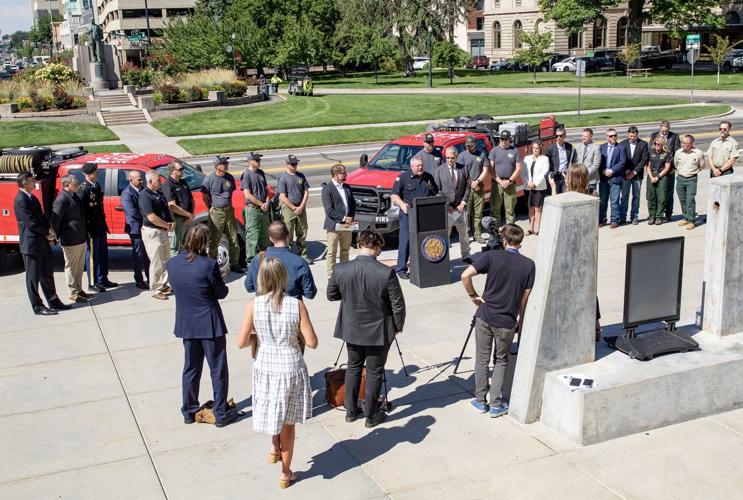

BOISE — Firefighting agencies gathered Tuesday at the Idaho State Capitol for a pre-season wildfire briefing. As fire season enters into its early stages, state leaders underscored that the historically hot and dry conditions bring the potential for a significant and costly fire season.
Fire outlook
Officials who spoke at Tuesday’s Land Board meeting and subsequent pre-fire season press conference consistently said widespread drought conditions are expected to continue, conducive to a heightened fire season.
As of Tuesday — still very early in the fire season — there have been 59 fires across 549 acres, 26 of which were human caused, 13 were natural and 20 have a cause yet to be determined, the Idaho Department of Lands' (IDL's) division administrator of operations Jake Strohmeyer said.

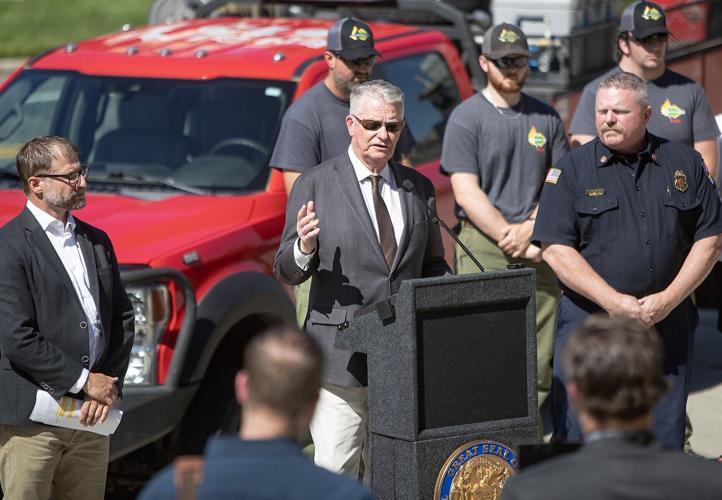
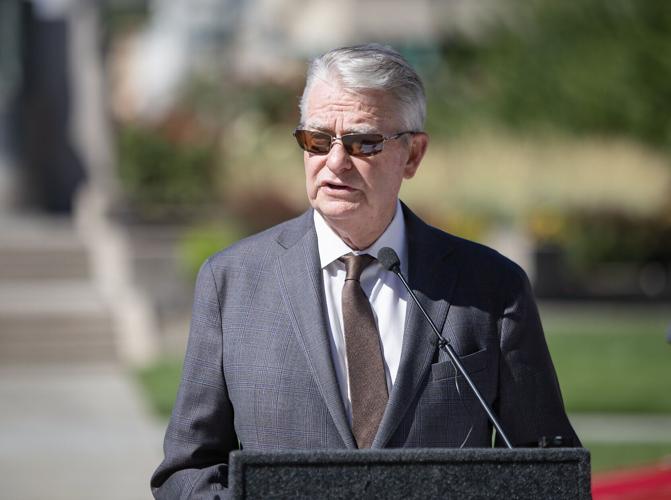
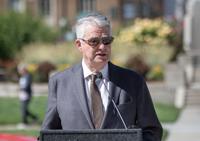
Gov. Brad Little delivers a detailed update on preparedness for the 2026 fire season during a press conference outside the Capitol building, Tuesday, June 16, 2026.
While the winter months saw near-normal precipitation, warm temperatures resulted in above-normal snowpack only being observed at elevations above 6,000 feet near the panhandle and 7,000 feet in southern Idaho. Jim Wallmann, a Bureau of Land Management meteorologist at the National Interagency Fire Center (NIFC), said these temperatures were the second warmest on record, averaging 6 degrees above normal from December through May.
The limited snowpack in Idaho, which was at a record low as of April 1, has impacted the fire fuels in the state, with conditions characterized as “above normal” for much of southern Idaho. After a wet April in southwest Idaho, an abundance of fine fuels, such as tall grasses, have grown in the region, Wallmann said.
If the dry and hot conditions continue as expected, these fuels only add to the potential for future wildfires.
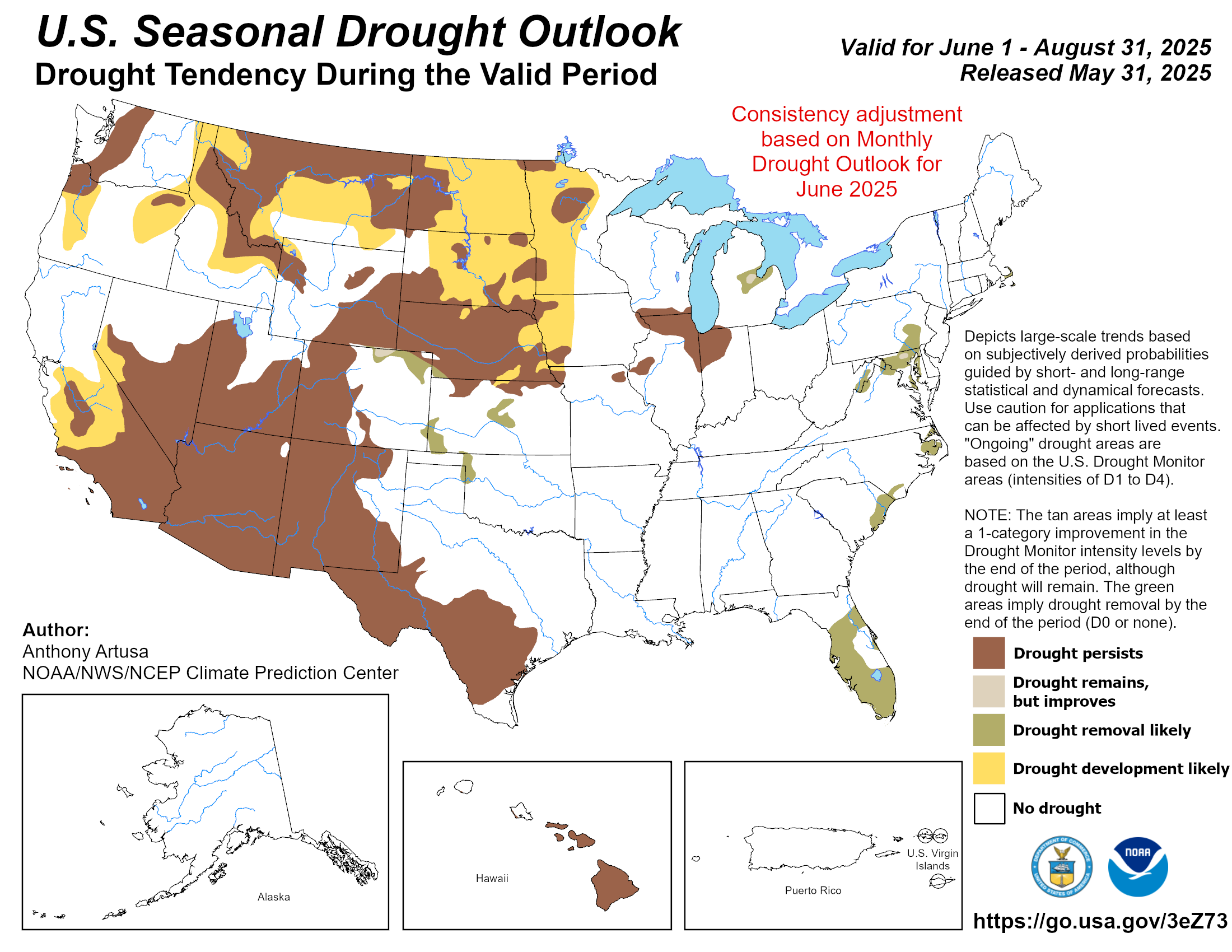
In some respects, Wallmann said what Idaho is observing is not unique. According to the U.S. Drought Monitor, about 60% of the country is experiencing drought conditions. Though these conditions are starting to show signs of improvement in the southeastern U.S., the snow drought in the western U.S. is contributing to worsening drought conditions. The most recent national seasonal drought forecast indicated that drought will persist through much of Idaho at least through to the end of August.
In April, the Idaho Department of Water Resources issued an emergency drought declaration for each of the state’s 44 counties. According to the U.S. Drought Monitor, Owyhee and Twin Falls counties are experiencing “exceptional drought,” the highest intensity on the drought scale.
Personnel improvements
Though conditions conducive to wildfire are expected to persist over the coming months, officials reiterated IDL was in a positive staffing position before fire season gets into full swing.
Across IDL's 50-engine fleet, Strohmeyer said 36 will be fully staffed, 11 more than the previous fire season. In terms of individual personnel, the department has 260 operational firefighters heading into the fire season, 31 more than last year. He added that 48% of these firefighters have one or more years of fire experience and all of the department’s full-time firefighting positions have been filled.
The department is also bringing back a Type 1 helicopter based out of Coeur d'Alene which just came under contract, but is still working to bolster its air resources for the future.
While IDL works to restart its helitack program, which provides aerial support for wildfires, the department will be partnering with the Minnesota Department of Natural Resources to bring on their Type 3 helicopter along with their crew. Strohmeyer said this arrangement will allow firefighters to receive needed training for when IDL's helitack program restarts, potentially as soon as next year.

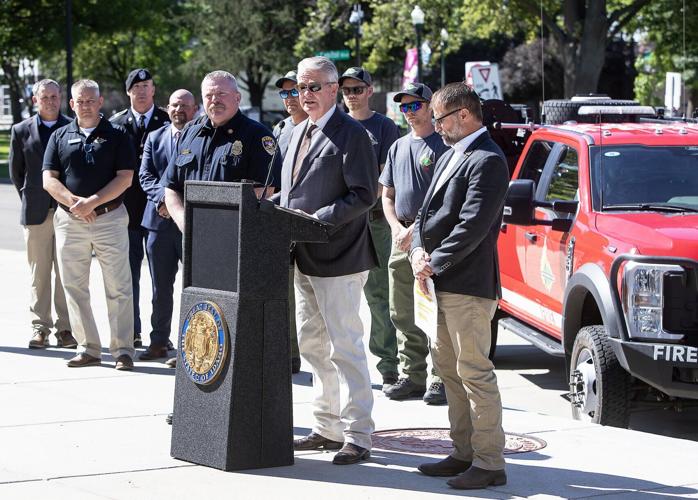
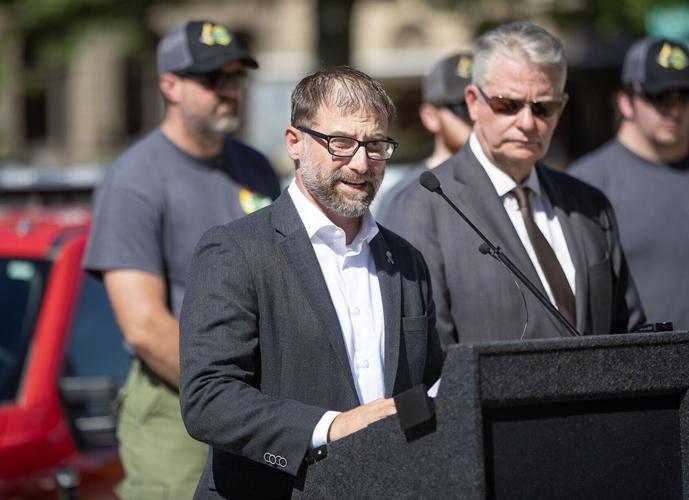
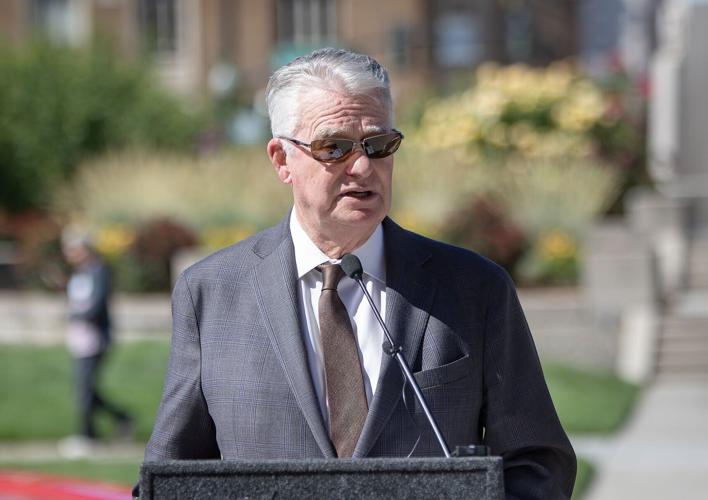
Idaho Department of Lands Director Dustin Miller adds to a detailed update on preparedness for the 2026 fire season during a press conference outside the Capitol building, Tuesday, June 16, 2026.
IDL Director Dustin Miller further highlighted 11 IDL wildfire detection cameras were operating across the state, with eight additional cameras due to be installed this year. This comes in addition to the official adoption of “Ready, Set, Go!” as the state’s evacuation messaging framework to ensure consistent standards are in place when communicating wildfire response.
“If we aren't the first, we're one of the first states in the United States to actually have a statewide mass evacuation protocol,” Nampa Fire Protection District Chief and President of the Idaho Fire Chiefs Association Kirk Carpenter said, "and we can only do that when we have relationships that span across to all state and federal partnerships.”
Gov. Brad Little highlighted additional improvements to cooperation with federal partners, including the U.S. Forest Service. Idaho received $10 million in federal funding through its Good Neighbor Authority agreements to improve forest restoration.
Idaho leaders also signed onto a shared stewardship agreement with the U.S. Forest Service in December, an arrangement that is expected to double timber production in the state and bolster cross-boundary management between federal and state public lands.
“I want Idahoans to know that Idaho is prepared,” Little said. “Preparedness is a result of years of investment, coordination, hard work by our firefighters and land managers, emergency responders, local government, and countless other partners.”

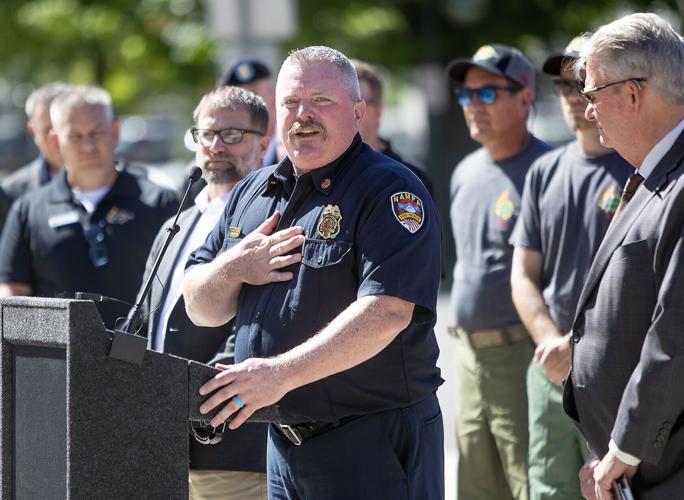
Nampa Fire Protection District Chief Kirk Carpenter, president of the Idaho Fire Chiefs Association, adds to a detailed update on preparedness for the 2026 fire season during a press conference outside the Capitol building, Tuesday, June 16, 2026.
Status of fire suppression funding
The state enters fire season this year after new funding allocations did not arrive for the state’s fire suppression fund this fiscal year, which hit a low point of $2.8 million in the spring. As of June 9, with efforts to fight wildfires now underway, IDL is already entering into deficiency spending with a cash “balance below $0,” Julia Lauch, Idaho state forester, said.
Deficiency warrants are utilized by the state when fire expenditures exceed both the available wildfire appropriation and the balance of the state’s fire suppression fund. The state controller has the ability to issue these warrants against the state general fund as they are incurred, effectively functioning as a “credit card” for the state, as Little described it.
A transfer of $32.8 million to the wildfire suppression fund is slated for July 1, once fiscal year 2027 begins. When incorporating projected billing for Idaho and the reimbursement of costs incurred to support neighboring states during 2025, this amount will dwindle down to an estimated $4.8 million, Lauch noted.
This is well below the state’s five-year average for fire suppression costs of $47.2 million as well as the $76.2 million in fire suppression costs incurred in fiscal year 2025, a 10-year high. Asked by Little whether the expectation was the department would end up “burning through” allocated funds early in this year’s fire season, Lauch responded this was the case.
If that expectation holds true, IDL would need to bring forward a supplemental funding request during next year’s legislative session to fund the wildfire costs incurred in the coming months. Opposed to this level of reliance on deficiency warrants, Little has consistently urged the legislature to fund fire suppression costs ahead of the summer months, rather than paying for them after the fact.
Though firefighting contractors will still get paid regardless of whether funding has been allocated, “you’re always in a better negotiating position if you got cash in the bank instead of issuing a deficiency warrant,” Little said.

(0) comments
Welcome to the discussion.
Log In