

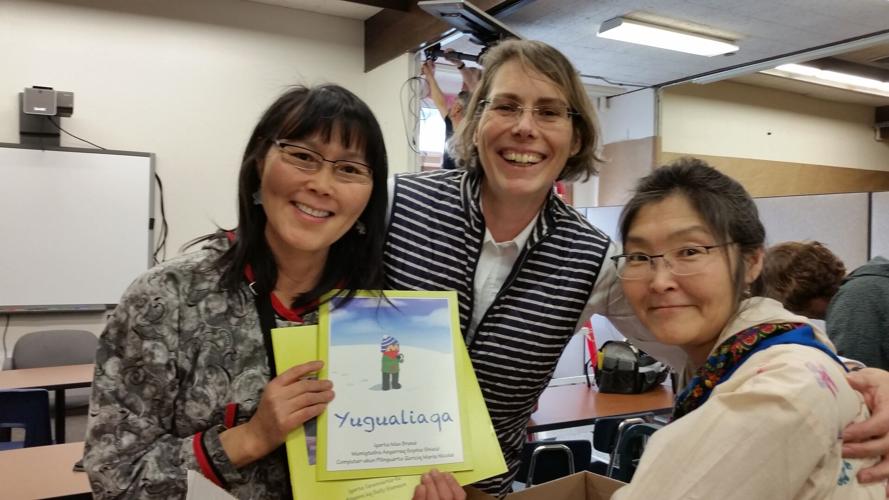
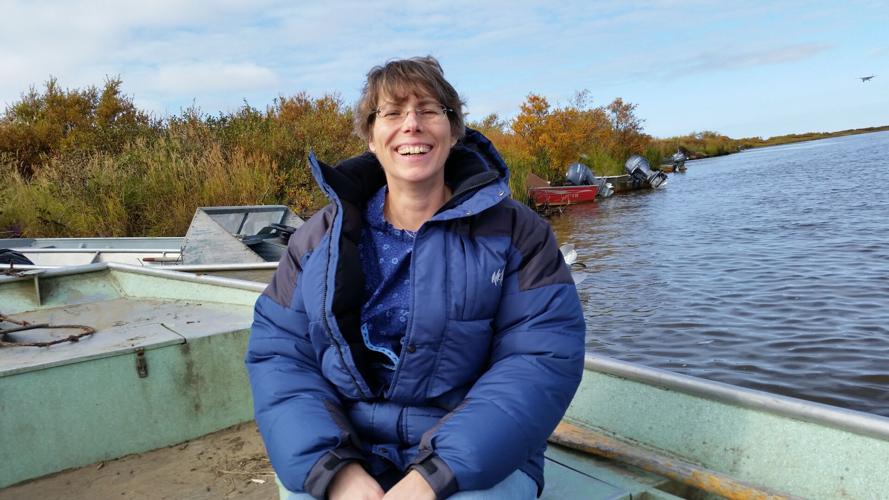
Sabine Siekmann was only 17 when she boarded her first plane in 1988, leaving Rotenburg, Germany, for Pocatello as a Rotary exchange student.
She had no idea that years later she’d ride a snowmobile across the Alaskan tundra with her infant strapped to her chest.
She had no idea she’d fly in a four-seat bush plane over Alaska’s Yukon-Kuskokwim Delta to reach remote villages accessible only by boat or all-terrain vehicle.
She had no idea of the lives she would touch in those tiny communities scattered across America’s largest and northernmost state.
She only knew she loved words and language. And when she first saw Pocatello — its wide skies and looming mountains — she knew she’d found a place to call home.
After her exchange year, Siekmann returned to Germany until college. She then came back to Idaho State University on a tennis scholarship, earning a bachelor’s degree in English literature and an interdisciplinary master’s degree in English and anthropology.
ISU professor Chris Lother changed everything.
“ISU had a very good program,” said Siekmann, who now lives in Fairbanks, Alaska. “It was an interdisciplinary program, and…shout out to Chris Lother. I know he’s long retired, but he was an amazing professor. Without him, I would not have discovered linguistics and applied linguistics for myself. So it’s amazing what professors do sometimes.”
After ISU, she and her husband Eric Markham moved to Florida, where she earned her Ph.D. in second language acquisition and instructional technology from the University of South Florida. Her first teaching position came at Gettysburg College in Pennsylvania.
But Siekmann wanted a tenure-track position. When her husband suggested looking west of Denver, they found an opening at the University of Alaska Fairbanks.
The position was perfect — interdisciplinary and focused on distance education, exactly what she’d studied.
“I always thought it was really important to give access to education to anybody regardless of their geographical location,” Siekmann said. “So that was really attractive to me that there was this idea of making high quality higher education available to anybody off the road system…and the other thing that was really attractive to me was the context of working with Alaska Native languages.”
Central Alaskan Yup’ik is the most widely spoken Native Alaskan language, with more than 10,000 people considering it their first language. Most live in Bethel or the 50 or so remote villages surrounding it.
But English threatened to erase it.
The villages were hard to reach — accessible only by boat in summer or all-terrain vehicle in winter because of the wetland landscape. That made language education challenging.
Dual immersion programs existed, but children struggled. Some communities had switched mainly to English. Others taught Yup’ik for a child’s first few years, then abruptly switched to English.
“Which is kind of difficult if you just switch over cold,” said Siekmann, whose role involved communicating via telephone or video conferencing with dual immersion teachers, helping them understand pedagogy.
“You can’t just be like ‘I’m a certified teacher and I speak Spanish, now I’m going to be an immersion teacher,’” she said. “You do need special pedagogical strategies and skills to be a highly skilled immersion teacher and that’s where I come in.”
Siekmann also traveled. Once a month and several weeks each summer, she flew 400 miles from Anchorage to Bethel. From there, she’d take a boat, bush plane or all-terrain vehicle to visit villages and work directly with teachers.
The results were remarkable.
Not only was the dual immersion program revitalizing Yup’ik, but children were also developing stronger academic skills and excelling on tests.
“This established language pedagogy leads to really good…language outcomes and academic outcomes for the children,” Siekmann said. “Usually the immersion kids outperform the monolingual kids on all standardized assessments.”
Her passion was personal. As a native German speaker who learned English, Siekmann understood what multilingualism offered.
“I developed this interest in supporting indigenous languages and multilingualism because I’m bilingual,” she said. “My native language is German, and I learned English and I study other languages and I just think it really is a wonderful tool to have. And indigenous people were losing their languages and I wanted to be a part of helping people maintain that richness of their culture and their language.”
Siekmann still serves as a professor of applied linguistics at the University of Alaska Fairbanks and director of the university’s English as a Second Language program. But her days flying bush planes over the Yukon-Kuskokwim Delta are mostly over.
Her students have taken over.
“This whole time I was out there I worked with students earning masters and Ph.D.s, so I have a lot of Ph.D. (students) that I graduated that are Alaskan natives themselves, and that’s the work that I’m continuing now in Fairbanks,” she explained. “So I’m working with a cohort of Alaskan native Ph.D. students from all across the state and I have a grant to support that.”
Those students wrote letters supporting her nomination for the Emil Usibelli Awards, given annually by the University of Alaska Fairbanks. Three professors each receive $10,000 for exemplary work in three categories.
Siekmann won the Usibelli teaching award in September.
“To be recognized for my commitment in innovation in teaching...is really the biggest honor I can imagine receiving for my professional life, and that it also included so many letters from my students,” she said. “That was particularly meaningful that students took time to write letters in my support of this award, and the kind things they said about me (such as) that I’m there whenever they need me. They can call me. They have my cell phone. I talk to them on Sunday. I come out to visit them. So that really…makes me feel very emotional and very humbled by the recognition.”
Many of her Ph.D. students have picked up her work in Bethel and the surrounding villages.
“I don’t do that work anymore…because my Ph.D. students carried it on,” she said. “You want to make yourself not needed anymore. You want your students to stand on your shoulders and carry on the work…they should be the ones working with the teachers. I mean, who am I? I’m a German woman, I’m not Yup’ik. I can help them but really I don’t know about the culture and the language. That’s not my area. My focus was to build capacity for local leadership in these programs and I can see that happening now…I’m there to support them and that’s really what it’s all about.”
She credits ISU with making it all possible.
“I would not be doing this work without ISU,” she said.
She also understands the pressure young adults face when choosing their path.
“Right now a lot of (high school) seniors are thinking about where their life is going to take them and which college they’re going to pick,” she added. “There’s a lot of pressure on those high school seniors right now to know what they want to do. Life is like a winding road and sometimes it’s on those little things that you think are a detour that you really find your calling…I would never have known when I was 18 that I was going to end up in Fairbanks, Alaska, taking my infant child on a snow machine out over the Bering Strait...I just want to let people know it’s not a straight road and it doesn’t have to be and to explore your passions and follow your heart.”

(0) comments
Welcome to the discussion.
Log In