

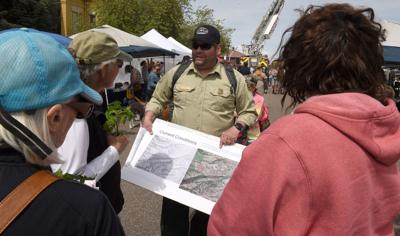

Wildland Urban Interface, aka WUI. If haven’t heard of WUI, you haven’t been paying attention to conflagrations that laid waste to Southern California last year.
And if you think that the WUI concept has no application here in Southeast Idaho, well, the U.S. Forest Service is challenging that proposition with a draft environmental assessment for the Caribou-Targhee National Forest.
The formal title of the publication is “Lower Portneuf Cooperative Vegetation Management Project” and the U.S. Forest Service’s Westside Ranger District of the Caribou-Targhee National Forest is holding a public open house to discuss this long-term project proposal on Monday from 4 p.m. to 6 p.m. in the Pocatello City Hall Council Chambers, located at 911 N. Seventh Ave.
The Caribou National Forest was established in 1907 by President Theodore Roosevelt and Targhee National Forest was established the following year. In a cost-savings measure the two were merged in 2000.
Page four of the draft proposal states: “The purpose of the Lower Portneuf Cooperative Vegetation Management Project is to restore forest health, reduce hazardous fuels across the project area, and to address wildfire risks in the wildland urban interface (WUI) of Pocatello. Forest health refers to the resiliency of the forest and its ability to self-renew following drought, wildfire, insect outbreaks, and other forest stresses and disturbances.”
The project lead is Arik Jorgensen, a U.S. Forest Service fuel specialist for the Caribou-Targhee National Forest Westside Ranger District, Soda Springs Ranger District and Montpelier Ranger District.
The project’s proposed areas form a patchwork totaling over 12,000 acres. The project is slated to begin in 2026, taking 10 to 12 years to reach completion.
The draft environmental assessment by the Forest Service calls for implementing four different treatments on vegetation within the project areas.
1) Clearing 2,959 acres with prescribed fire through broadcast burning, pile burning, tree well burning and jackpot burning.
2) Clearing approximately 8,184 acres by a combination of mechanical treatments along with prescribed fire techniques
3) Treat approximately 554 forested acres with harvest and stand tending techniques including the use of prescribed fire. Harvesting would be in and around the Scout Mountain campground, the cabins and 22 acres within the watershed near Elk Meadows.
4) Treat up to 488 acres of land adjacent to motorized and non-motorized trails and selected roadsides to create an uneven aged shaded fuel break.
Jorgensen said that of immediate concern is the WUI interface between the Caribou-Targhee and Pocatello.
“Those are the areas we would want to start working in the soonest. The area is right adjacent to Pocatello. There’s all this housing and everything in Gibson Jack and Mink Creek. So we’re looking at doing this kind of stuff in this area first,” he said.
Currently the Forest Service website wildfirerisk.org rates Pocatello at a very high risk of wildfire, higher than 98% of other communities in the United States.
“We’re looking at trying to create a snapshot in time where we won’t see uncharacteristic large disturbance. We see that across the West with insects and disease and wildfires where you know things aren’t doing what they historically did and it’s creating conditions that are usually outside that historic range. And so what we’re trying to do is introduce a disturbance that will hopefully perpetuate the ecosystem through natural disturbances later down the road as we see insects and disease increase and come and go, as we see fires occur. By doing things like this we’re trying to set the stage for the next disturbance essentially,” Jorgensen said of the proposed project’s intent.
The absence and suppression of natural fire disturbance over time has created unfavorable forest conditions in the area. These conditions include overly dense, homogenous and mature conifer stands and species that are encroaching and pushing out Aspen stands.
Aspen ecosystems provide habitat and forage for a wide diversity of animal and plant species. Aspen trees are also better adapted to survive wildfire intensity than conifers such as Douglas Firs.
Jorgensen said that one of the goals of the project is to restore the areas to a fire adapted ecosystem.
“When you try to buck against that you start building up unnatural fuel loads,” he said.
According to the environmental assessment, a majority of the Aspen stands in the project areas are at “high risk” with the absence of disturbances such as fire resulting in a shortage of younger-age Aspens and canopy openings for all types of vegetation.
“We have lost a significant amount of our Aspen through succession to conifer,” said Chris Colt, Forest Service wildlife biologist and an interdisciplinary team member of the project. “The other part of that is the age of our conifer is all, relatively speaking, all even-aged and we have a high fuel load density and so what we’re trying to do is address all of those issues.”
Colt said that there is the potential for a large-scale wildfire in this area that could spread into Pocatello with serious effects.
He said that most of the work would be done in patchworks of 50 to 100 acres, though each work area could range as large as 1,000 acres.
“We’re aiming at a mosaic,” Colt said, “a finished product that’s very mosaic-like, so it’s not large scale changes. We’re often looking at about 50 acres, I would say on average. There may be some that we have an opportunity to treat a thousand acres, but the average is probably 50 to 100 acres.”
The proposal to harvest timber in the Scout Mountain campground and summer cabins area has become a focal point in the draft plan.
Colt said that any eventual timber harvest in the Scout Mountain area would be after peak season, during the winter when the ground is frozen and there would be less rutting by logging trucks.
Both Jorgensen and Colt encourage anyone with questions or comments to come to the public meeting this Monday.
“We are literally trying to get public input back to us,” said Colt. “If you’re opposed, tell us why. We’ve had some great comments come in that we will be considering that may help us shape and improve the project. There are people that know this ground intimately out there. Well, share your knowledge, share your concerns.”
The comment period has been extended to May 15, 2025.
For online access to the Draft Environmental Assessment or to comment on the plan go to www.fs.usda.gov/r04/caribou-targhee/projects.
You also can drop off or mail comments to the USFS Westside Ranger office, 4350 S. Cliffs Drive, Pocatello, ID 83204.


(0) comments
Welcome to the discussion.
Log In