

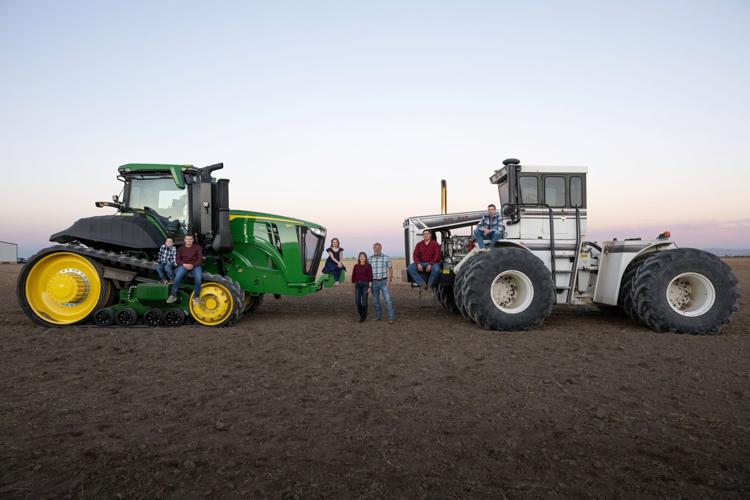
FIRTH — Connie Christensen was raised on a dairy farm near Firth.
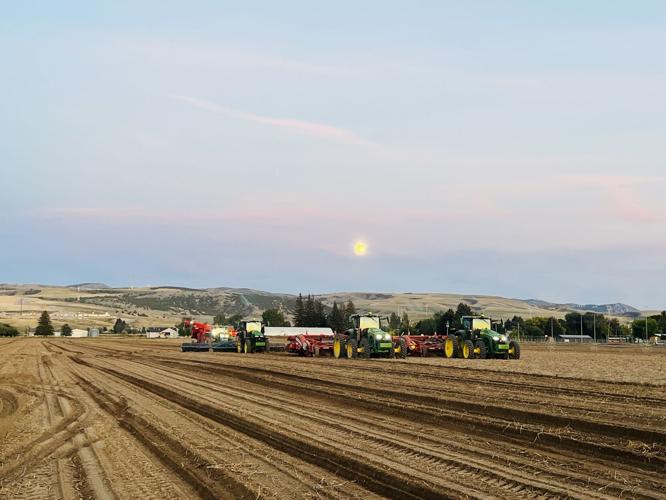
“I met my husband Thane in college and we’ve been married 43 years. We farm about 7,000 acres. I do the bookkeeping, drive semi-trucks and help with the cellar during harvest. We do sugar beets, potatoes and wheat, so during harvest I do whatever needs to be done. I’ve also been on the Bingham ground water board since 2017,” she says.
The farm is a combination of their family’s land.
“We are farming my husband’s grandfather’s farm and part of his great-grandfather’s farm, as well as my grandfather’s farm, which we bought from my Mom and Dad. We have long roots here—5th and 6th generation—and both sons and our daughter work with us on the farm. It is definitely a family farm, and we have grandsons old enough to come into it,” Connie says.
To keep a family farm going, a person needs to put in a lot of hard work and long hours. “We have a great team of employees. You have to be large enough to afford the equipment to do it all, and there are so many things that go into this. You don’t want to get too big as a family farm and lose the family end of it, so it’s a challenge.”
Farming is something you don’t retire from.
“My husband and I do get away a little more now that the family and employees can be here and cover for us, but we are still very involved,” she says. “If farming is in your blood and you enjoy this way of life, you really don’t want to stop. It’s not just a job! Being a farmer is more than an occupation; it’s your life, and who you are. When your farm is threatened, it is very personal and feels like your own life is being threatened. You do whatever you can, to survive and keep it going. When someone I disagreed with in a water discussion said ‘This isn’t personal, it’s just business,’ I had to tell them it IS personal! This is our life.”
Family farms are still the backbone of American agriculture. Farmers who have been in it for generations have a connection to the land and are good stewards of the land.
“When people think farmers are just mining the land and not taking good care of it, we disagree. If we did that, we wouldn’t be able to continue and neither could our children. I don’t want to destroy the land or water resources; we want to protect those for the next generation. Yet we also have to get to a point where we can look at it in a different way than we did historically. We can’t keep relying on the way we’ve done things for 150 years, farming in this valley,” Connie says.
“Our forefathers did a great service by digging canals and doing what they did to make the land productive. We can’t grow crops without water but our predecessors would not expect us to continue in the same way. They did something revolutionary! Those pioneers were very innovative, and we need to be, too. We must be willing to look at things in a different way than just what’s been done for 150 years. We need to change our practices and be able to keep things going for the future,” Connie says.
She is happiest working on the farm with her family. “I am very uncomfortable in political meetings, trying to help resolve issues, but someone has to do it. That’s how I got into the Groundwater District. We felt like we needed a different look at things. My husband and son have more than a full-time job trying to keep their part of the farm going. We’d been to some of the water meetings and my son turned to me and said, ‘Mom, tag! You’re it!’ So I’ve been the one going to the meetings these past years since my time is a little more flexible. I can do our bookkeeping any time, and have good help with my daughter and daughter-in-law.”
Farmers don’t have business hours. “We work until we get the job done. It’s a good life for raising kids and being able to work with our families, with family around us. I am so proud of my grandsons and the things they are learning. They have a lot more to learn, and we have some younger ones that still aren’t sure what they want to do, but it’s nice that the two older ones are leaning in this direction, to be part of the family farm.”
WATER ISSUESConnie is working with the Bingham Groundwater District, trying to help resolve some of the conflicts and concerns about the irrigation problems in southeast Idaho, and water shortages. “We’re in the process of trying to get some infrastructure for recharge in East Idaho to help store more water in the aquifer. We’re just getting started on recharge wells in East Idaho, but in Southern Idaho especially in the Southwest Irrigation District, they’ve been doing recharge wells (to keep the aquifer filled) for 35 years,” she says.
“I realize the mitigation plan we have is a bit scary and it’s going to be a lot of work, but we need the recharge to supplement and support the plan and the aquifer. The recharge (injection) wells in the southern area have raised the aquifer levels considerably and improved the water quality. Randy Brown is on the board for their district and we invited him to do a presentation at one of our recent meetings,” Connie says. “There is some concern about the recharge wells but we’ll put a great deal of monitoring and safeguards in place. There have been recharge wells for 35 years in the Murtaugh and Oakley area and they’ve never had any pushback from the local people. They are trying to do more each year, and everyone there has been very supportive.”
The first step to do a recharge well is to get a base testing program of what the water is like before you start, and testing will continue — to know what’s happening.
“We are holding meetings to try to explain it. Some of the people who have come to the meetings tell us they appreciated our information and understand it better. It will take time to educate more people about the facts,” Connie said. “We must try to work things out. We farmers can’t pretend that we can just be left alone and the problems will go away. If we can’t resolve the water shortage, our state will be in big trouble. A huge agricultural region will no longer be able to grow food if farmers don’t have water.”
Simply reducing the acreage being irrigated—by shutting off some of the water for farms—won’t solve the problems of drought.
Connie said, “We need to make sure the whole system can work. On our farm, we have ground water and surface water irrigation. We need to all work together and make it better, together, to be sustainable for the future.”


(0) comments
Welcome to the discussion.
Log In