

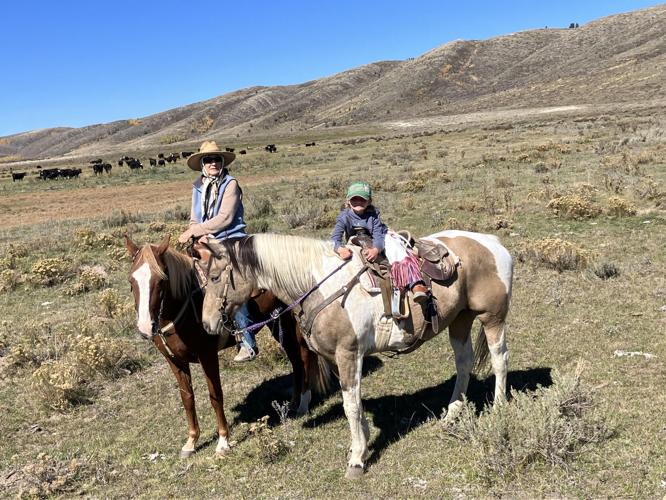
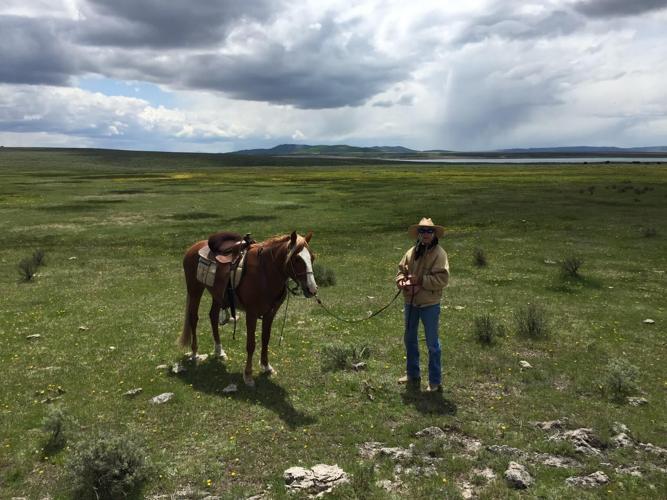
Bingham County rancher Debbie Reid-Oleson comes from a large pioneer family and is dedicated to doing her part to continue their agriculture tradition for generations to come.
She said, “My great-grandparents Nels and Emma settled in the Blackfoot River Valley in the 1870s. They came with the Mormon migrations as children. My grandmother, Agnes Just Reid, was an author and poet. She wrote ‘Letters of Long Ago’ a story about Nels and Emma. Agnes was the youngest of the 10 kids Emma had.”
Emma rode sidesaddle all her life and was an expert horsewoman.
“She passed her love of horses down through the generations. Her sidesaddle is now on display in the Boise Museum. I grew up on that ranch—the oldest child in my family,” Debbie said. “Whenever my dad needed help I was the one who went to help him. I learned to ride at an early age and I’m still riding in my 70s.”
Debbie attended high school in Firth and graduated from the University of Idaho with a degree in social work.
“Then 20 years later I graduated with a master’s degree in counseling from ISU and had a 20-year career as a school counselor,” she said.
She married George Oleson, a third-generation rancher, and they live 10 miles down the river from where she grew up. Their Lazy V4 Ranch includes land along the Blackfoot River and north of the Blackfoot River reservoir.
“While raising a family and ranching, many women have careers on and off the ranch. My income enabled us to do a lot of things we would not have otherwise been able to do, and provided health insurance for our family. Many women in our ranching and farming community have held off-farm jobs to help fill out the scope of what a family needs,” Debbie said.
When she retired from the school job in her 60s she became more politically active and helped collect signatures for two education initiatives to put on the ballot.
She was also a 4-H leader for 20-plus years.
Debbie said, “I love 4-H and feel it is the best program for kids. I did all kinds of projects with my kids besides the regular ones like beef and horse projects. My daughter did a cat project one year, and I taught all my kids to sew and cook. My boys are good cooks and they can also mend their clothes.”
She has three children. Justin, the oldest, is now a rancher and an attorney. Shawn is a rancher. Daughter Mimi is married and is now a rancher and teacher. “She is named after my grandmother — Mimi was what all of us grandchildren called her,” Debbie said.
All three of Debbie's kids were active in high school rodeo and went to the national finals in their events.
“I got to see quite a bit of the country, hauling their horses to all those events. Now my grandchildren are doing it,” she said.
Everyone in Debbie's family is a hard worker.
“Ranching teaches us that we don’t quit until a job is finished," she said. "There are many life skills learned growing up on a ranch. You feed the animals before you feed yourself.”
Ranch kids develop a good work ethic, responsibility and dependability, Debbie said.
She is currently working on a very big project to remove Russian olive trees that have taken over part of their pasture land.
“You can’t kill those trees by spraying them. We have to cut them off close to the ground and treat the cambium growth ring that’s right inside the bark with Roundup,” Debbie said.
This is labor-intensive, but it works.
Debbie is involved with many projects including the Bingham County Groundwater District, working to try to educate people about the current irrigation challenges and trying to find solutions.
Challenges continually arise but farmers and ranchers do what they have to do to make things work.
Debbie said, “We keep doing this because we love the land and want it to be productive and sustainable. We fight weeds, drought, bad weather, and try to get along with all the people who are moving into our area."
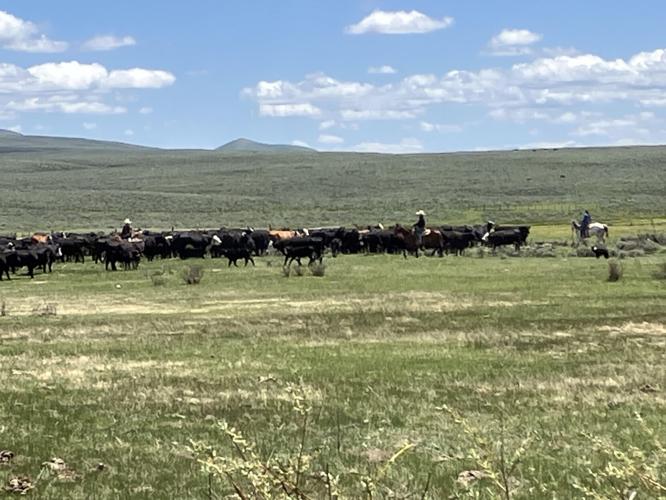
She continued, “Most ranchers in our area depend on rangeland for summer pasture. When we take our cattle up in the hills and leave them there, we try to go at least once or twice a week to check on them, but it’s hard to keep track of everything. One year someone shot arrows into several of our cattle. We’ve also had people shoot an animal that was close to the road, take a quarter of it and leave the rest to rot.”
This kind of thing is always discouraging.
Debbie said, “Our cattle are up there from May until we round them up the first of September. We have water projects to maintain stock water. We’ve drilled wells and put up solar panels to run the pumps to supply the water troughs that are up away from the creeks—to keep cattle out of the riparian areas. Then some people steal our solar panels or vandalize the water system.”
Trespasses on private land are bad enough, but it’s even more frustrating to have to put up with all the things encountered on public land grazing allotments.
“I’ve been depressed by what’s happening in the world, in our country and our state and county in recent years, but ranchers don’t give up. We still have hope and faith that somehow things are going to be smoothed out. I’ve been political all my life and have often called my senators and representatives,” Debbie said.
Her joy is being able to live on the land and do her own thing and take care of the land. She hopes to have a government that wants to help families stay on the land and doesn’t thwart the freedom to keep farming and ranching—to grow food for this country in a way that is sustainable.
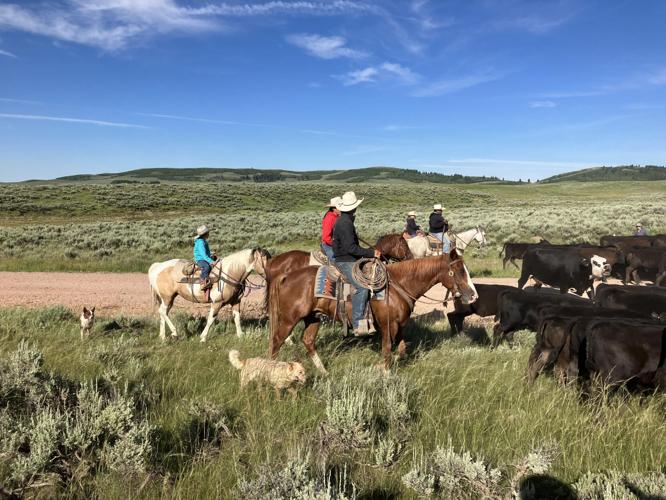
“Every spring we trail our cattle—cows with young calves—to the Eastern Idaho grazing area where they stay until fall round-up," she said. "Then the cows would be moved onto our private land until the weather made us trail them back to the valley ranch. There is always this circle of life, this rhythm with the seasons, that brings joy, hard work, and a satisfaction of living that we hope continues for future generations.”


(0) comments
Welcome to the discussion.
Log In