


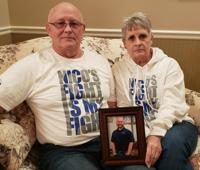


POCATELLO — Bannock County late last year quietly settled a multi-million dollar wrongful death claim with its former coroner after his son died in December 2018 as an inmate at the Bannock County Jail.
After filing a tort claim in June 2019 accusing Bannock County Sheriff Lorin Nielsen and his staff at the Bannock County Jail of being “deliberately indifferent” and “grossly negligent, reckless, willful and wanton” in their actions leading up to the death of former county coroner Kim Quick’s 40-year-old son, Lance Quick of Pocatello, the Quick family accepted a $2.1 million settlement offer from the county, according to records obtained from the Idaho Counties Risk Management Program, or ICRMP, which insures Bannock County.

Lance Quick
ICRMP would not disclose any additional details, but Kim Quick told the Idaho State Journal on Thursday that all the parties involved agreed to the settlement on Dec. 12, 2019, two days shy of the one-year anniversary of Lance Quick’s death.
“We never did this for money,” said Kim Quick, who retired in January 2019 after 26 years with the Bannock County Coroner’s Office. “Our goal is to get some accountability from those that made mistakes because we can’t have this happen again to anyone else. Our community deserves better. Our goal was to get the county’s attention and I think we have that now.”
When contacted for comment regarding the settlement, Nielsen declined, referring all statements to the Bannock County Prosecutor’s Office.
While Kim and his wife Shauna, who reside in Pocatello, are glad they reached a settlement with the county resulting in a monetary amount they can use to improve local mental health services in Lance’s memory, the couple said the incomplete criminal investigation into his death makes them feel the county is attempting to dodge accountability for their son’s torturous final days.
Last week, Bannock County provided the Journal with a copy of the Tri-County Sheriffs Association’s report on the investigation into Lance’s death.
The Tri-County Sheriffs Association was tasked with investigating Lance’s death to uncover any evidence that would indicate whether or not Nielsen or Bannock County Jail staff members committed any crimes in their treatment of him.
The sheriffs’ offices in Bannock, Fremont and Bingham counties completed the investigation into Lance’s death for the Tri-County Sheriffs Association and documented the findings of that investigation in a report that was provided to the Bannock County Sheriff’s Office in November of last year.
The Bannock County Sheriff’s Office was supposed to then provide the report to the Bannock County Prosecutor’s Office, which would make a final determination on whether criminal charges should be filed regarding Lance’s death.
But the report didn’t find its way to the Bannock County Prosecutor’s Office until about two weeks ago and now the county prosecutor says he doesn’t want to make a final ruling on it because of the conflict of interest that exists in that his office regularly works with Sheriff Nielsen.
So it’s hoped that another East Idaho prosecutor’s office will review the investigation and determine if criminal charges against Nielsen or jail staff members are warranted.
The Tri-County Sheriffs Association’s investigative report, in conjunction with much of what the Quick family’s attorney, Karra Porter of Salt Lake City, wrote in the June 2019 tort claim, paint a disturbing picture of the last days Lance spent alive, incarcerated and mostly incapacitated inside a 6-foot by 10-foot jail cell with no sink, toilet or bed.
On Dec. 8, 2018, Lance, who Shauna says had previously been diagnosed with post traumatic stress and bipolar disorders, began to experience a manic and psychotic episode that led to his arrest by Pocatello police on a suspicion of misdemeanor driving under the influence charge.
Pocatello police subsequently transported Lance to the Bannock County Jail for incarceration, which is standard practice for someone arrested for drunk driving.
Sheriff Nielsen said Lance was unable to communicate with jail staff from the onset of his incarceration and that jailers were aware that Lance was mentally ill and experiencing a mental breakdown, Porter wrote in the Quick family’s tort claim, a legally required document filed as a precursor to a lawsuit.
Despite Kim, who was still coroner at the time, and family friend Jodi Carlson, who’s a nurse, repeatedly informing Nielsen that Lance was bipolar and needed medication and hospitalization for his mental condition, Lance was instead moved on Dec. 10 into a 60-square-foot jail cell equipped with nothing but a drain in the middle of the floor and a camera on the ceiling for jailers to monitor the cell’s lone inmate.
“It was obvious shortly after arrival (at the jail) that Lance’s mental and medical health were deteriorating,” the tort claim states. “Lance showed this through behaviors such as: not eating or drinking, talking to himself ... engaging in bizarre behavior such as ‘washing’ himself with food, taking his clothes off, (and) talking and gesturing to himself. From day one, jail staff repeatedly told Lance’s friend (Carlson) and parents that he could not speak to them because he was ‘incapacitated.’”
On Dec. 11, jail officials sought and obtained a temporary custody order that said Lance should be in a mental health facility and that he “shall not be detained in a non-medical unit used for the detention of individuals charged with or convicted of penal offenses,” the tort claim reads. But Lance remained at the jail rather than being transferred to a mental health facility.
A jailer called the behavioral health unit at Portneuf Medical Center on Dec. 12 asking if Lance could be admitted there. The jailer was told that no beds were available there, but that a jail deputy could transport Lance to the hospital itself for medical treatment.
But because PMC stated that it would require law enforcement presence if Lance were brought there for medical treatment, jail officials refused to transport him and — literally — just left him in the cell to die, the tort claim said.
The tort claim states that Lance’s mental health continued to deteriorate until he completely lost touch with reality. At the same time, because he hadn’t had food or water for so long, he began to grow weaker and slower. By the morning of Dec. 14, jail personnel had started including in their logs whether Lance was still breathing, the tort claim states.
Around 10:20 a.m. on Dec. 14, jail staff members checking on Lance in his cell found him lying on his back and not breathing.
CPR was performed but he was dead, the tort claim states.
Logs and reports from the jail’s staff included in the Tri-County Sheriffs Association’s investigative report mostly support the depiction of what happened in the Quick family’s tort claim.
According to autopsy information included in the Tri-County Sheriffs Association’s report, Lance died from “complications of hypernatremic dehydration and ketoacidosis secondary to a prolonged period without food or water,” or in other words, Lance died from starvation and dehydration.
Aside from interviews with Bannock County Jail staff members about the case, the Tri-County Sheriffs Association’s investigative report does not include any additional details regarding the manner of Lance’s death and whether it should be declared a homicide, suicide or accidental death.
Moreover, it appears as if after initial investigations were conducted in December 2018 by the sheriffs’ offices in Bannock, Fremont and Bingham counties for the completion of the report, nothing more was put into the case, with investigators indicating they would update the report once the autopsy was completed and its results attached.
However, no additional entries were submitted after the autopsy information was added to the report.
The report was turned over to the Bannock County Sheriff’s Office on Nov. 6, 2019, but wasn’t provided to the Bannock County Prosecutor’s Office until Jan. 31, 2020, when Bannock County Commissioner Terrel “Ned” Tovey, who was involved in working out the settlement with the Quick family, provided the document to Bannock County Prosecutor Steve Herzog.
While it was not his responsibility to provide Herzog with the report, Tovey said he did so to ensure the Tri-County Sheriffs Association investigation proceeded as expected.
Herzog confirmed such was the case during a Thursday phone interview, during which he said that now that he has the incident report he intends to recuse himself from handling the case because of a conflict of interest.
The next steps involve finding an East Idaho prosecutor’s office willing to take the case on, and from there it’s up to that office to determine whether any criminal charges should be filed, Herzog said.
He said he hopes that another local prosecutor’s office will agree to handle the case in the next two weeks, but he could not provide an exact timeline for the investigation’s progression beyond that.
“Nothing has been done with this criminal investigation yet,” Kim said. “It has just been sitting on a desk somewhere for 14 months, and even then, nothing has been done on the criminal side of things. But we need some accountability because the county has failed miserably.”
The Quick family says they plan to put the $2.1 million received in their settlement with Bannock County into a trust account. The Quicks hope to spend the money on improving mental health services in the Pocatello area and are trying to figure out the best way to do that.
The Quicks want to turn the tragedy of Lance’s death into a legacy of better mental health resources.
“Our full intent is to give this money back to the community in the mental health field,” Kim said. “But it has to be a non-profit organization that receives the money and we want it to be able to make perpetual change. Such an organization may not even exist yet but if that means creating one of our own in Lance’s name, then we’ll do it.”
Additionally, Kim and Shauna have established the Lance Quick Memorial Fund with the Idaho Community Foundation, which aims to enrich entities that support mental health treatment in Idaho. Those interested in contributing to the fund can do so by visiting idahocf.org/current-future-donors/donate-now or by referencing the fund by name at any Idaho Central Credit Union branch.
Shauna said she’s determined to prevent other local families from ever going through a tragedy like what her family has endured.
“We need to get more people on board and involved with mental health,” she said. “If you have cancer, you have a team there for you. But if you have mental health concerns, you are on your own and are sent all over the place. Everybody needs to come together and there needs to be more education on it. Otherwise, whose son is going to fall through the cracks next?”

(0) comments
Welcome to the discussion.
Log In