

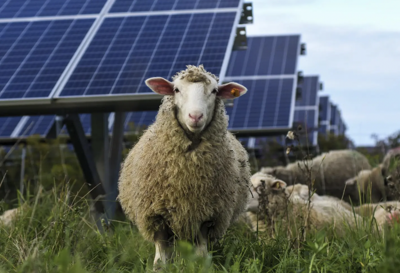

POCATELLO — The Bannock County Commission voted to ban commercial solar and wind projects during a zoning ordinance amendment meeting held Tuesday evening at the county courthouse in Pocatello.
Several dozen local residents attended the packed house meeting, with 27 people speaking against passing the ordinance that would ban large-scale alternative energy projects in the county and 18 people speaking in favor of the ban.
Ultimately, the ordinance banning commercial solar and wind projects in Bannock County passed with commissioners Ernie Moser and John Crowder voting in its favor and Commissioner Jeff Hough voting against it.
Though any future commercial wind and solar projects in the county have effectively been put on hold until further notice because of the ordinance, the debate surrounding the topic appears far from over.
Part of the reason for approving the ban was the impending expiration of a temporary six-month moratorium on large-scale solar and wind projects that was set to expire on April 9.
A major catalyst for the entire conversation came after Bannock County commissioners received feedback from their counterparts in Twin Falls County about the massive Lava Ridge wind farm project that calls for about 400 wind turbines to be installed on approximately 84,000 acres near Twin Falls.
Additionally, a Utah-based renewable energy company, Balanced Rock Power, has proposed a 300-megawatt solar farm project in the Downey area of Bannock County that the company states would encompass 2,400 acres of land, create over 300 jobs and generate about $1.7 million in annual tax payments to the county.
John Knight, the chief executive officer for Balanced Rock Power, spoke against the ban at Tuesday’s meeting and asked the county commission to take the time to fully understand the pros and cons of each side of the issue.
“I’m familiar with the problems that you are facing and the concerns that you have,” he said to the county commissioners at the meeting. “We want to be able to work with the county and the community to make sure that we can develop a project that works not only for us, but more importantly for the community in which it’s sited because in the end the project will be there for 30, 40, 50 years. My belief is that this project will provide significant revenue for the community, significant educational opportunities and significant job creation.”
Another solar energy company, the Chicago-based Hecate Energy, has a proposed 600-megawatt solar farm project in Bannock County.
Alex Pugh, director of development for Hecate Energy, said at Tuesday’s meeting that he was hopeful the county would consider taking the time to develop an ordinance that would work for everyone.
“You can imagine how disappointed we’ve been to see that the commission intends to throw the baby out with the bathwater here and issue a total solar ban,” he said. “We understand that there’s concerns, there’s a lot of legitimate concerns that have been raised and quite frankly, the onus is on us to address them. What we ask is that this commission and the county create an ordinance by which we can actually address those concerns. And so for example, if there’s concern about the method and timing of decommissioning bond placement, let’s work through that. What makes the most sense for the county? How do we mitigate your risk here? If there’s concern about what happens to modules at the end of life, make us put a plan in our decommissioning plan and have us update that every five years and show you what we’re going to do with the materials at the end of life.”
Both Hecate and Balanced Rock committed to not putting forth any official applications for large-scale solar projects in Bannock County until a workable ordinance is in place.
While Bannock County already had an ordinance guiding wind energy projects, it lacked one for solar. So the plan was hatched to ban all commercial wind and solar projects temporarily while the commission as well as the Bannock County Planning and Development staff could study the projects and create an ordinance that would address, among other concerns, environmental impacts, rules for decommissioning projects and the needed zoning requirements that would dictate whether a particular parcel of land could become home to a commercial solar or wind farm and what conditions must be met to do so.
In February, the commissioners voted to have the Bannock County Planning and Development Council create a new ordinance that would ban large-scale solar and wind projects in the county.
During Tuesday’s meeting, the commissioners sought feedback from individuals and the solar project companies about the ordinance.
Before casting their votes on the ordinance to ban commercial wind and solar projects, all three commissioners each provided the public with a statement.
Hough, before voting against the ordinance, said, “The opening of the Declaration of Independence says that we have the right to life, liberty and the pursuit of happiness. Passing a no-solar ordinance denies individuals the basic right to pursue happiness because it is a red herring to the real issue of property rights. It has been said that passing an ordinance allowing people to consider such an option would be akin to letting the camel’s nose under the tent. And then where would it stop?”
Hough continued, “I would make the same argument the other way. If we allow the government to deny the opportunity for individuals to explore options, where does the insidious creep of government power stop? We have to have faith in the system.”
Crowder, before voting to approve the ban, said that as he understood it there were no other provisions to put forth an interim ordinance that would afford the commission additional time to study the impacts and address concerns that large-scale solar and wind projects would bring.
Crowder said, “Where we are today is we can put in a ban, which doesn’t stop us from talking about anything we want to, or we let the emergency ordinance lapse and then regardless of these two companies saying, ‘Well, we’re not going to put anything until we get an ordinance that everyone can agree on,’ but you’re not the only two companies that might be looking at this area. There can be many companies doing so. I don’t think we’re in a position to do anything other than put in a ban and then you can have all the discussions you want… or we just opened the door to conditional use permits being put forward.”
Moser was the last to make a statement, explaining that he felt a ban was best as it protected the county now, but he hinted toward there being further discussions on the topic later down the road.
“We’re in a tight spot here,” Moser said. “I’m all for property rights. But I’m also all for doing this the right way the first time. And we’ve talked about dialogue. We’ve talked about a lot of different things. We haven’t had the time to work out the dialogue. And so that’s where I lean with Commissioner Crowder is that we put this ordinance in because we’re at that deadline. And then we can adjust an ordinance because that’s what we’re doing right here today. We’re adjusting an ordinance and we have the opportunity to talk to have the dialogue.”
He continued, “There’s places in Bannock County that solar is wonderful. There’s places I don’t think it should be. And so we haven’t had the opportunity to have that big dialogue and to look over the whole thing.”

(0) comments
Welcome to the discussion.
Log In