

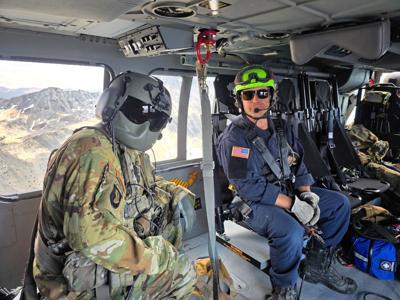
When a hiker falls in the distant reaches of the Idaho backcountry, a hunting party goes missing in the high peaks near Custer County, or fires rage across the expanse of the Gem State, a crew of Idaho Army National Guard aviators are always ready and waiting.
These guardian angels are the pilots, crew chiefs and medics of the Idaho National Guard’s aviation battalion medevac unit.
Whether launching a daring hoist rescue or backing up firefighting and rescue crews battling wildfires across the state, the Gulf Company crew is always mission-ready.
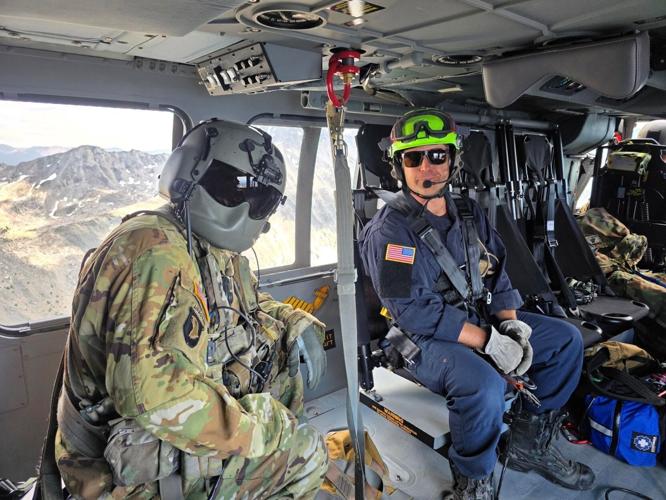
While most hold full-time jobs maintaining and flying aircraft for the federal government during the week, by the weekend they are on-call volunteers. At any given moment, they may be tasked to climb into a Black Hawk helicopter and fly deep into the Idaho wilderness to pull an injured or stranded person out of terrain no other aircraft can reach.
“A lot of these people make a lot of sacrifices to be able to save lives, which I think is also the most rewarding mission we do,” said Capt. Fernando Soto, who recently took command of Gulf Company.
The unit is activated only when someone’s life is in immediate danger, with risks that include loss of eyesight or limbs. The squad is also deployed in situations where homes and property can be in danger, including wildfires and other disasters.
Because Idaho’s Guard has a standing non-compete agreement with civilian responders, the crew will usually only deploy after options like Saint Alphonsus, Air St. Luke’s, Idaho Mountain Search and Rescue, Life Flight or other rescue operations have been exhausted. Gulf Company typically gets a call when the terrain, altitude or hoist requirement is beyond what those agencies can safely handle.
“If a civilian asset can do the mission, they take priority,” Soto said. “They only call us when nobody else is able to do the job. In Idaho there isn’t another aircraft with hoist capability, so we’re about the only option.”
Depending on where the emergency takes place, the local county’s sheriff’s office will notify the Air Force Rescue Coordination Center, which contacts the nearest capable unit. Once Gulf Company is called into action, Soto begins mission planning, checking weather and terrain, while a volunteer crew assembles at the flight facility. Once the coordination center issues a mission number, the crew is cleared to fly.
Commanders weigh who has flown together recently, the weather and altitude, and who holds the added qualification to operate the hoist, which is often reserved for the unit’s more experienced pilots given the risks, including nighttime missions flown under night-vision goggles.
Gulf Company deploys a UH-60 Black Hawk that gives it a reach other aircraft in the region can’t match. The Black Hawk’s twin turbine engines can lift up to 22,000 pounds, allowing crews to reach patients at extreme elevation. In one recent mission in Custer County, the crew hoisted an injured hiker from 11,400 feet after the person fell roughly 300 feet down a mountainside.
Because crews often know little about a patient’s condition before arriving on scene, they bring a variety of rescue equipment, trauma supplies and tourniquets, though the unit’s medics aren’t licensed to administer drugs in Idaho and cannot give medications.
To help close that gap, Gulf Company often partners with organizations like the Boise Fire Department, whose firefighters train regularly as hoist riders and can fly down to provide advanced medical care Gulf Company’s own crew cannot legally offer.
The unit also leans on Idaho Mountain Search and Rescue, an almost entirely volunteer organization that often engages in difficult forays into remote locales to rescue stranded civilians, long before a helicopter is ever called.

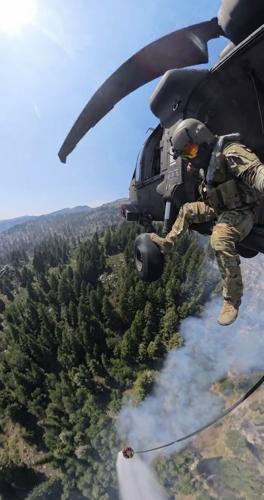
Members of the Idaho Army National Guard were recently activated to assist fire crews by dropping water on the Big Grass Fire.
Gulf Company’s level of readiness doesn’t happen by accident. Its crew is often composed of aeromedical evacuation pilots like Weston Kania and Kyle Pearl, who have undergone extensive flight and readiness training.
The hoist progression itself requires a level of currency and maintenance of the skill set. Crews train several times a month over rugged terrain near Anderson Ranch, simulating engine-power loss, steep cliffs and shifting winds to sharpen the coordination between pilots, medics and the hoist operator, who are often described as the eyes and ears guiding the aircraft during a rescue.
“From my own experience, it was a difficult progression,” Kania said. “It’s not an easy thing early on to be really proficient at. But it’s like anything else. The more repetitions you get, the more familiar you become with it. You learn new methods, you fly with different people, and you learn new techniques.”
Pearl said Gulf Company’s crews try to practice three to four times a month, and one of the most significant factors is the coordination between team members.
“One thing I like to do with my team is create random scenarios,” Pearl said. “As if it was a real rescue, to get everyone working together and talking. Just working on it as much as we possibly can, and then we evaluate each other inside the aircraft. You have to be able to take constructive criticism because there are a lot of lives on the line. So we work really well together and build each other up, become a family.”
Pearl continued, “Being able to have that brotherhood, rely on each other and actually help the community of Idaho is just a tremendous feeling. That’s the thing that I love about it — being there for the community and being able to walk away from the aircraft with our brothers and sisters, knowing that we helped somebody.”
Gulf Company’s mission also extends beyond rescues. Crews fly the Black Hawk loaded with water buckets to help fight wildfires, with a recent callout to the Big Grass Fire near the Idaho-Oregon border, where two aircraft, each carrying up to 4,256 pounds of water, assisted state firefighting efforts. In emergencies, the unit can also help evacuate civilians.
The unit also works to keep the public engaged in other ways. Soto said the Guard’s Community Relationships Program allows residents to request tours of the facility and aircraft, and the unit frequently brings helicopters to schools and local events for static displays. Anyone interested in Army aviation can contact a local recruiter or visit the unit during a drill weekend, Soto said, while those interested strictly in search and rescue can volunteer with Idaho Mountain Search and Rescue or other organizations.
Gulf Company’s advice for hikers is simple: Don’t go alone, and if you do, make sure someone knows your route. Satellite messengers and modern cellphones with SOS features have made it easier for rescuers to find people in trouble.
As with any unit within the National Guard, the crew is always training for its wartime mission and is supplemental to active-duty forces. The reward for constant vigilance and dedication, it seems, is the crews knowing that they’ve made a difference.
“The benefit we get is that we actually just get to perform our real-life mission stateside, which is huge for me to be able to serve the citizens of our state and people’s families,” Kania said. “If myself or one of my family members was stuck out in the mountains, I definitely want somebody to volunteer to go pick them up. That’s what I’ve gotten out of it over the last couple of years.”

(0) comments
Welcome to the discussion.
Log In