






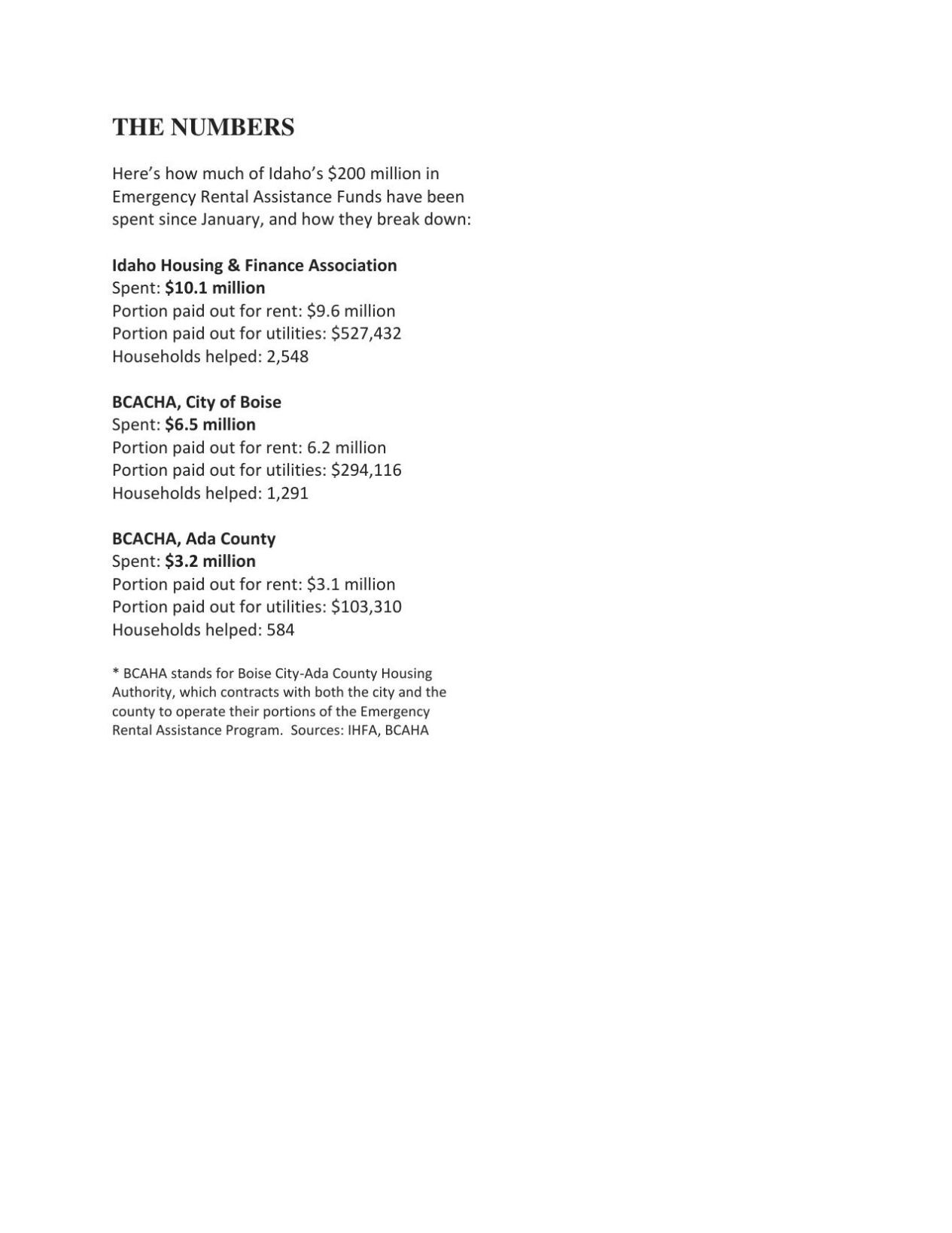
BOISE — Idaho has received $200 million in federal emergency rental assistance aid since January to help struggling tenants pay rent and utilities amid the coronavirus pandemic, but in the seven months since, has paid out just under $20 million, or 10% of the total.
With Idaho’s housing prices skyrocketing and rents going right up with them, no one disputes that there’s plenty of need.
“I think a lot of the reason money’s not going out is because, ‘I can’t find the web link,’ ‘I can’t figure out my pay stub,’ ‘I don’t know where that document is,’” said Sen. Melissa Wintrow, D-Boise, who proposed the first version of the emergency rental assistance program in Idaho that was funded with $15 million in CARES Act aid, all of which was spent. “People just need some help,” she said. “And they need a person, not a web link, not a pamphlet. They need someone to help them through.”
Brady Ellis, vice president of housing support programs for the Idaho Housing and Finance Association, which is administering $175.7 million of the federal rental assistance that flowed to the state, said the U.S. Treasury recently altered its guidance and opened the door for more of the funds to pay for that kind of help, from case management to social workers to bringing in organizations that can help applicants, including those with disabilities, through the process.
“Treasury has recently pivoted a little bit … so there’s more flexibility within those guidelines,” Ellis told the Idaho Press.
Where previously, just 10% of the funds could go to administration or services to help applicants through the process — and that meant administration costs ate up most of that — now states can spend 10% on each of those, Ellis said. Ten percent of Idaho’s $175.7 million would come to nearly $17.6 million. “It is a lot of money,” Ellis said. “We definitely see merit and benefit in doing that, and are discussing how that might work.”

Brady Ellis
The emergency rental assistance program allows renters who earn up to 80% of the area’s median income and are facing housing instability due to the fallout from the COVID-19 pandemic to receive help with rent and utilities in up to three-month increments, with total aid lasting 12 months, or in extreme cases, up to 15 months. The aid can cover current, past and future rent payments; utility bills; fees; and internet service.
Wintrow cites the cases of two of her constituents. One was an 80-year-old North End resident with a brain injury whose landlord wanted to renovate her small, rented home of 15 years to rent it out at closer to market rates. The renter wasn’t able to manage applying online or even by phone for help. But once Wintrow assigned an intern, a social work student, to manage her case, she got help with rent, finding a new place, moving, and home care. “She would have been homeless,” Wintrow said. “No one was coming to help her.”
In the second case, Wintrow said she heard from a constituent whose neighbor was suffering from behavioral health issues, had had COVID-19, was trying to find a job and had gotten behind on his rent. “He didn’t even have a stable internet connection,” Wintrow said. “I asked my constituent who’s calling me, ‘Can you help him do it?’” The constituent agreed, brought the neighbor over to his home, and helped him successfully apply online for assistance.
“When you’re in trauma, when you’re in stress, when you’re in crisis, boy, how helpful is it to have someone who can help you, can calm things,” Wintrow said. “We’ve got to put more resources, time, heart and energy into getting the information out and then helping people through it, period. That’s my two cents.”
In addition to the $175.7 million that the state Legislature allocated to Idaho Housing and Finance Association for emergency rental assistance aid statewide, the Boise City-Ada County Housing Authority is overseeing $24.3 million it received directly from the same federal program for residents of the city and Ada County, with $11.5 million allocated for city residents and $12.7 million for county residents. The split is based on population.
So far, the authority has paid out $9.7 million, 40% of the total it’s been allocated. Of that, twice as much, $6.5 million, has gone to help Boise city residents, compared to $3.2 million for county residents. That means more than half the city’s allocation already has been paid out; the funds must be spent by September 2022.
“I do think it will run out,” said Deanna Watson, executive director for the housing authority.
She noted that additional funds will follow from what she called “ERAP 2,” the next allocation of federal emergency rental assistance program funding, from which Boise and Ada expect to get about $15 million, while the state has been allocated $152 million for other communities across the state. That’s from the American Rescue Plan Act, or ARPA. The Idaho Legislature hasn’t yet acted to appropriate any of that $152 million, as it has until Sept. 30, 2027, to spend those funds.
“That’s why there wasn’t any urgency on appropriating that,” said Paul Headlee, legislative budget director.
Top lawmakers reviewing the ARPA funds available to Idaho recently expressed concern after learning that through the end of June, just $8.2 million of the $175.7 million in aid already allocated by lawmakers had been paid out. So Headlee asked for information on what outreach had been happening. Ellis responded with a list of 23 ways the Idaho Housing and Finance Association is reaching out to raise awareness of the program, from TV and radio ads to Spanish-language materials, to fliers in utility bills, to notices to landlords.
“We certainly have done a lot of marketing efforts to increase the visibility of the program, increase the awareness,” Ellis said. He also noted quick processing of applications. “To a large degree, we feel like we’re meeting that demand that we’ve seen so far,” he said.
Juli Frontino has seen the impact on the ground. She manages about 100 rental units in Boise, and has had about 10 of her tenants tap into the assistance program over the past year.
“Some of them find it on their own,” she said. But the majority contacted her about an issue paying their rent, and she steered them to the program.
“Any of my tenants that did call got assistance,” Frontino said. “It’s not like it was a hard program to go through.”
Tenants — or their landlords — can apply online, or by phone.
“Some of them got a month paid; they just needed one month of help because they were off work for a month,” Frontino said. “I had an elderly couple who really got hit hard by COVID and they got six months of their rent and utilities paid.”
Frontino’s been in the rental business in Boise for 20 years. “I’ve never seen a time like this,” she said. “This is pretty unprecedented, where the rental market prices keep driving up, and then you have people that are in such dire need that they need assistance from federal funds to pay the rent. It seems very contradictory.”
The market also has made it difficult for displaced renters to find new places they can afford.
“Just like the housing costs for home buyers are going up, rental rates are going up as well,” Ellis said, “and rental vacancy rates are extremely low. So it’s difficult to find rentals out there. It can take time.”
Ellis said the Idaho Housing and Finance Association can allocate funds through the program for temporary motel stays, security deposits and other costs associated with getting into a rental. “It’s definitely a difficult situation,” he said.
Tom Eubanks had two rental homes in Boise until just a few months ago, and was glad his tenants were able to keep up with their rent through the pandemic. “I was one of the fortunate landlords,” he said.
But he also was getting older and finding it more difficult to keep up with the work the houses required, “and the market, with the crazy market that we’ve had and the values going up, it was a good time to sell the rentals because of the price that we were getting,” he said.
Both homes sold to a couple who planned to refurbish them and put them back on the rental market. “I don’t know what they’re charging, but I’m sure, because of the money that they probably put into it, it’s probably a significantly higher price than what I was receiving,” he said. “That’s just part of the situation that’s going on now in the housing market.”
Watson said the housing authority’s piece of the rental assistance program has been awarding, on average, $4,500 per family.

Deanna Watson
“We’re trying to keep the barriers as low as possible,” she said.
Unlike the housing authority’s other, longstanding rental assistance programs, there are no caps on rental rates, and income limits for the tenants are higher.
“We talk about ERAP as being a program for tenants — it’s just as much a program for landlords,” Watson said. “With the moratorium on evictions, a lot of them have been struggling with ‘how do I pay my bills, if I can’t collect my rent?’”
Both the authority and the Idaho Housing and Finance Association make the assistance payments directly to landlords (or utilities), but if there’s a landlord who refuses to take part, they’ll pay the tenants so they can pay the landlords themselves.
“We invite landlords to apply, we encourage landlords to apply,” Ellis said. “We view this program as one that’s for their benefit and their support as well.”
Watson said the authority isn’t likely to add new service programs like the Idaho Housing and Finance Association is contemplating; it’s already making referrals and working with community partners like Jesse Tree to assist applicants who have problems with the application process.
Frontino said, “They’re really quick to do a turnaround, and I usually have confirmation of payment within a week and then payment arrives within the next two weeks. So it’s really been a simple process, as long as the tenant does their part and … the landlord does their part.”
“I know that there’s a lot of funds not being used,” she said, “because for some reason a lot of people aren’t asking for it, and I know that there are a lot of people out there needing it, so I’m not sure why they’re not asking for it. But it’s out there.”
Ellis said the Idaho Housing and Finance Association is focused right now on shifting its emergency rental assistance program onto a new software platform, which will be completed this month. Then it’ll turn to developing new service programs to help guide applicants through the process. He anticipates that those services will mean more aid going out the door to those who need it.
“It will increase,” he said. “It’s hard to say how much.”
But Idaho could lose part of its $175.7 million this fall if the pace doesn’t pick up. That’s because it’s not currently on pace to spend it all by the September 2022 expiration date. This year in September, the U.S. Treasury will look at the spending rates by agencies distributing the funds and consider “recapture and redistribution,” Ellis said. “Treasury will look to see what are your spend rates, what has been the demonstrated need across all these programs all throughout the country, and then they’ll pull from some places and try to put it to other places.”
But even if Idaho loses part of its funds from the current round of funding, he noted, there’s still the ARPA funds for the future. “So there is a fallback,” he said.


(0) comments
Welcome to the discussion.
Log In