





POCATELLO — Jurors heard more about DNA evidence and watched a police interview of Brad Scott Compher during the seventh day of his first-degree murder trial Wednesday at the Bannock County Courthouse.

Nori Jones
Most witnesses over the past two days have been testifying about various DNA testing that was conducted throughout the course of the 10 years between the murder of 25-year-old Nori Jones in September 2004 and Compher’s arrest in September 2014.
Compher, who has been charged with felony first-degree murder for allegedly killing Jones, has been incarcerated at the Bannock County Jail since his arrest.
Male DNA located on items recovered from Jones’ Pole Line Road when she was found with over 20 stab wounds matched Compher’s DNA, according to testimony from Derek Cutler, a technician who in 2014 worked for Sorenson labs based in Utah.
Several pieces of evidence obtained from Jones’ home were sent to Sorenson labs to undergo a process called Y-STR testing, which isolates male DNA from other DNA sources, Cutler said.
Y-STR testing is commonly used when there is a possibility that male DNA may be masked by excess amounts of female DNA.
Cutler testified that he conducted Y-STR testing on a ring that was obtained from the crime scene, as well as Jones’ fingernail clippings obtained during her autopsy.

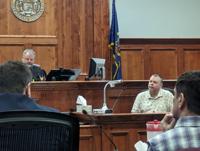
Witness Derek Cutler testifies during the seventh day of the trial for Pocatello man Brad Scott Compher, 49, who is accused of fatally stabbing Nori Jones, 25, to death inside her Pole Line Road home in September 2004.
Additionally, Cutler said that Y-STR testing was conducted on two DNA samples obtained from Compher — one from a cigarette that was believed to have come from Compher and a direct sample from Compher that officers obtained by administering a swab of Compher’s mouth.
Cutler also testified that Y-STR testing was conducted on a DNA sample obtained by a different potential suspect, Robert Spillett, and on DNA voluntarily provided by Jones’ boyfriend at the time of her death, Rio Wilde.
Cutler testified that a Y-STR profile was obtained when the ring was tested, which ultimately matched Compher’s Y-STR profile obtained from both the cigarette and his mouth swabs. Cutler said that in Caucasians, the Y-STR profile obtained from the ring was 11 times more likely to have derived from Compher than it would have come from a randomly selected male individual. Further, the Y-STR profiles of both Spillett and Wilde did not match the Y-STR profile of the ring and they were excluded, Cutler said.
Though the Y-STR profile obtained from fingernails clipped from Jones left hand was not suitable for comparison, Cutler testified that there was a mixture of Y-STR profiles located on clippings from her right hand and that the major profile from those clippings matched Compher’s profile. In Caucasians, that Y-STR profile obtained from the clippings was 106 times more likely to have derived from Compher than it would have come from a randomly selected male individual, Cutler said.
The Y-STR profiles obtained from both the anal and vaginal swabs administered during Jones’ autopsy were also 106 times more likely to match Compher than they would match any other randomly selected Caucasian male individual, Cutler said.
During cross examination from Compher’s defense team, which includes Chief Deputy John Scott Andrew of the Bannock County Public Defender’s Office, contracted attorney Gary Edward Proctor of Baltimore and Bannock County Deputy Public Defender Rilie Fry, Cutler testified about allegations that Sorenson labs mishandled evidence.
Cutler said that he works elsewhere now doing similar work but that the allegations did not affect his decision to switch companies.
Cutler said that he believes an investigation into the allegations found that out of 60,000 cases only three were identified as being problematic and another five were recommended for retesting because of inconclusive results. Cutler said that to his knowledge the cases in question were identified as being tested between 2016 and 2019 and involved a process that was not being used when the evidence in Compher’s case was being tested in 2014.
When defense counsel asked Cutler whether or not he was aware that the allegations dated back to 2008, Cutler said that he was not aware of that and added that Sorenson labs was founded in 2008.

Witness Cynthia Hall testifies during the seventh day of the trial for Pocatello man Brad Scott Compher, 49, who is accused of fatally stabbing Nori Jones, 25, to death inside her Pole Line Road home in September 2004.
Additional testimony surrounding DNA evidence came from a former quality manager for the Idaho State Police forensic lab in Meridian in 2014, Cynthia Hall.
Hall testified that there was less than a 1 in 93 trillion chance that DNA obtained from a print left on a rear window of Jones’ home came from anyone other than Compher. She said that she came to that conclusion after conducting STR testing of DNA obtained from the print itself and both the cigarette and mouth swabs recovered from Compher.

Witness Anthony Busch testifies during the seventh day of the trial for Pocatello man Brad Scott Compher, 49, who is accused of fatally stabbing Nori Jones, 25, to death inside her Pole Line Road home in September 2004.
Retired Pocatello police detective Anthony Busch was back on the stand Wednesday, providing testimony about an interview he and current Pocatello police Capt. Bill Collins conducted with Compher at the Pocatello Police Department in June 2011.
The interview had some audio issues, with audible breaks every three or four seconds, audio that did not match up with the video and a few segments where there was no audio at all. The cause of the audio issues was not discussed during the trial.
During the interview, Compher can be heard saying, “I have never been to that house ever,” when asked if he knew Jones or had been to her residence. Collins and Busch informed Compher that his fingerprints were located at the residence and asked him several times to explain why and at one point Compher says, “I have no idea how my prints got there. There’s a lot of stuff I don’t remember what I did.”

A photo showing a video that jurors watched during the seventh day of the first-degree murder trial for Brad Scott Compher on Wednesday. The video depicts an interview between Pocatello police and Compher in June 2011.
Compher was offered a glass of water during the interview but he never takes a drink. He kept his hands in his pockets or affixed to his legs for the majority of the interview, pantomiming with them only a few times when speaking.
Court ended Wednesday with a brief discussion between the 6th District Judge handling the case, Javier Gabiola, Compher’s defense team, and the prosecution team — Bannock County Assistant Chief Deputy Prosecutor Jonathan Radford, Chief Civil Deputy Brian Trammell and JaNiece Price, the homicide and narcotics specialist for the prosecutor’s office. The discussion was about interactions attorneys had with two jurors. It was determined that brief exchanges between Radford and one juror and Andrews and another juror would have no impact on the case.
It appears that the state will rest its case-in-chief on Thursday as Andrews discussed his potential list of witnesses, which will include Spillett on Thursday and convicted murderers Torey Adamcik and Brian Draper on Friday.
Adamcik and Draper were both convicted of first-degree murder for the September 2006 stabbing death of their Pocatello High School classmate Cassie Jo Stoddard.
Compher’s trial is expected to last through March 8.
If convicted of the felony first-degree murder charge, Compher faces up to life in prison.

(0) comments
Welcome to the discussion.
Log In