

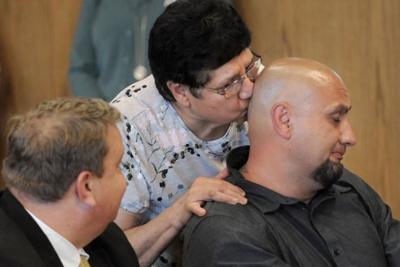

The Idaho Falls City Council voted Thursday night to accept a settlement agreement with Christopher Tapp for $11.7 million.
In October 2020, Tapp sued the city of Idaho Falls and several former Idaho Falls Police Department officers after he was wrongfully imprisoned for the 1996 rape and murder of Angie Dodge.
The money will be covered by the city’s insurance company. As part of the settlement the city also agreed to send an official letter of apology to Tapp, and to host “a full discussion with thought leaders on interrogation techniques.”
Tapp spent 20 years in prison after he was wrongfully convicted in 1998. He was exonerated in 2019 after police arrested Brian Dripps, who confessed that he committed the murder. Dripps was convicted in 2021.
The City Council voted unanimously for the settlement after discussing it during an executive session during Thursday’s council meeting.
“Tonight we attain closure for something that’s been a long time coming,” Idaho Falls Mayor Rebecca Casper said after the vote.
The settlement brings to a close the case that has haunted Idaho Falls for more than a quarter of a century.
Casper told the Post Register that the settlement will allow the city to move on. “A protracted legal experience is never smooth and calm,” Casper said.
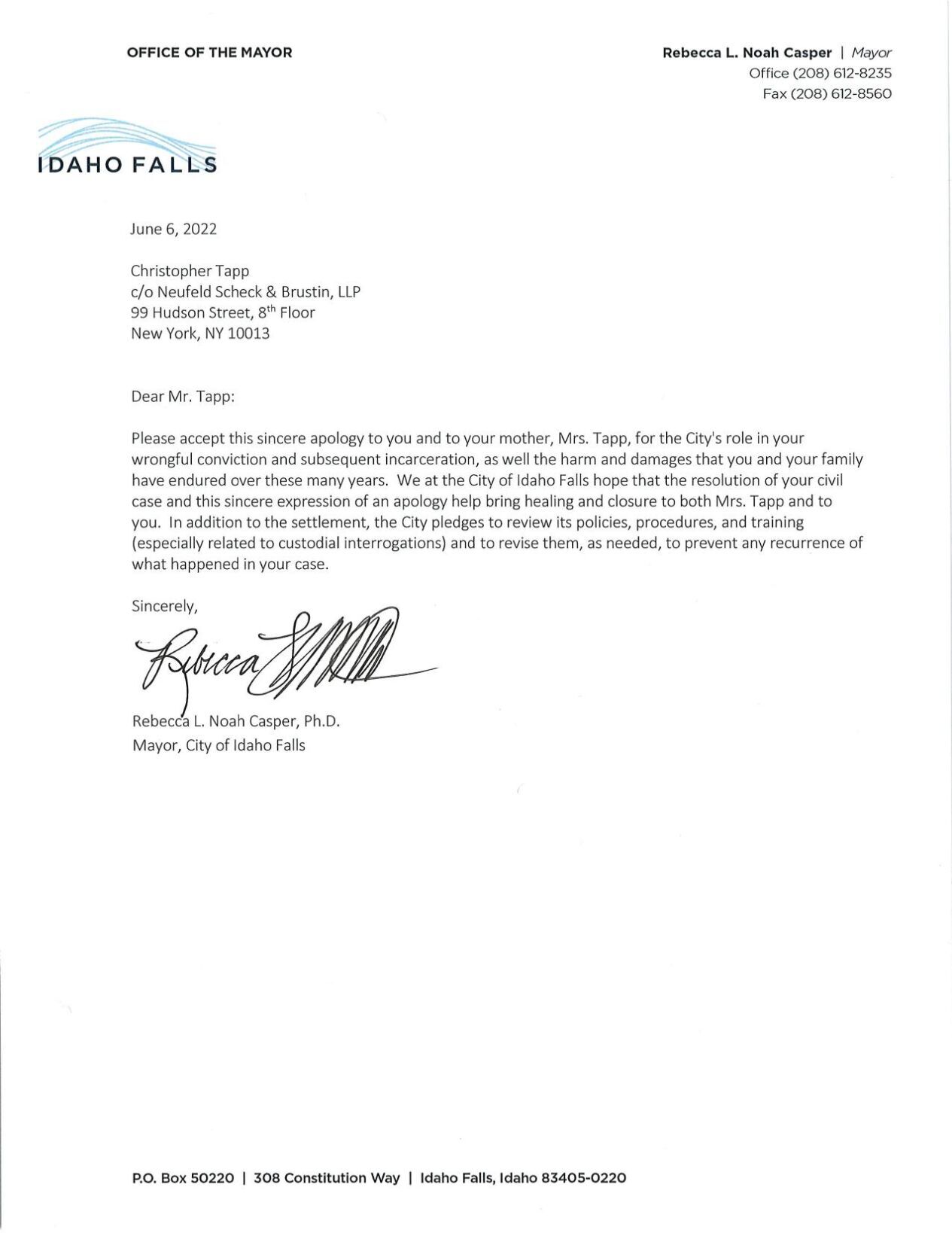
“We want the healing to begin,” Casper added.
Tapp’s lawyers released a statement shortly after the vote was made.
“No dollar amount could ever make up for the over 20 years of my life I spent in prison for crimes I did not commit,” Tapp said in the statement. “However, the settlement will help me move forward with my life.”
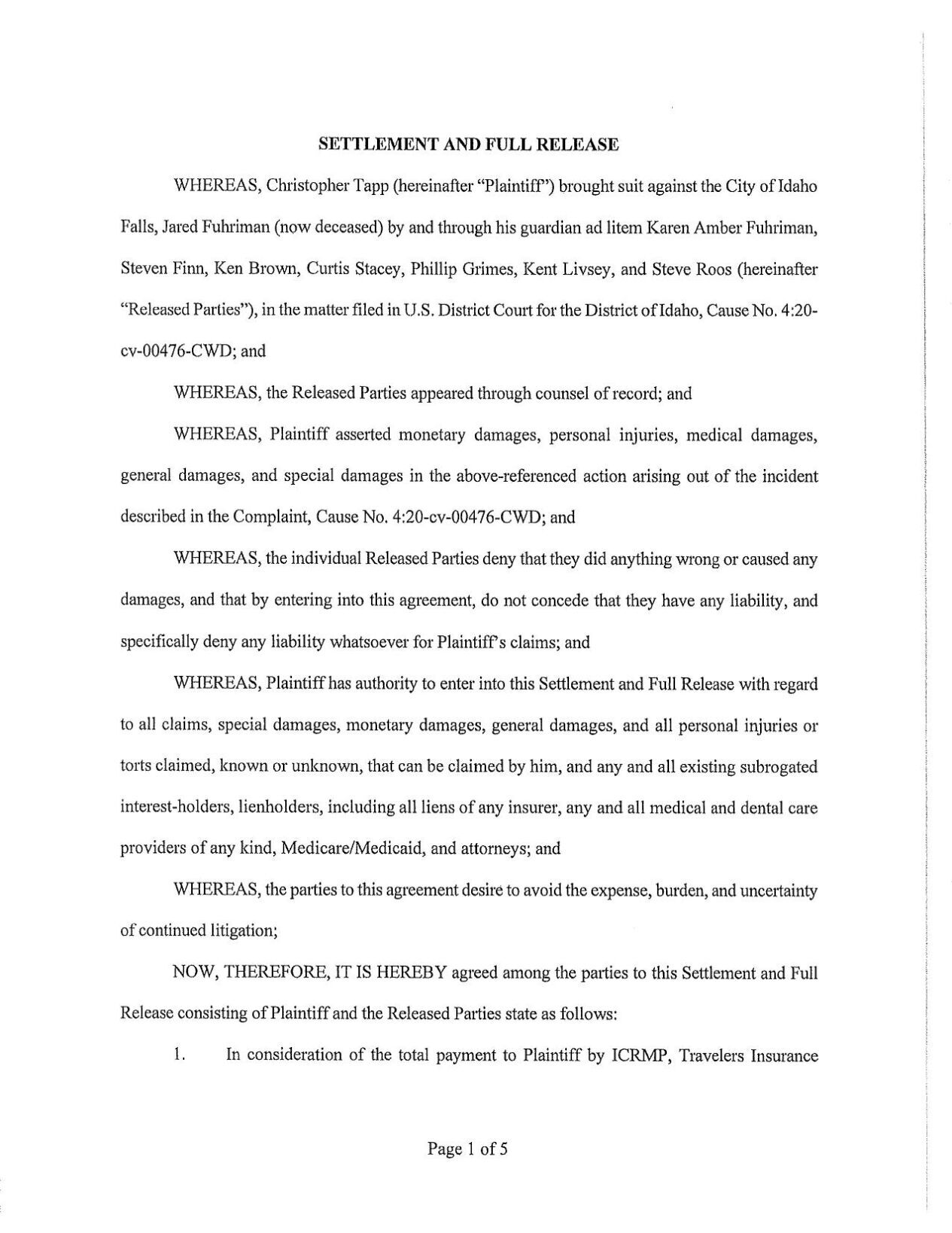
As part of the agreement, Tapp’s attorneys said they will not bring anymore legal action against the city or its employees, including those not named in the lawsuit.
In addition to the city and the Idaho Falls Police Department, Tapp sued several former officers involved in the investigation, including Ken Brown, Steven Finn, Curtis Stacey, Phillip Grimes, and former IFPD Chief Kent Livsey.
The lawsuit also named Jared Fuhriman, a former IFPD detective and Casper’s predecessor as the city’s mayor. He died on May 22, 18 days before the settlement was reached.
Steve Roos, also a former chief of police, also was named for not following up when the integrity of the case against Tapp came under scrutiny.
Angie Dodge, who was 18, at the time, was found raped and murdered in her residence in 1996. A few months later in 1997 Tapp was arrested and police said he had confessed to participating in the murder.
A review by Judges for Justice and a former FBI investigator reviewed the interviews with Tapp years later and discovered, however, that Idaho Falls Police Department officers had fed Tapp details from the crime scene and then said in court under oath that he had volunteered those details on his own.
Tapp challenged his conviction with help from the Innocence Project. In 2017 he accepted a deal in which he pleaded guilty to murder in exchange for his release from prison. The deal bought him his freedom, but did not clear his name. Then-Bonneville County Prosecutor Daniel Clark said the deal “finalized the question” of Tapp’s guilt.
The question of Tapp’s guilt came up again, however, in 2019 when the Idaho Falls Police Department announced it had arrested a man named Brian Dripps in Caldwell.
Detectives identified Dripps through genetic genealogy and confirmed his DNA was a match for a sample at the crime scene. Two months after his arrest, a police investigation did not find any ties between Dripps and Tapp and Tapp was exonerated. Dripps also had told investigators he committed the crimes alone.
In March 2021, Gov. Brad Little signed the Wrongful Conviction Act, a law to compensate those who have been wrongfully convicted. The bill was inspired by the exoneration of Tapp after he served 20 years in prison. In June 2021, the state paid Tapp $1.2 million.
The law stated that if a wrongfully convicted person receives a reward or settlement in a civil lawsuit, the amount they receive from the state is reduced by the amount they won in the lawsuit. The clause was intended to preventing wrongfully convicted persons from being compensated twice.
The settlement is likely the highest paid out by an Idaho city or county government entity to a single individual. An online search did not reveal reveal any larger settlements. The search revealed that Bannock County had paid $2.1 million to the family of a man who died in the Bannock County jail in December 2018 from dehydration and starvation.
June 13 marks the 26th anniversary of Angie’s death. In an interview with the Post Register, her mother, Carol Dodge, asked that the city also issue an official apology to the Dodge family.

(0) comments
Welcome to the discussion.
Log In