

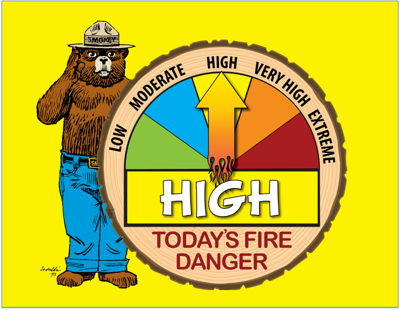
With hot, dry weather the current norm, nearby public lands and national parks have pushed the fire danger arrow up to “High” in recent days.
Similar to avalanche danger warnings in the winter, the National Fire Danger Rating system is used to alert the public to the danger levels on public land. The current fire danger listed by the Eastern Idaho Interagency Fire Center is “High” for all of the region, including central Idaho and the Salmon area and most of western Wyoming. Fire crews were battling 10 wildfires in eastern Idaho as of Tuesday, one listed at 1,200 acres and growing south of American Falls. Crews were fighting another wildfire about 10 miles north of Island Park.
“Fires in heavy, continuous fuel, such as mature grassland, weed fields, and forest litter, will be difficult to control under windy conditions,” Yellowstone National Park said in a news release. “Control through direct attack may be difficult but possible, and mop-up will be required. Outdoor burning should be restricted to early morning and late evening hours.”
Public land officials are urging campers and outdoor recreators to take caution, especially with campfires. A “High” danger rating means campfires are only permitted in established fire rings in campgrounds and in some backcountry campsites.
“The land management agencies are actually getting together this week to discuss (fire) restrictions and if we meet the required components,” said Sarah Wheeler, of the Eastern Idaho Interagency Fire Center.
Although human-caused fires and fires threatening structures are generally fought by firefighters, the National Park Service considers natural fires a part of the ecosystem, and they play a role in shaping and maintaining the health of the area’s wildlife habitat and vegetation.
“Several native plant species evolved adaptations so they survive and, in some cases, flourish after periodic fires,” Yellowstone park said. “Fire influences ecosystem processes and patterns, such as nutrient cycling and plant community composition and structure.”
As of Tuesday, Yellowstone was not reporting any fires in the park.
The park service said when determining fire danger, fire managers use several indicators such as the moisture content of grasses, shrubs, and trees; projected weather conditions including temperatures and possible wind events; the ability of fire to spread after ignition; and availability of firefighting resources across the county.
“In areas where campfires are allowed, fires should never be unattended and must be completely extinguished,” Grand Teton National Park said. “The charred remains of a campfire must be repeatedly doused with water and stirred into the campfire ring for it to be completely extinguished. All embers and logs should be broken up.”
Public lands are also under a fire prevention order until Oct. 20 prohibiting fireworks, steel ammunition, tracer ammunition, incendiary ammunition and exploding targets. The public is also advised to keep vehicles off dry grass to prevent the catalytic converter from coming in contact with the vegetation.
“Be cautious out there! Should you start a wildfire, even if it’s by accident, you could be held liable for damages and firefighting costs,” said Amy Baumer, Salmon-Challis National Forest spokeswoman in a news release.


(0) comments
Welcome to the discussion.
Log In