

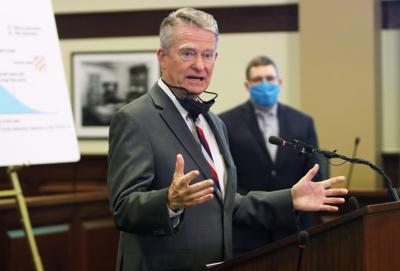

With the sharp increase in coronavirus infections Idaho’s seen in the past two weeks, Gov. Brad Little says “we’re looking at all the options,” including a possible partial rollback of the state’s staged reopening plan.
On Friday, officials confirmed 128 new COVID-19 cases in Idaho. The state also confirmed 111 new cases on Thursday.
In Southeast Idaho, officials reported Friday there were 144 cases, up by 10 cases from the prior day.
The spike follows the state’s decision to move on June 13 into its Stage 4 reopening, allowing all Idaho businesses to reopen and permitting gatherings of up to 250 people, as long as social distancing and other preventive measures could be met. Two weeks earlier, bars had been allowed to reopen in Stage 3, after Little moved them up from the original schedule, which had them in Stage 4.
Little’s been sending signals for the past week that if the reopening is rolled back, it likely would be by region, rather than statewide.
“Prospectively, going ahead, we’re looking at all the options,” he told the Idaho Press.
“But I’ve got nine counties with no cases, no lab-confirmed cases. As long as I can protect critical health care capacity, ICU beds, ventilators, etc., and (state Health & Welfare Director) Dave (Jeppesen) and I and the coronavirus group have talked about this a lot, that’s our preferred choice.”
“But it could happen drastically,” Little said, referring to a huge jump in both infections and hospitalizations. “We don’t think so, because as we do more testing and tracing we’ve got a better idea. But it’ll be more regional in nature.”
When Little announced on June 11 that the state would move into its Stage 4 reopening two days later, he said it had only “narrowly” met its criteria for the move, which include caseload counts and trends, testing data, hospital capacity and infections among health care workers.
Stage 4 allows gatherings of more than 50 people, allows nightclubs and large venues to reopen, and allowed visits to resume to patients in nursing homes or other long-term care facilities, as long as new health protocols are followed.
“We’ve taken many steps to alleviate the hardships caused by this pandemic,” Little said at the announcement. But, he said, “We almost did not make it to Stage 4 this week,” because some Idahoans still haven’t been practicing recommended preventive measures such as mask-wearing, social distancing and good hand hygiene. He recommended that all continue to pay close attention to those practices.
Little said the need to allow nursing home patient visits to resume was a key concern when he made the call to move into Stage 4.
“This has been one of the most concerning issues to us,” Little said during a statewide call-in with the Idaho AARP on Tuesday. “We’ve got 400 long-term care facilities in Idaho, and my hat really goes off to ‘em. They’ve done a really excellent job for the most part, but those people that are in those care facilities really want to see their friends and families. So that was probably one of the most motivating factors for me to get to Stage 4.”
There have been growing calls across the nation to end bans on visits to nursing home residents, as data has begun to emerge showing that the patients’ isolation has contributed to deterioration in both their mental and physical health, and calls from anguished family members to end the ban have increased.
The ban on visits hasn’t kept COVID-19 out of Idaho’s long-term care facilities. As of June 12, 53 deaths, more than half the 87 reported statewide at that point, were among residents of nine Idaho long-term care facilities.
The state has seen 30 outbreaks at facilities and 304 total cases among residents or staff; as of June 12, 12 facilities still were experiencing outbreaks involving 162 cases. The state is now posting weekly updates on outbreaks at long-term care facilities, including which facilities are involved, online at coronavirus.idaho.gov/ltc/.
The Idaho State Journal contributed to this report.

(0) comments
Welcome to the discussion.
Log In