

The fifth and final concert of the Idaho State-Civic Symphony’s 2023-2024 “Music of Latin America” season will mark the end of a truly outstanding concert series under the baton of Nell Flanders, conductor/artistic director, who is completing her second season with ISCS. On April 26 at 7:30 p.m., at the Stephens Performing Arts Center, the performance will feature guest soloist Eleanor Christman in Robert Schumann’s Concerto in A minor for Cello and Orchestra, Op. 129 and, as with each concert this season, will highlight a particular region or country of Latin America, this time Brazil. This concert, “Brazilian Voices,” will feature selections by Brazilian composers Clarice Assad, Oscar Fernández and Heitor Villa-Lobos.
Of the vast library of compositions by Robert Schumann (1810-1856), one of the most original compositional voices to emerge in the 19th century, only three are concertos — one each for piano, cello and violin. Schumann grew to understand the cello after turning to the instrument in 1838 as a musical outlet when he suffered a hand injury while trying to extend his reach on the piano. More than a decade later, Schumann composed the Cello Concerto during a two-week period in 1850, and it is this beautifully dramatic and lyrical work that Christman will perform.
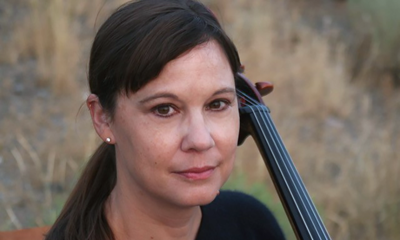
Eleanor Christman is an assistant professor of cello at Idaho State University and the principal cellist in the Idaho State-Civic Symphony. She has also played in the Tallahassee Symphony, Madison Symphony, Ballet West, Utah Symphony, Boise Philharmonic, Helena Symphony and will perform this May as a member of the Colorado Mahlerfest Orchestra. Passionate about chamber music and as a member of the Monarch Trio in residence at ISU, Eleanor has performed throughout the region, most notably as part of the community series of the Grand Teton Music Festival. She finds great fulfillment in educating future generations of cellists and also teaches at ISU’s Summer Institute for Piano and Strings, the Teton Valley Chamber Music Festival and has been invited to teach and perform at the Saarburg Festival in Germany this July. Christman holds a BM degree from Indiana University and MM and DMA degrees from the University of Wisconsin. She plays a Camillo Mandelli “da Calco” cello, dating from circa 1928.
“Bonecos de Olinda” by Brazilian-American Clarice Assad (b. 1978) was inspired by the carnival celebration in Olinda, an historic city in the Northeast state of Pernambuco in Brazil. The Bonecos of Olinda are giant hollow figures made of fabric, aluminum, paper, wood and fiberglass. They originated in medieval Europe and were used in processions in the form of Catholic saints, finding their way into Brazil during the colonial years. Assad captures the carnival atmosphere of music and dancing in this piece with the rhythms and sounds and the relentless energy of that celebration in Olinda. Assad is a powerful communicator renowned for her musical scope and versatility, a prolific Grammy Award-nominated composer with more than 70 works to her credit, and a celebrated pianist and inventive vocalist who inspires and encourages audiences’s imaginations to break free of often self-imposed constraints. Her innovative, accessible and award-winning VOXploration series on music education, creation, songwriting and improvisation has been presented throughout the world, gaining new audiences for this artist both onstage and off.
“Reisado do Pastoreio” by Oscar Fernández (1897-1948) is a three-movement suite based on the story of the three wise men said to have visited the baby Jesus. The symphony will be performing the Batuque movement. Fernández was an important and prolific Brazilian composer, writing over 100 different works in his 51 years in many different genres. He was also an important educator, founding the Conservatório Brasileiro de Música in Rio de Janeiro. In this piece, the last movement is an Afro-Brazilian folk dance called batuque. Originally danced by slaves in the Cape Verde islands, the batuque thrived in Brazil because of the large number of slaves who were brought there. It is infused with polyrhythms in the percussion overlapping with rhythmic patterns in the woodwinds, brass and strings. The result is a thrilling finale that was as much a surprise to its original audience in 1930 as it is a delight to today’s audiences.
Concluding the concert will be “Bachianas Brasileiras No. 4” by Heitor Villa-Lobos (1887-1959). The complete “Bachianas Brasileiras” is comprised of nine ensemble groupings, ranging from a duo for flute and bassoon to a large ensemble of piano and orchestra. Only No. 4 will be performed at the concert, the orchestrated version created by Villa-Lobos in 1941 to his original composition for solo piano. Villa-Lobos was fascinated by the folk music of indigenous peoples, traveling throughout Brazil to collect songs from the vast variety of cultures in his home country. His collection comprises a large repository of primary source material that is still of great value to ethnomusicologists. He studied at the National Institute of Music in Rio de Janeiro, but resisted the constraints of academia as stifling to individual creativity. A surprise to audiences when he mounted his first compositions, this surprise soon found favor with the Brazilian government which sent him to Paris for advanced study. During his seven years in France, Villa-Lobos discovered European composers, and J.S. Bach’s works played a pivotal role in his own style. He was also acquainted with luminaries such as Aaron Copland, Pablo Picasso and Andrés Segovia with whom he collaborated on new guitar works.

(0) comments
Welcome to the discussion.
Log In