

This article was originally printed in the Idaho State Journal Centennial Edition, section seven on Monday, June 21, 1982
By O.K. Johnson
Idaho State Journal
The origin of Blackfoot is an enigma all to itself.
A couple of theories are prevalent about the beginnings of the town labeled in the 1880s as “the commercial center and best agricultural and cattle growing district in the territory.”
 But separating fact from fiction concerning Bingham County’s dominant city has even puzzled some old timers and historians.
One theory holds that Blackfoot originated first as the “little wayside railroads station” for the Utah Northern and Oregon Short Line systems.
According to that theory, Blackfoot was the railway point nearest to the mining districts of Custer County and hence became the supply point for an extremely large territory.
A silver mine supposedly was discovered on Martin Creek 74 miles west of Blackfoot with the city serving as the miners’ supply base. Homesteaders then came to the area to sell farm produce to the miners.
A railroad line from Blackfoot to Mackay was constructed and later a road from American Falls to Aberdeen was proposed. Businessmen located in Blackfoot once it was designated as a railroad terminus.
The second theory attributes Blackfoot’s existence solely to homesteaders. That theory holds that mining was not a factor.
It is apparent, however, that Blackfoot’s origins, began in the early 1802, according to an 1835 article written by Byrd Trego.
Trego writes that trappers used to arrange meetings in the Blackfoot area before the establishment of the Fort Hall outpost. Trappers used to meet at the Blackfoot Hill, now known as Ferry Butte, to hunt buffalo and fish on the nearby river.
Settlers began gravitating to the area after the battle of Bear River and to distinguish it from settlements along Bear River and the Bear River, the area became commonly known as the Blackfoot area.
A ferry was constructed across the Snake River in 1860 at Ferry Butte and a second called Telford Ferry was built about 12 miles away.
The first settlers to the area were Frederick S. Stevens and a person identified only as Mr. Warren. They settled the area in 1866 when the site of the city was nothing but “uninviting sagebrush” according to “The History of Idaho” by former Idaho Governor James H. Hawley. He served as governor from 1910-1912.
According to Hawley’s history, there were occasional Indian troubles in the area and Warren “fitted up his cabin as a place of safety for a few scattering families when the savages grew too familiar.”
From the latter ferry, Blackfoot got its first official name, Central Ferry. A post office established on October 10, 1878 carried that name and mail addressed to the area was labeled “Central Ferry inside Oneida County.” Theodore T. Danilson was named the first postmaster.
The city itself was actually laid out in 1878 in anticipation of the Utah Northern Railroad’s arrival on Christmas Eve of that year. According to a 1914 history, “the town boomed immediately and became an industrial center. The railroad accompanied the transfer of supplies and equipment to freight wagons bound for the rich mining country of central Idaho.
“As freighting decreased and water from the Snake River was supplied to the fertile valley soil, agriculture became the most important industry.”
In a 1973 Journal interview given to correspondent Esther Lake, Fred Stevens said he had the first stage station in Blackfoot. He and his family moved to the Blackfoot area from Soda Springs and told the following about Blackfoot’s earliest developments.
“There was not a town here then,” Steves said when his parents first arrived in April 1866. “Nothing but a freight station, barn and house out where the old Snake River bridge is now. It was called Telford City.”
“This was a station for freight wagons coming through. A ferry to take them across the river was run by Telford Kutch and Tom Cosgrove. When folks around here had a letter to mail they stuck it in the cracks of the Telford barn and the next freighter would pick it up and take it on.”
The construction of the People’s Canal west of Blackfoot helped draw additional settlers to the area. Business promoters advertised that there “was a world of land that might be settled and tilled.” The new town of Moreland west of the Snake River thus came into being.
Actually there was a move to name Moreland after the famed lawyer William Jennings Bryan, who at that time was running for president. Area residents felt naming the settlement after a president of the United States would speed things along.
Bryan, however, lost and the settlement was named Moreland.
Central Ferry became Blackfoot’s first official name in 1878 since all mail was addressed that way. It wasn’t until March 20, 1879 that the name was changed to Blackfoot. The city was originally incorporated in 1907.
The naming of the city, Blackfoot, itself is a source of mystery shrouded in folklore. It is said that trappers saw some Indians walking across a recently burned prairie. The trapper noticed the Indians had “black feet” and subsequently named the area Blackfoot.
The Indians, however, were not Blackfoot Indians of Montana.
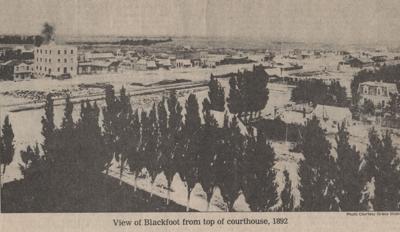
 By now the railroads were a staple of frontier life. Even after the official name change to Blackfoot, the city was known as throughout the state as “Grove City” because of an abundance of old shade trees. In 1886, the first trees ever planted in the Upper Snake River Valley were set out around the Blackfoot Courthouse by Alfred Moyes.
Excursions were even take to the fledgling city over the years to see the trees which were “in marked contrast with the unbroken expanse of native sagebrush.”
When the territorial legislature convened in January 1885, Blackfoot was a part of Oneida County. Political intrigue and manipulation resulted in Blackfoot being named the seat of government for the newly created Bingham County instead of Eagle Rock (Idaho Falls) to the north.
“It was agreed to beforehand that there would be no debate on the bill. By fast action Blackfoot was substituted for Eagle Rock as the county seat. The measure reached the floor of the legislature and was read.
“The friends of Eagle Rock could only gasp when they heard the clerk read in Blackfoot as the county seat.”
The existing courthouse was constructed in the summer of 1885 on its present Shilling Street location. County commissioners appointed justices, constables, road supervisors and other local officers.
Hawley’s history says that “the business section is built up with attractive and substantial structures of brick and stone, the latter being quarried near the city.”
This period of Blackfoot’s history was characterized by gambling, carousing and occasional shootings.
One episode gave the flavor of the early days..
“About a dozen gun-packing cow poke had the habit of making it a night each time they hitched their horses in Blackfoot. After a whale of a lot of drinks — enough to make cowboys drunk — they began shooting up the town.
“One night when the cowboys started acting up again, the people of Blackfoot, armed with rifles, shotguns and pistols, surrounded them and put them in jail. Each was fined $150. “
 Blackfoot was designated the site of the Territorial Insane Asylum by the 13th Territorial legislature in 1885. The legislature passed a $20,000 bond issue for the construction of the insane asylum (now State Hospital South).
“L Shilling donated a tract of ground and the institution opened July 2, 1886,” Hawley’s history records. There were 26 men and 10 women brought from a Salem, Oregon institution to run the facility.
The first building had a stone basement, the first two stories constructed of brick and the third story was of wood frame construction. It burned to the ground on November 24, 1889, but the 47 male and 20 female patients were all saved.
The Territorial Legislature had passed an additional $15,000 appropriation for additional construction that was partly finished when the fire broke out.
Roman Catholics held the first organized religious services in Blackfoot in a business on what is now Main Street.
Blackfoot was one of the mission outposts for an obscure priest known only as Father Nattini. Mass was later celebrated in private homes.
It was the Methodists, however, who built the first church in 1885. The Baptists and Episcopal faiths followed suit. The Roman Catholics did not build a church facility until 1904.
After Pocatello to the south was designated a terminus for the Northern Pacific Railroad, Blackfoot’s economy became more geared to farming and ranching.
The first edition of the Idaho News was published in Blackfoot on June 11, 1887/ Subsequent editions of the weekly paper declared that business was improving and that Blackfoot was a “splendid place for business and home of cattle kings . . . a city of churches and magnificent schools.”
County commissioners levied a territorial tax of 21/2 mills, three mills for schools, two for the bridge fund, two for the general fund, 15 mills for the courthouse bond and a flour mill tax for a special fund plus assessing $20 for every $100 of valuation.
“By this time (mid 1880s) Blackfoot probably had 250 residents, two general stores, a banking business run by C. Bunting, five saloons, one lumber company, several eating places, a railroad house, and a meat market that only sold beef.”
Jack Christ, whose family came to Blackfoot in the early 1900s, recalled stories his father told him about the town’s early beginnings. Christ also drew on his own recollections regarding the importance of the railroad to the Bingham County capital.
“As a kid in the days of the railroad, there was a prosperous and well-built railroad depot. The Mackay train (The Oregon Short Line) took them up to Salmon to the stage.”
According to a local history buff, the run was affectionately named, “Arco, Mackay and back.”
Christ said the boardwalks around the businesses had to be enlarged because of the traffic, but they got rid of them about 1909.
“There used to be a promenade every Saturday evening and the stores would open.
“I remember Blackfoot had a chance to get the university (now Idaho State University) and that’s why one street was named University Street. I think it was a pipe dream.”
Frank and Marie Weise, their children John Mox, Marie and Helena, moved to Blackfoot in 1908 from Oklahoma. Helena recorded her impressions of early Blackfoot life in 1979.
“We came to Blackfoot Nov. 14, 1908,” Helena wrote. “Arriving so late in the fall did not give us much time to prepare for winter. Besides, we did not have snow in Oklahoma. For transportation we needed a heavy-duty wagon and bobsled, we were told.
“There was livestock to buy. As we may be snowed in for the winter, we had to buy large quantities of food. I remember getting coffee in 50-gallon cans. Main Street was the main drag at the time. Hitching posts were posted at the edge of the railroad at the right of way. We tied our team there while shopping and attending church.
“It took us three hours to drive to town. In winter we would put straw in the wagon box which had been placed on the sled. We had two quilts which were only used for these occasions. Hot bricks were placed at our feet. When we reached the town, the quilts were removed to cover the team until we returned to the sled.”
A 1914 history concluded that Blackfoot developed from “a little freighting station where at times cowboys from the surrounding ranges would come and indiscriminately shoot up the place” to a town that had “grown to its present and enviable position of wealth and prominence.”
Hawley’s History of Idaho records that in 1907 Blackfoot had electricity furnished from American Falls, the first sugar factory in Idaho, handsome church edifices, two nurseries, three banks with deposits exceeding $2 million, a pork packing plant, U.S. Land office, an opera house (now the Nuart Theater), a “wide-awake commercial club,” telephone exchange which handled the interstate communications of Idaho, Utah, Wyoming, Montana and parts of Oregon, and “many pretty homes.”


(0) comments
Welcome to the discussion.
Log In