

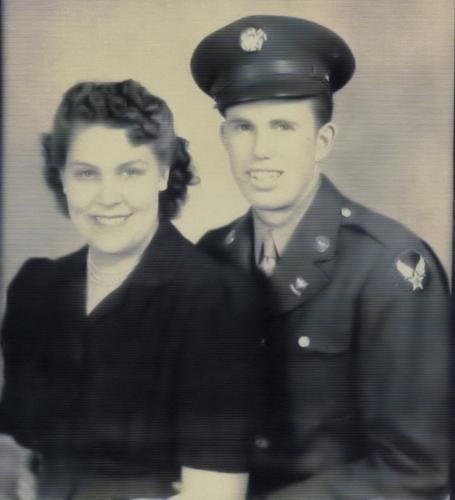
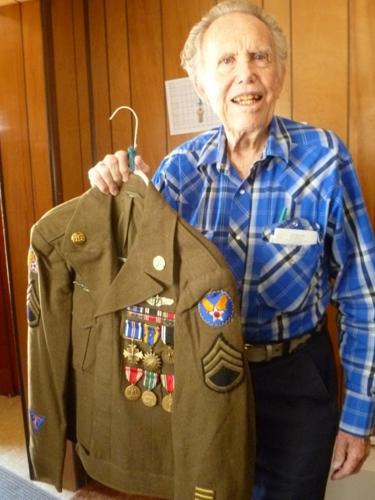
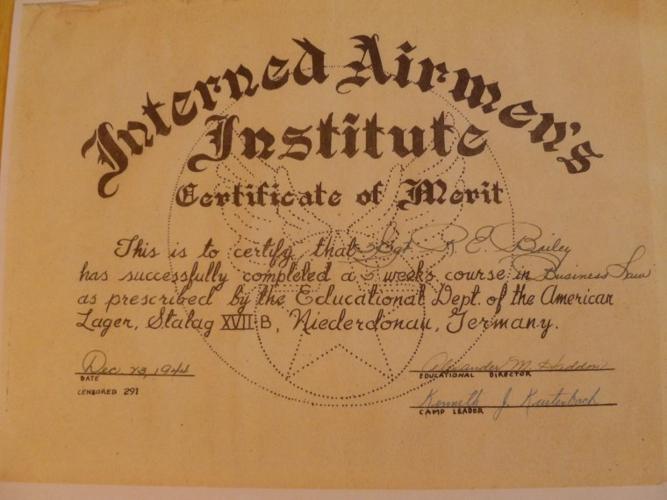
Raymond Bailey has taken his share of classes in his lifetime, in all of the typical subjects that Idahoans study in high school and college. Bailey also took a class in Business law; but he took that that class in Stalag 17B, while a Prisoner of War.
One of the thousands of American, British and Allied troops that were held in the storied Prisoner of War camp Stalag 17B outside of Krems, Austria, Bailey suffered through 13 months of imprisonment. As a way to keep POWs occupied, Americans taught each other classes in their fields of expertise, in hopes of keeping up morale, and making good use of their time. Bailey spent some of his time in the German stalag studying Business Law, as taught by a fellow prisoner, and he has earned a certificate from the “Educational Dept. of the American Lager, XVII-B.”
Now 90 years of age, Bailey shared the story of how he became a POW, how he survived it, and how it felt to be liberated.
Bailey was born and in raised in Wyoming, and as a young man considered taking a job with the Boise construction company Morrison-Knudsen, to help build airfields on Wake Island, a tiny island in the Pacific. He had his interview with the company, and left.
The next day, the Japanese Imperial Navy attacked Pearl Harbor in Hawaii, then Wake Island on the following day. As a result of that attack, all military personnel and all the Morrison-Knudsen civilian construction workers on the island at that time were taken prisoner and subjected to brutal treatment for the remainder of the War. Bailey missed that “opportunity” to become a POW, but was to soon to have another crack at it.
Married in 1941, Bailey went to trade school, and was eventually drafted into the Army in September 1942, and later tested out as a good candidate for the Army Air Force. Originally training as a radio operator and a mechanic, he became an expert in using Morse Code, able to receive 16 words a minute.
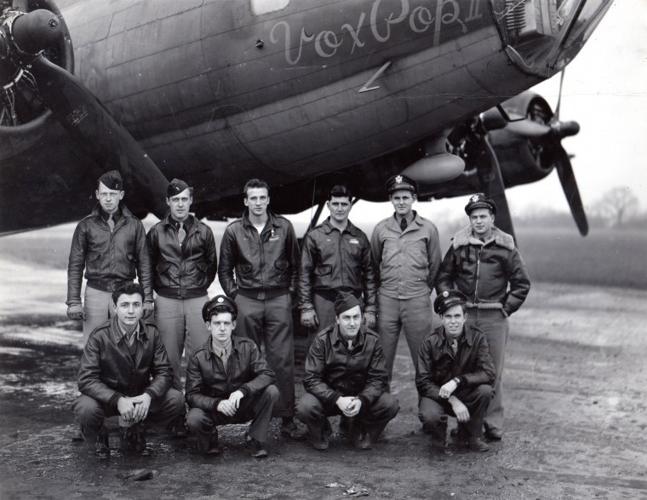
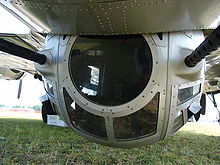
But Bailey ended up in the ball turret of a B17 bomber instead of behind a radio or a Morse Code transmitting device. After completing gunnery school, Bailey shipped out to England, where he and his crew were assigned to a new airplane, called it the “Vox Pops” and flew raids over Germany. During this time, Bailey shot down a German ME 109, for which he received an oak leaf cluster on his air medal.
On a milk run over France the Vox Pops met its fate. “We got shot up good, but nobody was hurt,” Bailey said. The plane headed for home in England, but didn’t quite make it. “It got too dark at night and then we were too low on fuel. They put it on autopilot and sent it out to sea. We parachuted out over England,” Bailey explained. This was when Bailey earned the nickname “Bail Out Bailey.”
Bailey and his crew were later flying in the Vox Pops II performing a mission over Berlin to bomb a ball-bearing plant. Returning after a successful mission, even in the face of heavy enemy fire, the unit received the Presidential Citation for the most enemy fighters destroyed by heavy bombers in one mission.
On a mission in April 1944, the crew was not so lucky. Flying another deep penetration mission to Germany, the plane again successfully dropped its payload of bombs on target, but was hit in the number three engine, and the engine burst into flames.
“It was the third shot that got us,” Bailey described. “I saw the hit, and I called it into the pilot. ‘Number three’s on fire,’ I told them, and we got the bail out order,” he said. “I knew then that we just had to get out of there.”
Bailey managed to climb out of the ball turret into the belly of the plane, put on his parachute, and then jumped out the waist door. But Bailey landed smack dab in the middle of a German Army Base.
“I drifted down and I could see an army camp,” Bailey said. “I hit the roof of a two-story barracks, and my feet just shot out from under me, and I slid down the roof. I remember going over the edge of the roof, and the next thing I knew they were cutting my chute off,” he said.
Bailey was taken into custody, and subsequently interviewed by a German general. “He took off in
German and I never understood a word he said,” reminisced Bailey. He eventually ended up in the famous Luft Stalag 17B, along with thousands of other Allied prisoners.
Conditions for the prisoners in the camp were appalling and unsanitary, and many were close to starvation, surviving on Red Cross parcels out of Switzerland. But utilizing the prisoner network, Bailey and a fellow prisoner managed to build a crystal radio set. “You could get parts, or trade or buy things if you let it be known in a quiet way.” Bailey said. “We took the antenna wire and worked it into the crack between the boards where the ceiling and the walls came together and ran it about 100 feet,” Bailey explained. “Then we put the ground wire down. “The Germans never found it,” he said with a smile.
Keeping other parts of the radio in separate places unless they were actually using the radio, Bailey managed to receive BBC radio, and get real news about the progress of the war. “The Germans would tell us their version of how things were going,” Bailey said, “and on the radio we got the facts. ”
By April 1945 it became apparent to the prisoners that things were coming to a head in the European Theater. The prisoners of Stalag 17B were rounded up and forced to march out of the camp, toward the American lines. The reason for this forced 30-day march has been described by war historians as partly so that stalag would not be overrun by Allied troops, but also because the Germans preferred to end up in the hands of American or British forces, rather than Russian Forces.
As the thousands of prisoners marched, they scrounged off the land they passed, and were separated into smaller, more easily guarded groups. Bailey recounted that his group of about 100 POWs eventually came to a large wooded area somewhere in the Black Forest of Bavaria, and the Germans simply razed a wide path around four sides of the grove of trees, then herded the POWs into the center. The guards patrolled the perimeter, while the prisoners suffered among the trees for lack of shelter, food or water.
“One of Patton’s scouts finally came around the third or fourth day,” Bailey recalled. The next day General George Patton’s Army patrol rescued the prisoners without a shot being fired. “They came out of the forest on all four sides,” Bailey said. He was released from German enemy control into the hands of the Allies on May 5, 1945, three days before V-E Day (Victory in Europe Day.)
Bailey’s early celebration of V-E day felt more like relief, than a party, he said. “They gave us 10-in-1 food, and we never tasted anything so good,” Bailey quipped. The now former POWS were escorted to a vacant factory, and then to de-briefing camps to await their ride home.
But “Bail Out Bailey” still had to get over one more hitch before getting his ticket home. “They were starting to let people go back home, but you had to have 85 points, and they only had me down for 82,” he recalled. “I was halfway back to my room and realized that they hadn’t counted one of my battle stars.” After Bailey informed the administrators of this error, he was awarded 20 more points, and switched his travel orders. “I guess they felt worse about it than I did,” he said. “They knew I had been through the middle of it, and I still couldn’t get out,” he said with a laugh.
In his three years of military career, and his 13 months as a POW, Bailey earned the Good Conduct Medal, the European Theater of Operations Medal with Battle Stars, The Air Medal with four oak clusters, the Presidential Unit Citation, and the Distinguished Flying Cross.
After mustering out of the service, Bailey went to work in Idaho. His last job was as a line foreman for Utah Power and Light. Along the way, he served as the Mayor of Lava Hot Springs for 10 years. Bailey’s and his wife, LaRue, raised four children, and LaRue passed away in 1978. Bailey later remarried, only to have lost his second wife just two months ago. “I was lucky to have been married to two such wonderful sweethearts, he said.
By Eniko Jordan for the E Journal Extra of the Idaho State Journal.
The following information was taken from www.stalag17b.com
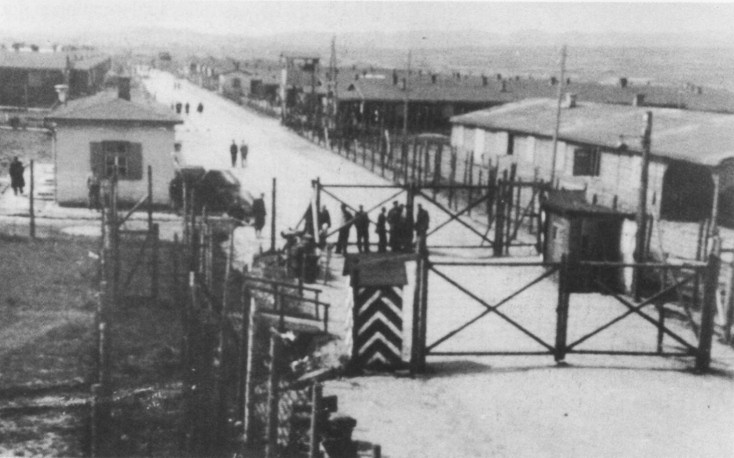
Stalag 17B was situated 100 meters northwest of the village of Gniexendorf. This village is located six kilometers northwest of Krems, Austria (48-27N – 15-39 E).
Stalag XVII B was about one square kilometer (about 250 acres). It was surrounded by a pair of barbed wire fences, 13 feet tall. About six feet inside the inner fence there was another wire, about 18 inches above the ground, called the “warning wire”. Any prisoner crossing the warning wire would be shot immediately without warning by guards in one or more of the watchtowers armed with machine guns and searchlights located around the camp. The camp was further divided into “compounds” segregated by nationality.
Sanitary conditions at the camp were poor to awful. Cold water for washing was only available for a short period of time each day. Only one outdoor latrine provided toilet facilities for each entire compound of 4 double-barracks, or 1,600 prisoners. At night, no one was allowed to use the outdoor latrine; instead, prisoners had to use a bucket in each barrack. In 1941 many hundreds of Russian prisoners died during a typhus outbreak. Because of awful sanitary conditions and poor diet, dysentery was a common problem among all prisoners in Stalag XVII B.

(0) comments
Welcome to the discussion.
Log In