



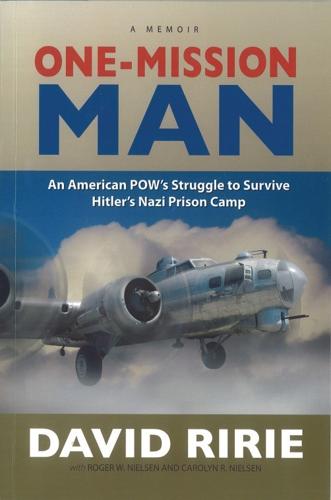
A recently published book by a World War II veteran from Ririe shows the determination and courage of those who flew combat missions in the European theater.
David Ririe’s book “One-Mission Man” is a straightforward look at his experiences in a very challenging time.
Growing up on a farm in the small rural community that carries his family name, Ririe took heed of his country’s call and enlisted in the U.S. Army Air Corps in 1942.
Through a complex series of events, he became qualified as a bombardier on the Boeing B-17, a heavy bomber, and was based in the Suffolk area of England.
Despite getting shot down on his first mission over German-occupied Europe, the quiet heroism of his story is not diminished as he and his fellow prisoners of war initiate numerous escape attempts from Stalag Luft 1, the POW camp in northern Germany where they were held.
Assisted by writers Roger W. and Carolyn R. Nielsen, Ririe’s book is noteworthy for telling the story of an ordinary young man who rose to meet the tasks before him with courage and honor.
One of the most interesting things about the book is the inclusion of small informational boxes that contain details about the larger course of the war to help put Ririe’s experiences in context.
The convergence of several historical events in the war required Ririe to confront issues of enormous complexity.
His story shows someone who stayed true to the basic values he held, despite the pressures of mastering a complex weapons system during training and then in combat.
And his descriptions of what they faced are vivid.
“As we approached Rostock (Germany) we saw the city in the distance clearly through a cloudless sky — just as clearly as its anti-aircraft batteries saw us,” Ririe wrote. “Uncomfortably accurate ack-ack filled the air.”
He then described how the enemy gunners used a clearly defined pattern of shots as they zeroed in on the plane to get a hit.
“The third shot hit with a jolt,” Ririe wrote. “The impact lifted the tail of the plane and threw us forward in our seats. Metal fragments pierced the thin aluminum skin covering the fuselage, sounding like gravel thrown on a tin roof.”
But their ordeal was not over. The German fighters pounced on them after the B-17 departed from its bomb run, which led to a crash landing, injuries and death.
Despite his ordeal, Ririe maintained optimism and gratitude.
“...I regard myself to be a very blessed man,” he wrote. “Life has a way of working out if you work hard, stay on course and have faith.”
For more information on the book go to www.tetoncrest.com.

(0) comments
Welcome to the discussion.
Log In