

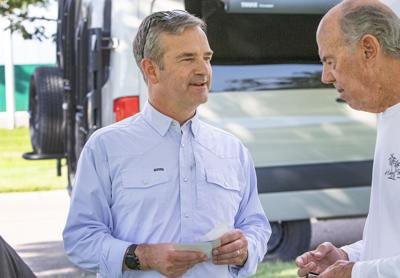
BOISE — The contest for an Idaho Senate seat saw a notable departure last week that puts three-term incumbent Republican Sen. Jim Risch and former Idaho Rep. Todd Achilles as the leading candidates in the race. Both candidates indicated their approaches won’t be changing in the three months before the election.
The narrowing of the field three months out from the November election came with Democratic candidate David Roth’s departure from the race and stated conclusion his efforts would be better spent helping other Democrats engaged across Idaho.
Roth, who had previously mounted Democratic bids against Republican Rep. Mike Simpson and Republican Sen. Mike Crapo, exited after facing increasing pressure from the Idaho Democratic Party to show viability in his candidacy, as was previously reported by the Spokesman-Review.
Following Roth’s departure, the Achilles campaign issued a statement declaring they were ready to “take advantage” of the changing race, a development they feel could work in favor of the independent bid.
They are looking to unseat Risch, 83, who has a storied career in Idaho politics. Risch was first elected as an Idaho state senator in 1974 before serving as lieutenant governor and operating in his present role as a now three-term U.S. senator. President Donald Trump previously gave Risch his “Complete and Total Endorsement for Re-Election.”
Achilles, 59, entered the congressional race after serving in the U.S. Army and then working in the tech and telecommunications sector for more than 20 years. His start at the Legislature came in 2024 when he was appointed to replace current Boise City Council member Colin Nash. Achilles, who served as a Democratic lawmaker, went on to retain his seat in the 2024 election before resigning to enter the Senate race and changing his party registration to unaffiliated.
Achilles has cited a growing disillusionment with the two-party system, failure to address the national debt and deficit and lasting overseas foreign military engagements as being among key issues prompting his change in political affiliation.
“The fundamental problem, and I hear this from Idahoans from Boundary (County) to Bear Lake (County), is Congress isn’t working,” Achilles said. “... We need to break the grip of the two-party system on Congress, we need to get money out of our elections, and serving as an independent is the best way to do that.”
The Achilles campaign has sought to challenge Risch directly, including by putting up billboards that facetiously wish the 83-year-old senator a happy birthday, as well as challenging Risch to a series of debates from August through October. The latter challenge was issued in May and has not received a response, Achilles said Friday, though he said his cross-state outreach effort will continue in the months ahead.
Risch, for his part, has offered little in direct response to Achilles. On Friday, he underscored that Idaho’s political nature continues to be among the most conservative and called into question Achilles’ independent branding.
“David Roth’s withdrawal does not change the fundamentals of this race or the underlying realities of Idaho politics,” Risch said in an emailed statement. “There were two Democrat candidates in the race, and now there is one. Idaho remains one of the most Republican states in the nation, and I am proud to consistently deliver conservative votes for our state. Todd Achilles still faces the enormous challenge of overcoming his Democrat record.”
Asked about Risch’s statements on his political persuasions, Achilles responded that his core values should be viewed as aligning with conservative ideals.
“Standing up against monopolies and protecting fair markets and free markets, that’s conservative — he’s not doing that,” Achilles said. “Making sure we protect our public lands and fully fund our federal agencies — that’s conservative.”
Roth’s departure brought outside interest in the race from the Forward Party. The third party, whose slogan is “Not Left. Not Right. Forward.,” was founded in 2021 by former Democratic presidential candidate Andrew Yang and former Republican New Jersey Gov. Christine Todd Whitman.
The group has endorsed Achilles and several other independent candidates across the country, and Yang — perhaps most famous for his $1,000-per-month universal basic income proposal — highlighted Achilles as the foremost challenger to Risch in Idaho’s Senate race.
“If Todd gets the resources necessary to make his case, he’s got a shot to change the game by ousting an octogenarian incumbent in a deep red state,” Yang said in a blog post. “What would be more fitting in the year of the Odyssey for Achilles to topple someone thought to be untouchable?”
According to campaign finance data from the Federal Election Commission, Risch remains well ahead in fundraising in the race, with $4.4 million raised since being reelected to his third term in 2020, $3.3 million of which came after Jan. 1 of last year. By comparison, Achilles has raised $692,000 since July 1, the day he first announced his candidacy.
Lindsey Drath, CEO of the Forward Party, said among the group’s central tenets is to improve ballot access across the country, with ballot requirements for independent candidates varying by state as well as office sought. In the case of independent candidates looking to run for U.S. senator in Idaho, they must petition for ballot access and receive signatures from 1,000 qualified electors.
“That’s a barrier for entry that the Republican and Democratic candidates don’t have,” Drath said. “And so what we’re working to do is to get ballot access across the country so that we can introduce competition into the political arena in order to reduce hyper-partisanship and toxic polarization.”
Drath pointed to polling indicating voters are broadly dissatisfied with the Republican and Democratic parties, which have respective favorability ratings of 40 percent and 39 percent, according to a 2026 Pew Research survey.
Drath said she didn’t believe it was a coincidence several independent U.S. Senate candidates endorsed by the party — including Achilles, Bob Chew of Colorado and Seth Bodnar in Montana — were each military veterans running in rural Western states that are characterized by a “pioneer culture.”
“(Independent) candidates being representative of Mountain West states is not a surprise,” Drath said. “The Democratic Party has kind of ceded competitive edge in those states to the Republican Party in the same way that the Republican Party has ceded competitive edge in places like New York and California in years past.”


(1) comment
Don't expect Risch to debate anyone whose charisma and intelligence would expose his own lack of either.
Welcome to the discussion.
Log In