


U.S. Census Bureau housing inventory estimates released at the end of May indicate housing units in Teton County are going up at one of the fastest rates in the country.
The data shows that housing units in Teton County increased an estimated 4.2 percent from July 1, 2020, to July 1, 2021. This makes the county’s housing supply the 17th fastest growing inventory in the nation. Just considering counties located west of Texas, Teton County ranks No. 4.
Teton County’s housing inventory grew from an estimated 5,853 units to 6,099 units in that timeframe. There are over 3,000 counties, parishes (Louisiana), and boroughs (Alaska) in the United States.
Also of note, neighboring Madison County is No. 12 in the nation and tied at second for counties located west of Texas with a 4.5 percent increase in its housing inventory.
Both Teton and Madison counties are only behind Washington County (+4.7 percent) in southwest Utah. Custer County (+4.5 percent) in western South Dakota is tied with Madison County for percent increase in housing units.
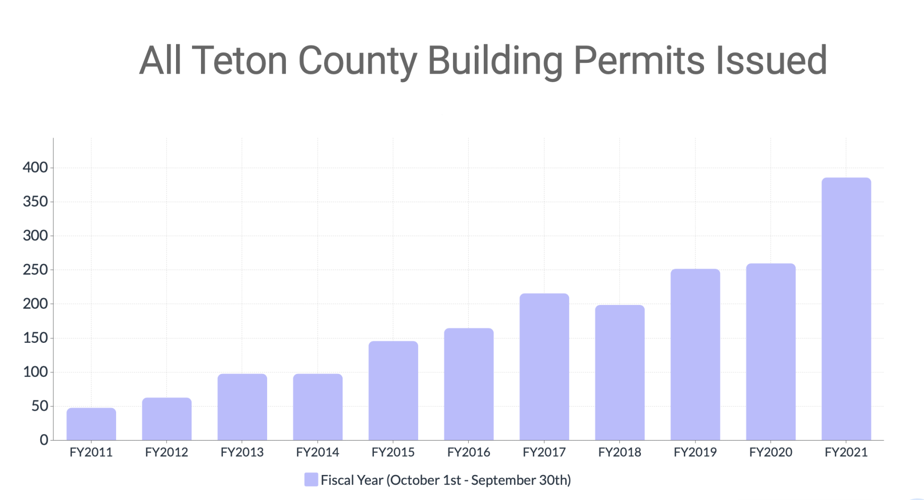
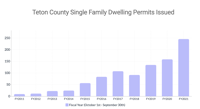
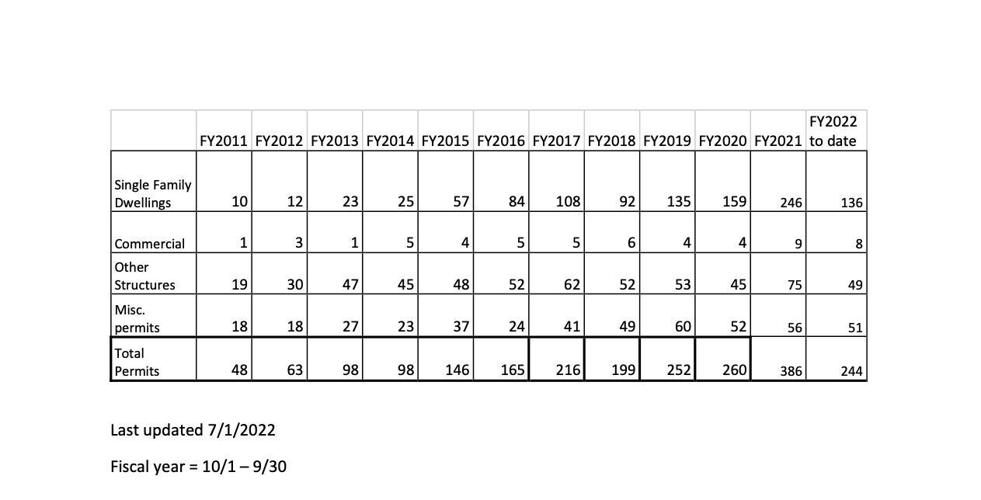
Teton County data shows this substantial increase as well. According to building permit data from Teton County Building Official Wendy Danielson, overall building permits increased from 260 to 386 permits issued from Fiscal Year 2020 to FY21. Fiscal years start on Oct. 1 and end on Sept. 30.
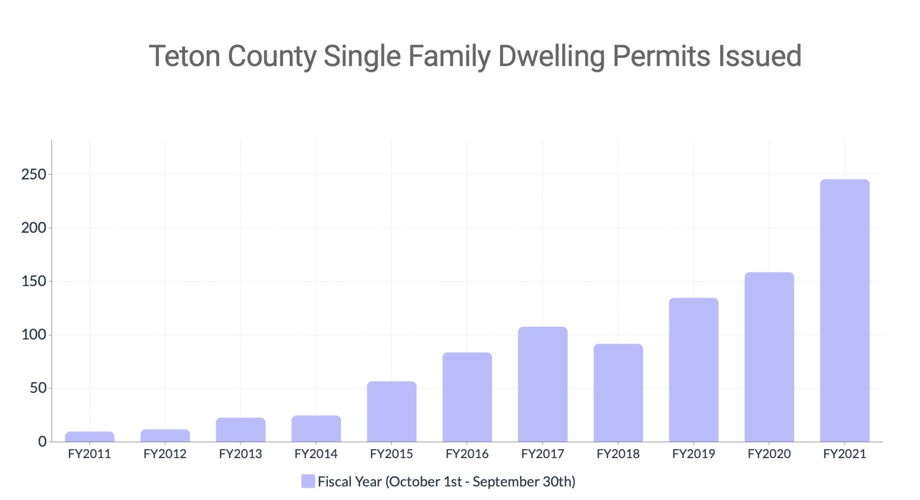
The single-family dwelling permit component saw the largest increase from FY20 to FY21, jumping from 156 permits issued to 246 permits issued in Teton County.
The pace of new building permits issued is not slowing down — 246 building permits have been issued since Oct. 1, 2021, 136 of those being single-family dwelling permits.
Danielson elaborated on what the Teton County data says about the current state of building and building permitting in Teton County.
“I think that it shows that we are definitely in another upward trend of new homes being permitted and built,” Danielson said. “We did issue more building permits in the calendar year of 2021 than we did in 2007 (calendar year, 378 permits total) which was the last boom.”
She continued: “This is definitely, by far, the most activity that I’ve seen being with the building department.”
Danielson has been with the building department for 14 years.
Concerning the national census data, Danielson was impressed with the study and said it goes against traditional beliefs about housing growth in the state.
“Typically we hear about Ada County and some of the western Idaho counties,” Danielson said. “I don’t think I have seen a study that was that comprehensive before. I was surprised to see that we were up there.”
What wasn’t a surprise is that Madison and Teton counties were experiencing similarly high levels of growth.
“I knew that Madison County and Teton County were kind of paralleling each other in a lot of ways with that trend,” she said. “I knew that they were pretty crazy, too. It will be interesting to see if the trend remains the same for the two counties to mirror each other or if one will have any downward trends before the other.”
The relatively large single-family dwelling unit increases are due to county zoning regulations requiring the lower densities those projects offer versus other types of housing.
“Victor and Driggs, within city limits, have zoning districts that allow multi-family where the county doesn’t with the idea being that the density will be the driving factor on those,” Danielson said.
She is seeing those permits be shared more evenly throughout the county’s land area, although in the past the northern side of the valley had seen a majority.
“Initially there was a lot more going on out in the north end than there had been before, but some of that had to do with there being more availability of the property out there,” Danielson said. “More recently it is pretty well distributed throughout the county.”
Even though it is not her jurisdiction, through conversation with Driggs and Victor staff Danielson has heard that things are just as hectic in the cities.
“Since they have their own systems, their own tracking, they do their own inspections, I don’t really have a good idea of what their numbers are like but from talking with staff and driving around I think they are probably busier than they ever have been in the last 10 years,” Danielson said.
Danielson expects that the rush of applications that occurred in the run-in to the new land development code (LDC) being approved will subside as more people become educated on the LDC’s effects.
“I think that a month ago the lack of understanding of what the new code would and wouldn’t allow was driving people to submit building permit applications so that they would be able to have the permit to do what they wanted to do in case the new code prevented it,” Danielson said. “Now that the new code has been approved and will go into effect next week, the education of the public, and myself, to be honest, it is not as restrictive as people were afraid it would be.”
She expects that permit numbers will cool off a bit as the LDC is implemented.
“Honestly, for the building department, I would think that things will slow down to the status quo,” she said. “Building permits will be driven by what people want to do instead of being driven by the fear of not being able to build and wanting to get something in place so that they could.”



(0) comments
Welcome to the discussion.
Log In