





The male wood duck is one of the most beautiful birds on Earth. We’re lucky we can see them almost any day of the week, any time of the year, in Kathryn Albertson Park. They love to hang out under the cover of overhanging trees along the south edge. The females are pretty cool, too, in the classically understated way of female birds.
The wood duck is one of seven species of North American ducks that regularly nest in natural cavities. The others are the hooded and common mergansers, common and Barrow’s goldeneyes, bufflehead, and black-bellied whistling-duck.
I love the colloquial names of birds, and those of ducks are especially rich. They have deep historical roots in the cultures of hunters on both sides of the Atlantic. Some of the old names for the wood duck are summer duck, acorn duck, tree duck, branchier and squealer.
Summer duck comes from the fact that they are the only wild duck that nests in the summer in the southeastern U.S. Acorn duck, tree duck and branchier come from their affinity for trees and for eating acorns, and around here, the fruits of Russian olive. You can see them jumping onto branches of oak trees and clambering around like parrots to get those nuts. They have claws on the ends of their ducky feet to enable that monkey-like behavior.
“Squealer” is from the females’ plaintive cries. They seem perpetually perturbed, uttering loud squeals in flight and even while seemingly chilling out in the shade of a wooded pond.
Because wood ducks nest in cavities, they take readily to nest boxes. The construction and placement of boxes for this species is a traditional conservation project across the country. This activity started in the late 19th century when wood duck populations were declining due to overharvest, deforestation and loss of wetland habitats.
Populations rebounded after the Migratory Bird Treaty Act of 1918 with Canada was enacted. This increase has continued to the present day. The population trend from 1966 to 2022 — in the most recent analysis from the Breeding Bird Survey — shows a positive trend of 1.09% per year, which is quite good.
In addition to ending the overshooting of the birds, wildlife conservationists took steps to allow the recovery of beaver populations. Beaver had been nearly annihilated by trapping. They are keystone species in many ecosystems, building dams that create ponds which have a variety of long-term benefits to the environment. A pond surrounded by woods is perfect wood duck habitat. And this is exactly their habitat right here in Kathryn Albertson Park.
Building and placing nest boxes is a perfect project in many ways. First, it’s super easy compared to other actions, such as restoring habitat, changing laws, establishing refuges or changing public opinion.
Second, a nest box project typically shows almost immediate results as ducks move into boxes. This is very satisfying for the people involved. But there are also issues. Just because there are ducks in a box doesn’t mean they’ve successfully raised young birds. Of course, that’s the real goal.
Boxes also get taken by other species seeking a safe spot to raise young. We don’t mind giving up a few boxes to western screech-owls, northern flickers or even flying squirrels. But the real competition usually comes from gray squirrels in the East and fox squirrels Out West.
Another problem is that boxes are easy to make and put up, but equally easy to forget. I have seen countless wood duck and other boxes falling apart in the woods in many places across the country. This isn’t necessarily bad — a dilapidated box doesn’t really hurt anything — but it makes the value of boxes short-lived. Maintaining and cleaning out boxes after the breeding season results in more nests, eggs and ducklings in the long run.
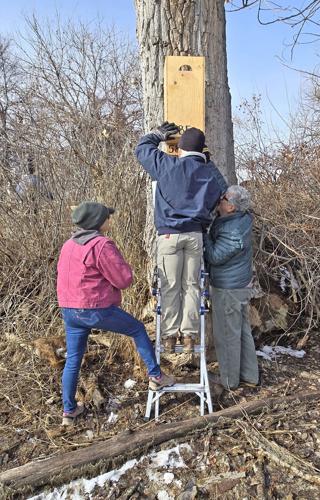
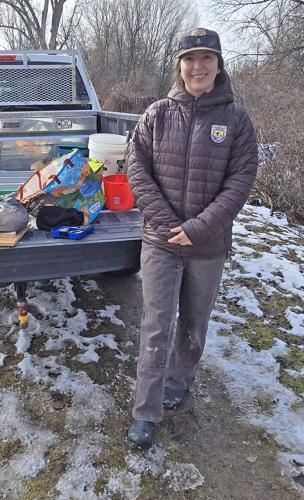
All of this came to mind when we visited Deer Flat National Wildlife Refuge a few weeks ago, where we ran into a crew putting up new nest boxes along the East Dike Road. Boxes have been there seemingly forever, in various conditions, from fine to falling apart. At least one had been blasted by the shotgun of some slob “hunter,” giving the entire hunting community a bad name.
We’ve hiked and birded the East Dike Road countless times over all seasons and many years. The only thing I’ve seen in a box is a western screech-owl. But it’s impossible to know what’s in those boxes unless you have a camera on a pole with which you can peer in. Nesting birds (and mother squirrels) sit tight, keeping a low profile against predators.
The only natural wood duck nest site I know of is in a tree at Barber Park, about 30 feet off the ground. My wife, dog, and I were standing on the edge of the Boise River when a female wood duck came rocketing in over our heads and disappeared into a hole in a tree. I still don’t know how she slowed down enough to enter that small cavity with so much grace.
Birds are known to nest as high as 60 feet off the ground. Those nest sites are typically very secure. Nothing I can think of, at least in North America, can reach those cavities.
But what of the young birds that hatch high over the ground? When they are ready to leave the nest, the female calls to them. Chicks typically leap from the cavity with their downy feathers and light weight slowing their descent. They also have flexible bones at that age. Whether they land on the ground or in the water, they tend to end up just fine.
But some ducklings get better treatment. E.G. Kingsford (1917) was camping near a wood duck tree nest in Michigan and wrote, “…one morning before sunrise she flew by from the tree to the river with a little duck in her beak… She then made 10 or 12 trips to the nest and each time took a little duck in her beak by the neck to the water, where all were huddled in a little bunch.”
Better yet, E.F. Pope (Bent 1923) wrote from Texas, “She emerged from the cavity in the stub with a young duck on her back and simply dropped straight down into the water… When she arrived within a foot or two of the surface she suddenly assumed a vertical position which caused the duckling to slide from her back into the water. She … “repeated the performance until the whole brood of 10 were on the water.”
Those were some lucky ducks.



(0) comments
Welcome to the discussion.
Log In