

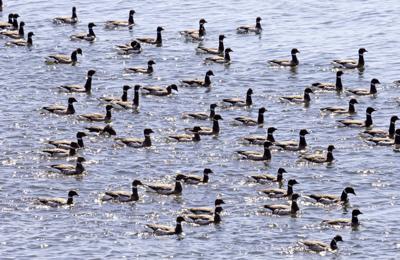
The state Department of Fish and Wildlife has announced a three-day hunting season for brant geese in Skagit County.
Hunting will be allowed Saturday, on Jan. 24 and on Jan. 27.
A count of more than 3,000 brant in Skagit County allowed the three-day hunting opportunity. Hunting will also be open Feb. 3 for youth, veterans and active military.
The requirement for a brant hunting season was just barely reached as 3,048 geese were counted. It’s the seventh consecutive year fewer than 6,000 brant have been counted in Skagit County bays.
“We squeaked by on account of just barely getting the numbers needed,” Washington Brant Foundation founder and Fir Island resident Maynard Axelson said.
Hunters must have a valid migratory bird authorization and a brant harvest reporting card.
Brant are a migratory species of goose with a sleek black head, white neck marking, and distinct brown and black body feathers with striking white flank feathers.
They winter in coastal bays, estuaries and lagoons where they eat eelgrass, sea lettuce and other aquatic vegetation.
The past two years, fewer than the needed 3,000 brant were counted, keeping there from being a season in Skagit County.
In 2021, the count was 2,481 brant, the second lowest count in the 71-year history of the survey.
“During the 2022 nesting season in the Arctic, that’s when avian influenza was in a widespread outbreak and had negative effects on reproduction resulting in lower numbers of young birds for fall migration,” Axelson said.
The number of hunting days allowed is related to how many brant are counted during the surveys.
“While we strive to provide harvest opportunity when appropriate, population counts below the 3,000-bird threshold require us to restrict opportunities for hunting this unique coastal waterfowl species to meet our conservation objectives,” Fish and Wildlife Waterfowl Section Manager Kyle Spragens said in a news release.
Numbers ticked up this year, and Axelson believes a decrease in avian influenza as well as changes in the climate could be factors as to why.
“In 2023, (avian influenza) was much less widespread and so there was more of a normal breeding season with more young birds added to the fall migration,” he said. This was also evidenced here this fall and winter, where so far, the bird flu has been much less widespread compared to a year ago with not near the previous outbreak in the wild population.”
And the climate piece of the puzzle?
“It started out as a very warm fall, however, recent colder weather could have possibly pushed a few more birds down our way from the Cold Bay area in Alaska where they gather in the fall,” Axelson said. “Population levels are good, but recent warming has resulted in large numbers of birds spending the entire winter at Izembek National Wildlife Refuge at Cold Bay, Alaska, located at the beginning of the Aleutian Islands. This has led to smaller numbers migrating down the coast to our area.”

(0) comments
Welcome to the discussion.
Log In