

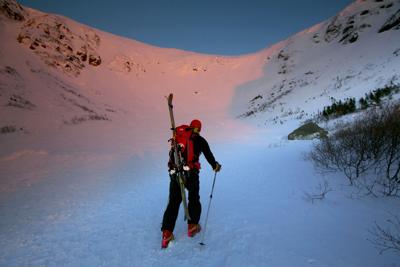
The appeal of backcountry skiing goes deeper than untracked powder. For many skiers, the most attractive parts of hiking up a mountain before skiing back down is the way the pursuit enriches their outdoor experience. In addition to the rush downhill skiers crave, the freedom to explore nature, the necessary technical skills and the physical demand combine to make backcountry skiing a rewarding challenge.
‘Everything is just new’
Kristen Schiel, a USU student, says backcountry skiing rekindled her love of skiing.
From the Salt Lake area, Schiel says she started skiing at a resort as a child. As time passed, she started wishing for something more.
“Once I was in my teenage years, I actually was just getting really bored of the resorts,” Schiel says. “I felt like I was just sick of skiing.”
Her boyfriend at the time introduced her to alpine touring. As she learned about avalanche safety and hiking for her turns downhill, it revitalized her interest in the sport.
“It reopened skiing for me as a passion,” Schiel says. “It was cool because you got to go to places where so few people were. It really was like being alone in the mountains again.”
One of the most appealing things about backcountry skiing is the way it opens up the mountains. A ski lift isn’t necessary, and areas that hikers might have a hard time reaching are attainable by ski, Schiel says.
“The cool thing about backcountry skiing is that you can really access so many different parts of the mountain that are even hard to get to in the summer, because you’re just on top of the snow,” Schiel says. “You really can look at a map topographically and just pick out a ridgeline, and you can access it that way once you’re on skis.”
Snow changes a mountain in more ways than covering obstacles. Brian Shirley, USU’s Outdoor Recreation Program coordinator, says mountains in winter can be even more peaceful than they are at other times.
Shirley recalls stopping during a recent ski trip in a spot he’d visited in late fall. He says he was moved by the difference in atmosphere.
“I listened, and I could hear nothing. The wind had died, and there was no noise,” Shirley says. “And then I kind of watched myself back three months to that point when I was standing (in the same spot). There were flies everywhere. I could hear some sheep … which was cool, but I was sweating a little, and I had dirt in my shoes then. And now I’m in ski boots, I’m standing on top of this beautiful white snow. Everything is just new.”
Experiences like that are the driving reason behind his backcountry pursuits, Shirley says. People naturally seek connections with nature.
“There’s something deep in our psyche that draws us there over and over,” Shirley says.
It’s not just about the downhill
The siren call of first lines through deep powder pulls many skiers to the backcountry originally, but enjoying the slog uphill is a big part of the sport. There’s a major pace difference between getting up the mountain and getting down — backcountry skiers usually only see a handful of minutes going downhill for every hour they spend hiking up. The hike — or the tour — can be its own reward, Schiel says.
“I think the reason why I backcountry ski so much is that I really enjoy the hike,” Schiel says. “Which is a really important part, because you spend 80 percent of your time hiking. A lot of people who are just all about the down aren’t going to ever going to be into alpine touring.”
Since the backcountry is ungroomed, unexpected conditions can even ruin a skier’s chance of enjoying downhill runs, Shirley says. But most of the adventure comes from hiking up, across and through secluded mountain areas, he adds.
“When avalanche conditions are bad, or snow conditions aren’t fun skiing, there’s always great touring,” Shirley says. “Especially with our (valley) air quality.”
Earning your turns
Winter inversions in Cache Valley can severely limit a person’s options for an outdoor workout. In the mountains, however, the air is usually a lot cleaner — good news for backcountry skiers.
“Physically, it’s demanding,” Shirley said. “It’s a stronger cardio workout than you’ll get in most other venues.”
Shirley says he learned a good illustration of the sport’s rigors from a soccer player he skied with a few times. His friend had just finished his four years of eligibility in Division I collegiate soccer, playing midfielder, and his friends invited him to go alpine touring.
“He was a mediocre skier , but a super-fit athlete. And he said it was the hardest workout he’d ever had in his life, to keep up with his friends. Because it’s a totally different set of muscles, and you’re using balance, and cold air.”
SKIING AND MOUNTAINEERING, REUNITED
It’s not just hard physically. The technical challenge of the backcountry in winter adds another layer of appeal to the sport. In addition to downhill skiing skills, myriad other mountaineering techniques are important to a backcountry skier. They make their own trails, and picking the best ski route up a mountain requires both experience and experimentation.
The right clothing is crucial. Lugging ski gear up a mountain through heavy powder makes you sweat regardless of the temperature. A light, sweat-wicking layer keeps skiers comfortable on the way up, while warmer, more weather-resistant layers keep the wind from freezing them on the way down.
People think backcountry skiers must like the cold, but cold isn’t so much of a problem, Shirley says.
“The truth is, rarely am I cold … because the cardio is so intense the entire time you’re out, you’re just warm,” he says.
Predicting snow conditions is important, as well. At a ski resort, snow is groomed and sometimes manufactured to ensure good conditions, but backcountry snow is shaped by nature and constantly changing. Several factors influence how good the snow is for skiing on any given slope at any time, including air temperature, cloud cover, wind, slope angle and which direction the slope is facing. Most backcountry skiers keep an eye on weather- and snow-related websites to help them decide when and where to ski.
As Shirley puts it: “You become your own weatherman. You become pretty careful about understanding conditions. You don’t just show up at a mountain, like you do at a resort.”
IT’S DANGEROUS TO GO ALONE
Though understanding snow conditions helps backcountry skiers predict how fun slopes will be, the knowledge is even more crucial for avalanche safety. According to the Utah Avalanche Center, avalanches most commonly occur as a result of layers in snow — new snowfall or wind drifts can bury weaker layers of snow. The weak layers can give way under a skier’s weight, and the snow slides down the mountain as a slab.
Over the past 10 winters, the Colorado Avalanche Information center has recorded 90 skier avalanche deaths in Utah. On backcountry slopes, skiers need to be aware of the danger and actively looking for warning signs. Even if a slope looks tempting, if it’s the wrong incline under the wrong conditions, it’s best to be wary.
The Utah Avalanche Center supports backcountry skiers in the area, Shirley said. The center monitors conditions which may elevate avalanche risk and provides training for skiers and snowmobilers. Knowledge and preparation can help skiers avoid avalanches and increase chances of rescue if one occurs.
While the buddy system is recommended across all outdoor pursuits, avalanche risk makes it especially relevant to backcountry skiers. Most avalanche fatalities occur as a result of carbon dioxide poisoning, as the air the victim exhales is trapped in the snow nearest their mouths. According to the Utah Avalanche Center, victims have a 93 percent survival rate if someone digs them out within 15 minutes, but only 20-30 percent after 45 minutes. Unless a victim has a partner trained in avalanche rescue close by, there’s not much hope for survival.
Even though they’re looking to get away from crowds at the resorts, Shirley says most backcountry skiers he knows don’t go alone.
“I think that’s one misconception about backcountry skiers, is that they’re antisocial,” Shirley says. “It’s the opposite. It’s that they’re really in tune with that desire to have deeper connections with people. So there’s a deeper connection that forms with people when you ski together in the backcountry.”
WHAT KEEPS SKIERS COMING BACK
Even when skiing in a group, there are chances to be alone in nature. On flatter trails, Shiel says, skiers’ different paces often let them spread out quite a bit before meeting up later. In those moments, you feel a greater sense of connection with the area.
Shirley, whose job means he’s often taking beginners into the backcountry, says the need for connectedness gives the sport broad appeal.
“There’s something deep in being humans, in being part of the planet, that we have a desire to somehow connect with where we are,” he says. “That concept runs through most humans — even if they’re scared of nature, in some way they want some kind of connection.”
Winter backcountry touring often leads to moments of beauty, Shirley says.
“There’s that moment where you feel like you’re the only one experiencing it — there’s something really personal about that,” Shirley says. “You’re standing on this ridge, and you’re looking over this beautiful vista, valley, with snow, and the big spiral-cathedral kind of sub-alpine firs, and they’ve got that rime on them. And there’s just a moment when the sun’s hitting your face, and it’s a February day, and it’s 15 degrees. You’re looking at 2 feet of powder, fresh snow, below you. There’s some really deep, personal connectivity to that place, to that moment … it’s not re-creatable. It’s only available there.”
_______
Humans have been using skis for roughly 10,000 years, according to National Geographic, so it’s understandable that giving precise definitions of different ski methods can be a challenge. A simple way to look at skiing breaks it down into two groups — resort skiing and backcountry skiing. Backcountry skiing can be broken into several more categories, including cross-country, telemark, alpine touring, boot-pack skiing, snowcat skiing and heli-skiing. The most popular method of backcountry skiing is alpine touring, often abbreviated as AT.
AT is like resort skiing in many ways. The big difference isn’t location — many local skiers use AT gear to hike up Beaver Mountain before the lifts open — but in that AT gear is used to travel uphill as well as down. Anyone who’s spent more than a few minutes on downhill skis knows that without special gear, they don’t slide uphill. AT skiers put ascension skins on the bottom of their skis, which allow the ski to slide forward but not backward. The heel of AT bindings unlock to allow the user to hike on the ski. AT boots are more flexible for the hike up, but can be locked down to make them more stiff like a resort-skiing boot, giving the skier better control on the downhill.
Cross-country ski gear is designed to cover gentler terrain than AT, but with much greater efficiency. While ascension skins can be used in cross-country to hike up steeper slopes, the ski’s narrow, straight design and the lack of a downhill binding makes it extremely difficult to control downhill on steep slopes. So while AT gear is heavier and more tiring to use uphill, using it downhill is its main advantage.
Backcountry snowboarding is growing in popularity as well. Many boarders use snowshoes to access the slopes, strapping their boards to a backpack. A more recent innovation is the split-board, a snowboard that splits into two ski-like halves. Split boarders use ascension skins to hike up the trail, then lock the halves of the board together for the downhill.
___________
Steve Kent is a copy editor at The Herald Journal. He enjoys outdoor pursuits, including alpine touring in the Bear River mountains and rock climbing in Cache Valley canyons. He lives in Logan with his wife and daughter. You can reach him by email at skent@hjnews.com or follow him on Twitter @StevenDKent.

(0) comments
Welcome to the discussion.
Log In