

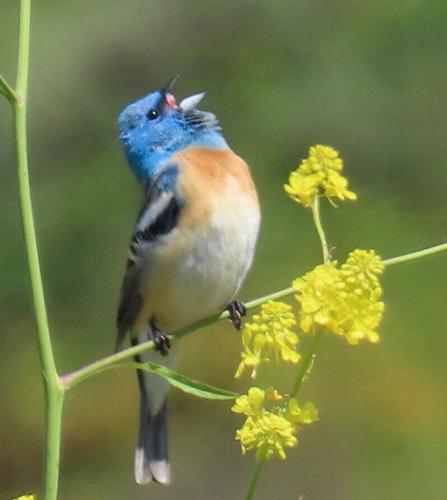



Bird song is beautiful and fascinating. I love hearing the first songs of returning lazuli buntings, western tanagers and Bullock’s orioles this time of year. And it’s fun to chase down some mystery singer until you figure out what it is. But mostly I simply enjoy my surroundings more when they are filled with bird song.
We commonly think of a song as a series of musical notes that are pleasing to the ear. But it’s also a functional category. Although many female birds sing some, most song is produced by male birds both to attract females and to fend off other males.
The other common term for bird vocalizations is “call.” Many calls are single, simple notes, but the category includes a huge array of other vocalizations. Calls are often given when birds want to maintain contact with a mate or member of a flock. Some of these are, in fact, termed “contact calls.”
But some calls serve as songs. The “long call” of the northern flicker is a series of loud, simple notes. Most people would not consider this to be a song, but it is the vocalization male flickers give during the breeding season. Functionally, it is a song.
Many songs are distinctive. For example, I don’t think anyone would mistake the song of the western meadowlark as that of any other species. Having just heard eastern meadowlarks again in Missouri in April, I’m struck by how different the songs of even these two closely related species are.
On the other hand, songs of some species are pretty similar. When I’m in lower mountain forests where both species occur, I have to think a bit about whether I’m hearing a Cassin’s finch or a house finch. And if you mix in some warbling vireos, you can have several individuals of three species with similar songs all going at once. Sorting these out should help keep the brain nimble.
Birders often become very good at distinguishing similar songs. The more experience you get, the easier it is to hear differences in what species are doing. Birders can also learn to distinguish among calls, but that is more difficult. Single, “chip notes” are often much alike. And because they are so short, they don’t give you much information to work with. But they all have subtle qualities that give the species away. Around here, you can practice on the reedy chip of the song sparrow and the softer and flatter chip of the yellow-rumped warbler.
Nathan Pieplow, author of “Field Guide to Bird Sounds of Western North America” (2019), describes the song sparrow’s most common chip note as “vimp,” “nasal and slightly burry.” He also says it can sound “polyphonic.” That’s when a bird makes two sounds simultaneously (see below). Song sparrows also have calls described as “tseet” and “tink.”
Pieplow describes the yellow-rumped warbler’s most common chip note as “chwit,” “low, seminoisy, and upslurred.” Yellow-rumps also give “sreet” and “tink” calls. These names may cause a reader to think, “whatever.”
But Pieplow isn’t just messing around. Both of the species I’m talking about here have a “tink” note. That’s a classification that holds across species. Many sparrows have a “tink” note. Other note types among sparrows include “psit,” “tsit,” “pink,” ‘tsew,” and “smack.” Even now, you might imagine how a “tink” is different from a “smack.”
Pieplow creates a number of other categories for grouping songs. I particularly like his idea of separating songs into these two groups — notes delivered too fast to count or notes delivered slowly enough to count. He presents another binary choice with two more groups — consecutive notes are the same or consecutive notes are different.
When you apply both of these simple screens, you get four groups: 1) Phrase — notes slow enough to count and all different, 2) Series — notes slow enough to count and all the same, 3) Warble — notes too fast to count and all different, and 4) Trill — notes too fast to count and all the same.
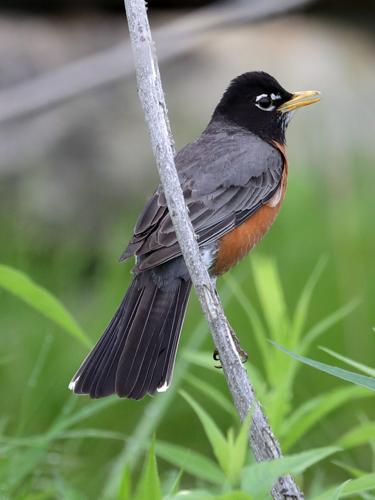
Examples of these around here are 1) American robin, 2) rock wren, 3) house finch and 4) chipping sparrow. One lingering problem is that many species’ songs end up in the category of “warble.” So, we have to dig deeper for additional factors to sort them out. Many species warble, not just the warblers (family Parulidae). Hope that helps.
Factors for helping us disentangle all the warbles out there include tone quality. Pieplow boils these down to seven different qualities — whistle, hoot, tick, buzz, noisy, nasal and polyphonic.
Whistles are clear notes given without noisy bits or buzzes. Think American robin. Hoots are obvious — great horned owl. Tickers are rare. Listen to yellow rail. Buzzes are sort of the opposite of whistles. Check out black-throated gray warbler. Noisy songs have many tones delivered at once. Try yellow-headed blackbird. Nasal qualities are rare generally but common among the nuthatches. Pick a species.
Finally, polyphonic vocals are intriguing because they arise from two sounds being produced at the same time by birds’ specialized vocal apparatus, the syrinx. My favorite species in this group is the Montezuma oropendola. Closer to home, the flight song of the western meadowlark is full of polyphonic notes. These are quite different from their whistled song and “teer” calls. Listen to vocalizations at All About Birds and Xeno Canto.
Finally, it’s helpful to realize that most taxonomic orders of birds have innate vocalizations. That is, they are born with their songs and calls. Only three orders — the hummingbirds, parrots and songbirds — learn their songs are they grow up. Young birds copy notes from adults, neighbors and even other species as they build their personal songs. This means that there is way more variation among song learners. So, for example, every song sparrow is a little different, while every Say’s phoebe sounds the same.
A lot of people out on the trails are listening to something on their phones. I can’t imagine any human words, spoken or sung, that are more wonderful than bird song. Michael Bassey Johnson writes, “When you go to say hello to nature, put every redundant sound away, for nature is music, and that alone should suffice.”
But, if you live for music, check out Appalachian Spring by Copland and Pastorale by Beethoven. I don’t listen to much classical music these days, but when May rolls around, I am compelled to listen to these masterpieces again.
I still prefer to listen to the earth when I’m out in the wilds. The chat and the bunting are sweeter to my ear than the flute and the oboe. The wind in the cottonwoods more soothing than a hundred violins.

(0) comments
Welcome to the discussion.
Log In