

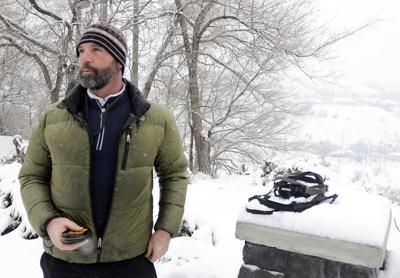
With a layer of “weak” snow at its base, Northern Utah’s snowpack could be setting up for more unpredictable avalanches this winter.
“The snowpack this year is really weak,” said Toby Weed, an avalanche forecaster for the Logan Ranger District. “It’s not looking good right now. When we get more snow we’ll have dangerous conditions.”
Although not much snow has fallen so far in the region, most of what’s on the ground is what Weed considers “weak” — “sugary” crystals that make for an unpredictable layer under whatever snow comes during the rest of the winter. That doesn’t necessarily point to more slides, he said, but it does make slides harder to predict.
Hundreds of slides were reported last weekend, although none were in this area. None led to fatalities, in spite of “a couple of close calls,” but already this season is shaping up to potentially be as hazardous as the winter of 2008-09. At least 12 people were killed in avalanches that year in the Western U.S. and Canada, including two Cache Valley snowmobilers.
So far the snow in the Bridgerland area is so thin that snowmobilers haven’t been out much, but Weed worries that the next storm may hit during the Christmas holidays.
“Unfortunately, that (next storm) will probably happen right about the time people want to get out in the snow,” he said. “Everything is suspect right now.”
One big key is ongoing education efforts, according to Paige Pagnucco, an education specialist with the Utah Avalanche Center. The Avalanche Center is a partnership between the U.S. Forest Service and other state and local agencies, and its website, www.utahavalanchecenter.org, provides daily updates on conditions, as well as safety tips for those planning to venture into the backcountry.
Pagnucco said more backcountry users — snowmobilers, skiers, snowshoers and the like — are becoming familiar with the locations and snow conditions most likely to result in an avalanche, and snowmobile manufacturers are offering better gear to prepare people to go out. Still, more people could benefit from specific training, such as the on-the-ground classes offered by the Avalanche Center.
“The formal education is still a little lacking sometimes, but that comes with time,” she said. “Most people around here know the Avalanche Center exists, and they know avalanches are possible.”
The center is relying more on social media outlets such as Twitter, Facebook and Youtube to get out the message. “We’re trying to increase the availability of the word, and it seems to be working,” Weed said.
That includes inviting recreationists to participate by reporting their location-specific observations of slides or snow conditions. Once those reports are posted on the center’s website, Pagnucco said, “It’s a really easy way to get a sense of what’s going on out there.”
Even when slide risks are not high, Weed and Pagnucco recommend choosing terrain carefully when recreating.
“You can still have fun on lower-angle slopes,” said Pagnucco, “but you don’t want to be on or underneath steep slopes.”
Weed agreed that avoiding slopes of 35 degrees or more, particularly when they’re drifted, “is a good way to stay alive.”
Weed said slides, although rare, do occur along the River Trail and in lower Green Canyon, where many people walk dogs and recreate with children. The worst are the “slab avalanches,” in which large sections of snow break loose and crash down the mountain before setting up into a surface that resembles cement.
Experts recommend that recreationists always carry safety equipment such as beacons, probes and metal shovels, and practice using them before going out. Weed advised anyone planning to go into areas that might be dangerous to take an avalanche class, and to call the avalanche hotline (toll free 888-999-4019, option 2 for the Logan area) before heading out.
“Especially this year, people are going to need to make really conservative decisions,” he said, “because the snow is going to be tricky.”
————
For more information: http://utahavalanchecenter.org/
Signs of danger
Logan Ranger District avalanche forecaster Toby Weed recommends family members go over the following questions with their loved ones before they go into the backcountry.
Any single warning sign from this list can indicate a potential avalanche situation; multiple indicators show a high possibility of a slide.
— Recent avalanches — If there are new avalanches, more are possible.
— Signs of unstable snow — Shooting cracks, collapsing or “whumpfing” noises, or hollow, drum-like sounds.
— Heavy snowfall or rain — Recent, significant snowfall or rain can make the snowpack unstable. Avalanches are often triggered directly after a storm.
— Wind drifting — Windblown snow can load slopes even when it’s not snowing.
— Rapid warming — Warm temperatures can cause snow to become saturated and less stable.
— Severe consequences — If you get caught, could an avalanche carry you into trees or other terrain traps like gullies or cliffs below?
— For current avalanche conditions and more information on avalanche safety in the backcountry, go to http://utahavalanchecenter.org/
If you see a slide:
Forecasters ask that anyone who sees an avalanche call or e-mail the details to 1-800-662-4140, or uac@ utahavalanchecenter.org. That information helps them form outlooks and provides critical information about snow conditions.

(0) comments
Welcome to the discussion.
Log In