

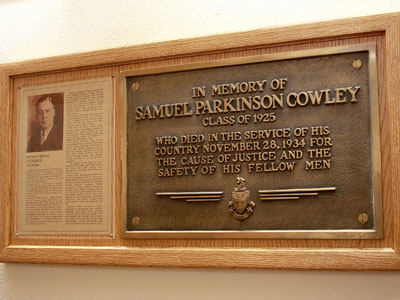
The stone monument sits directly in front of the CenturyLink building in Franklin, which seems appropriate inasmuch as the small plaque on the front links this century with last.
Thanks to an effort spearheaded by former mayor and chairman of the Franklin Pioneer Association, Brent Atkinson, the historical marker was placed there last summer, less than two months before Atkinson died from leukemia.
Three paragraphs and a couple of photographs tell the story of Samuel Cowley, who was born near the site of the stone monument just before the turn of the century in a home that no longer exists.
As the first permanent settlement in Idaho, Franklin residents are certainly no strangers to historical commemorations. But for a visitor who might just happen to wander across U.S. Highway 91 from La Tienda to read the plaque, they might be surprised to discover Samuel Cowley wasn’t a pioneer or a cowboy.
And while he was a lawman who died from wounds suffered in a shoot-out with a notorious outlaw, Cowley didn’t go down in a blaze of glory on the dusty streets of a small town in the American West.
Rather, he was regarded a national hero after meeting his premature demise at the age of 35 in a small town just outside of Chicago.
“This sacrifice was not just a magnificent demonstration of momentary heroism,” J. Edgar Hoover said in the years following Cowley’s death. “It was the culmination of the greatest adventures in moral courage — a truly moral life.”
———
Samuel Parkinson Cowley was born July 23, 1899, to Mathias Cowley and Luella Parkinson, one of Mathias’ four wives. A member of the LDS Church’s Quorum of the Twelve Apostles from 1897 to 1905, Mathias Cowley ended up stepping down from his calling due to his continued involvement with polygamy. Matthew Cowley, another of Mathias’ sons and a half-brother to Samuel, later served as an apostle, as well.
After attending school at the Oneida Stake Academy in Preston, Samuel Cowley later went to high school in Logan. He embarked on a four-year LDS mission to Hawaii when he was just 17, then returned to Cache Valley to attend Utah Agricultural College (now Utah State University), where he studied economics and was a member of the Sigma Chi Fraternity.
Cowley graduated in 1925 then went on to law school at George Washington University in Washington, D.C. He married Lavon Chipman in 1929 in the St. George LDS Temple, and the couple had two children, John and Samuel Jr.
In need of employment in the midst of the Great Depression, Cowley ended up signing on with an investigative unit operating out of the U.S. Department of Justice — known by several different names before officially becoming the Federal Bureau of Investigation in 1935. Cowley and his young family moved several times over a four-year period so he could work out of various field offices around the country.
Eventually Cowley was transferred to Washington, D.C., where he worked out of the bureau’s headquarters on several high-profile cases like the Lindbergh baby kidnapping and the manhunt for Pretty Boy Floyd.
But soon, the majority of J. Edgar Hoover’s focus would be directed toward Chicago and the growing notoriety of “Public Enemy No. 1” — John Dillinger. The leader of a gang that robbed four banks and killed 10 men in just 10 months, Hoover was desperate to bring the country’s most notorious criminal to justice and felt Samuel Cowley was the right man for the job.
“Find John Dillinger,” the longtime bureau chief told Cowley. “Stay on him. Go anywhere the trail takes you, and capture him alive, if you can. But protect yourself.”
Working out of the Chicago field office with Melvin Purvis in 1934, Cowley studied Dillinger’s every move, and eventually, working on an inside tip, he and Purvis and their special group of agents orchestrated an ambush at the Biograph Theater that led to Dillinger’s death on July 22.
Dillinger’s demise led to the ascension of a new “Public Enemy No. 1” — George “Baby Face” Nelson. A member of Dillinger’s gang, Nelson had killed a special agent in April, and Hoover directed the newly promoted Inspector Cowley to concentrate on bringing in the 25-year-old.
It wasn’t until November the bureau received information that Nelson, his wife, and another criminal, John Paul Chase, were traveling just north of Chicago in Wisconsin. Nelson’s car, adorned with Illinois license plates, was soon spotted by two agents, who then called Cowley to tell him they were in pursuit of the vehicle as it headed south.
Eventually two more agents, William Ryan and Thomas McDade, converged on the area, with Cowley and agent Herman Hollis close behind. Ryan and McDade were the first to meet up with Nelson, who managed to turn the tables by virtue of superior firepower. The agents somehow managed to hit the radiator of Nelson’s car with a bullet from a revolver, however, forcing the gangsters to the side of the road near a park in Barrington, Ill.
That’s when Cowley and Hollis arrived, and the duo was promptly greeted by heavy gunfire from Nelson’s machine gun and Chase’s automatic rifle. Armed with a shotgun, Hollis got off 10 shots before being hit, while Cowley is believed to have fired more than 50 rounds before going down.
With Hollis dead and Cowley severely wounded, Nelson, his wife, and Chase commandeered the agents’ vehicle and escaped.
In a recent talk by Samuel Cowley Jr., who was just 8 months old at the time of the “Battle of Barrington,” he said one of the first people on the scene later wrote his mother to tell her what the mortally injured agent had said to him.
“’Did they get Hollis? If so, help him. Forget me.’ These words coming from a man, who himself was fatally wounded and in great pain, proved to me an ideal, self-sacrificing American really did exist and this fact has been on my mind ever since,” he said.
Despite undergoing surgery at a nearby hospital, Cowley died early the next morning, on Nov. 27, 1934.
The body of “Baby Face” Nelson was found the same day, his body riddled with 17 bullets. His wife and Chase, who eventually ended up at Alcatraz, were brought into custody shortly afterwards.
Before being buried at Wasatch Lawn Cemetery in Salt Lake City, Cowley’s body laid in state at the Utah State Capitol building and several state and federal leaders and LDS general authorities spoke at his funeral. His wife, Lavon, ended up working for the FBI for many years, raising her two sons before finally remarrying some 30 years following her husband’s death.
It was during an interview nearly two decades after the shoot-out with Nelson, though, that J. Edgar Hoover famously referred to Samuel Cowley as “the bravest man I ever knew.”
“I have thought that his name should be Peter,” Hoover said. “He was a veritable rock to those who knew, who loved and trusted him. His was the calm of a man who did his best and left the final decision to a higher power.”

(0) comments
Welcome to the discussion.
Log In