

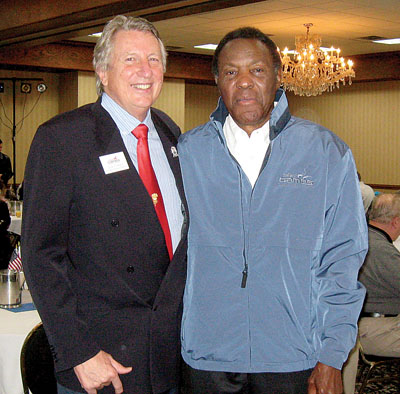
POCATELLO — Rafer Johnson promotes three simple ideas in his autobiography: stay open to suggestion, believe in yourself and realize that you can’t do it all alone.
Johnson, an Olympic gold medalist in the decathlon in the 1960 Olympics in Rome, was the guest speaker during the annual Breakfast With Fosbury and Friends, the traditional kick off to the Simplot Games.
His book, “The Best That I Can Be: An Autobiography,” was published 10 years ago and traces his modest beginnings from a ghetto in Texas to growing up in the all-white, town of Kingsburg, Calif., and then finally his time at UCLA as the president of the student body and as an accomplished athlete.
“I appreciate all the support that I’ve gotten over the years,” Johnson said. “The success that I’ve had has been because of that support.”
Johnson’s talents took him to athletic contests in Moscow, Melbourne, and Rome, and then to acting, broadcasting and politics in Hollywood and Washington, D.C.
In the 1960 Olympic Games, C.K. Yang of Taiwan beat Johnson in six of the first seven decathlon events, but Johnson lead by 67 points, if he came within 10 seconds of Yang’s time in the 1,500 meters, he’d take the gold medal.
But Yang’s personal best of four minutes, 36 seconds was 18.2 seconds better than Johnson’s previous best.
An automobile accident in 1959 benched Johnson for more than a year with a severe back injury. He and Yang trained together when he returned to UCLA in 1960.
Johnson finished only six yards and 1.2 seconds behind Yang, but delivered a personal best of 4:49.7. he won the gold medal and set a then-Olympic record of 8,392 points in the process.
Following the event Johnson told the press, “Tonight I’m going to shower and then just walk for about four hours and look at the moon. I don’t know where — just walk, walk, walk. I’ve got to unwind. I’m through, man, I’m through.”
Johnson employed weight training to boost his throwing ability, a technique not typically used by Olympic trainers in the 1960s.
“Growing up, we all do things that we like, and it doesn’t have to be sports,” Johnson said. “And we all need help sometimes, people helped me along my way.”
He received the 1960 Sullivan Award as the outstanding American amateur athlete of the year and was named the Associated Press Athlete of the Year.
Soft spoken, thoughtful and articulate, Johnson was 25 when he won gold. Following his Olympic achievement, he appeared in movies and worked in broadcasting.
Johnson was active in the 1968 presidential campaign of Sen. Robert F. Kennedy and was in the kitchen at the Ambassador Hotel in Los Angeles with Kennedy when the candidate was shot and killed.
He remained politically active and was involved in implementation of affirmative action.
Johnson served on the President’s Commission on Olympic Sports in the 1970s and is a member of U.S. Olympic Track and Field Hall of Fame.
In 1984 Johnson again took part in the Olympics. As the final torchbearer, he carried the torch up the stairs at the Los Angeles Coliseum and lit the flame that opened the games.
Johnson said he’s been in Idaho before, but it’s his first time in the Gate City and at the Simplot Games.
“Dick Fosbury talked about it a lot,” Johnson said. “It’s an opportunity to influence other young athletes.”
Johnson and his wife, Elizabeth Johnson, have been married for 32 years. They have two children, Josh and Jennifer Johnson. Jennifer competed in the 2000 Olympics as a beach volleyball player.
Britt and Rosanne Ripley shared breakfast with Johnson Friday and it was dream come true for Britt, who said the Olympian had been a big influence on him as a teenager.
Britt was just 15, when his father died and he was struggling.
“I was a young man without direction and was feeling very alone,” Ripley said.
Then he read a magazine article about Johnson and the challenges he had overcome to make it to the Olympic platform.
“It made my problems seem very small,” Ripley said. “It was very inspirational to me. He became my role model. I hung a picture of him on my bedroom wall and it stayed there until I graduated college.”
Ripley also won state honors in high school shot put and discus events.
“I never dreamed I would have a chance to meet (Johnson),” Ripley said. “And in Pocatello, Idaho.”
Simplot Spokesman Rick Phillips said 1,950 high school athletes from 23 states will compete at the Simplot Games, which kicked off Thursday night.
Phillips said the athletes pay a registration fee to compete in the games that are free to the public. Sponsorships from Adidas, Subway and a partnership with Idaho State University help to fund the event, now in its 36th year.
This year the Olympic-style competition will also be the venue for the 400-meter national championship.
“We’ve set records in this event here in the past,” Phillips said.
Phillips said the annual Breakfast With Fosbury and Friends sold out at 400 people.
“This is a chance for people to meet the Olympians,” Phillips said.
Fosbury took over as the honorary chairman of the Simplot Games following the death of Olympian Florence Griffith-Joyner in 1998.
Fosbury, the creator of the Fosbury flop, the back-first method that is now the standard for high jumpers, won gold in the 1968 Olympics held in Mexico City.
“I had early involvement in the Simplot Games as a track fan and then as an Olympian,” Fosbury said.
The first International Track Association professional meet was held in Holt Arena, then known as the Minidome, in 1975, Fosbury said.
The Olympic Games have changed over the past four decades and Fosbury said usually there are as many members of the media at the events as athletes.
“The games have grown to be huge events that invite the fittest people on the planet to compete, but the size has become a problem,” Fosbury said. “The host countries usually do a good job managing it though.”
Following his gold medal performance at the 1968 Olympics, Fosbury said he turned his focus to his career, graduated from Oregon State and moved to Ketchum in 1977 where he started an engineering firm. He retired two years ago.
Originally from Oregon, Fosbury now resides in Bellevue.
“I love Idaho, the environment, blue sky, stars at night,” Fosbury said. “And I love the people and their values.”

(0) comments
Welcome to the discussion.
Log In