

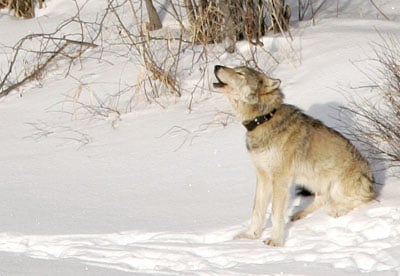
The recent killing of seven collared wolves from various packs around Yellowstone National Park has caused concern among environmentalists and animal rights activists as well.
The destruction of the animals, while technically legal (they are protected inside the park, but not outside its confines) took place on several different days from late October through mid-November. Four were killed in Montana, two in Wyoming and one in Idaho.
Already more than 23 wolves have been killed in areas adjacent to the park. Two were “dispersers” that hadn’t spent much time in Yellowstone of late, but three were from packs synonymous with the park’s wolf history — the Mollies, Blacktail Plateau and Lamar Canyon packs.
The action has polarized different groups — those opposed to such killings and those who want the hunting of wolves to continue, whether for sport or to protect livestock.
“We want to use these incidents as a way to stop the trapping which is scheduled to begin on Dec. 15,” said Jeff Welsch, communications director for the Greater Yellowstone Coalition, an organization dedicated to “protecting the lands, water and wildlife” of the area. “It’s important to understand that we are not opposed to hunting — I hunt myself — it’s just that these were collared and highly studied animals.”
Wolf packs, for the most part, have certain identifiable territories, but some do leave the group to go it on their own, thus the term “lone wolf.” Some of the animals will indeed be solo, or may join with other packs. When these groups come in contact with each other, confrontations do occur. When packs come in contact with man, the wolves usually come out on the short end.
Recently, the large canines were removed from the Endangered Species list and permission to hunt them was given in Idaho, Montana and Wyoming. In less than three weeks, the trapping of the animals will be allowed in those states as well.
As far as wolf hunting in Idaho, no more than two gray wolf hunting tags may be used in the following zones: Salmon, McCall Weiser, Sawtooth, Southern Mountains, Beaverhead, Island Park and Southern Idaho. While no more than five gray wolf hunting tags may be used in the following zones: Panhandle, Palouse-Hells Canyon, Lolo, Dworshak-Elk City, Selway and Middle Fork.
Baiting or hunting big game over bait is illegal, except for black bears. Wolves may be taken incidentally to bear baiting. It is unlawful to hunt wolves within 200 yards of the perimeter of any designated dump or sanitary landfill.
A person must have a trapping license and attend a wolf trapping class before purchasing tags for wolf trapping. Wolf trapping classes will be offered in all regions. Dates and times will be posted on the Idaho Fish and Game website.
Trappers must also check traps at least every 72 hours, same as for furbearer trapping. No more than three gray wolf trapping tags may be used in the McCall-Weiser zone. No more than five gray wolf trapping tags may be used in the following zones: Panhandle, Lolo, Dworshak-Elk City, Selway and MiddleFork.
“Priority No. 1 is the complete banning of wolf trapping — a practice neither Wyoming nor Idaho allows in most of Greater Yellowstone — in hunting units adjacent to Yellowstone, set to begin Dec. 15,” Welsch said. “Further, Montana should consider reducing quotas or eliminating hunts in areas surrounding the park. Yellowstone-area wolf populations have stabilized. Livestock predation has been negligible or, in the case of Gallatin County, non-existent. Population objectives needn’t be met on the backs of Yellowstone wolves.”
He added that many people he knew have become incensed over the incidents, “though not when they were removed from Endangered Species Act protections in Idaho and Montana, not when hunting seasons began in both states, not even when Wyoming was handed management reins — despite a biologically flawed road map that allows wolves to be killed like varmints anytime, anywhere and in almost any manner across more than 80 percent of the state.”
Several organizations which advocate the hunting of wolves, including the National Rifle Association, Sportsmen for Fish and Wildlife and the Rocky Mountain Elk Association (RMEA) were contacted by the Journal in preparation for this article, but only the RMEA responded.
That group sent an e-mail, which read in part, “Unfortunately, we will not make an official comment on the situation in time for your deadline, but we will, in its totality, next week.”

(0) comments
Welcome to the discussion.
Log In