

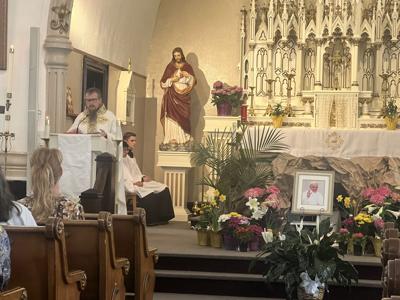
Catholic parishes across East Idaho are bracing for a severe priest shortage as a federal visa backlog threatens to force foreign-born clergy out of the country for at least a year — leaving growing congregations without priests to say Mass, hear confessions or anoint the dying.
In Pocatello, two of three priests serving the Holy Spirit Catholic Community could be forced to leave within months. Father Emil Parafiniuk’s visa expires in April, and Father Remigius Ihim’s expires in March. Other parishes in Idaho Falls, Salmon, Driggs and Soda Springs face similar losses.
Statewide, three foreign-born priests have already left Idaho, and as many as 14 more could be forced out over the next year due to a 2023 reinterpretation of federal immigration law.
“The Catholic Church in the United States relies on those foreign priests,” said Parafiniuk, who came from Poland. “We are serving the community at large, serving in hospitals, serving in schools, in prisons, serving our community. The federal backlog creates a lot of problems and it takes us away from our community.”
Both Parafiniuk and Ihim, who is from Nigeria, work in the United States on R-1 visas, which allow foreign religious workers to live and work in the country while obtaining permanent residency, commonly known as a green card.
However, R-1 visa holders can stay in the U.S. for only five years before they must apply for a change in status, such as permanent residency. If they don’t secure that change before the five years expire, current federal law requires them to leave the country for at least one year while reapplying for permanent residency.
The Biden administration complicated the situation in 2023 by placing vulnerable children in the same immigration category as priests, creating a severe backlog. As a result, many foreign-born priests cannot obtain green cards before their R-1 visas expire.
At recent Sunday services in Pocatello, Parafiniuk told parishioners there is a strong possibility the city’s Catholics will have only one priest for a period next year unless the visa situation is resolved. He is planning a town hall meeting toward the end of the year to explain how the reduction will affect services.
In the Catholic Church, only priests can perform certain duties, including saying Mass, hearing confessions and anointing the sick and dying. The three priests in Pocatello currently say five Masses on Sunday, two on Saturday and as many as 10 during the week.
Some parishes have deacons who can assist with certain duties like conducting funerals or officiating at weddings. Holy Spirit Parish no longer has a permanent deacon available.
Father Gabriel Morales is the third priest assigned to Holy Spirit Parish.
Two pieces of federal legislation — one in the House and one in the Senate — would allow foreign-born workers to request an extension of their R-1 visa status from the secretary of Homeland Security while awaiting completion of the green card process. Idaho Sens. Jim Risch and Mike Crapo are co-sponsors of the Senate bill.
“Senator Risch introduced the Religious Workforce Protection Act to allow foreign-born religious workers already legally in the U.S. to continue serving their communities while their application for permanent residency is processed,” said Janessa Tolman, press secretary for Risch. “Senator Risch is working with his Senate colleagues to pass this important fix and ensure religious workers who are integral to Idaho congregations do not have their service unfairly interrupted due to lengthy visa processing delays.”
It’s uncertain whether or when Congress will take up the legislation. The Senate is currently focused on passing legislation to reopen the federal government, and the House has been recessed since Sept. 19. It is uncertain when it will reconvene.
The Diocese of Boise, which has 79 priests serving 280,000 parishioners statewide, is preparing for what Idaho Bishop Peter Christensen called “severe hardship when foreign-born priests are required to leave the country for one year or more.”
In a statement to Idaho Catholics in March, Christensen noted the number of Catholics in Idaho has grown by 100,000 in the last four years, creating greater demand for priestly services.
“Just like our native-born priests, our foreign-born priests support the sacramental needs of all our faithful,” Christensen said. “Their work in parishes includes worship, education of our young, caring for the elderly, and visiting the sick and dying, to name only a few of their responsibilities. Our country is indeed made better by their contributions.”
Christensen thanked Risch and his staff for sponsoring the legislation he hopes will address the situation. But time is running out to fix the problem before Pocatello and other East Idaho Catholics start to feel the impact in their parishes.
“I really don’t know how we can manage a growing and exploding community in a good way,” said Parafiniuk, who noted there are about 6,000 Catholics in the Pocatello area.

(0) comments
Welcome to the discussion.
Log In