

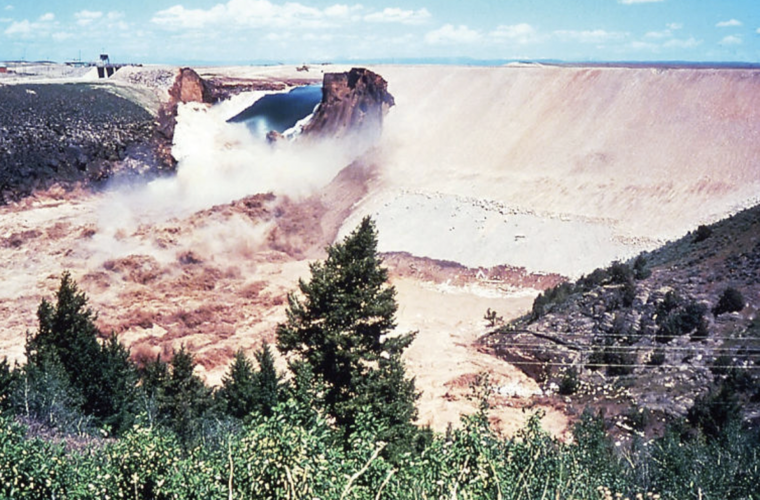
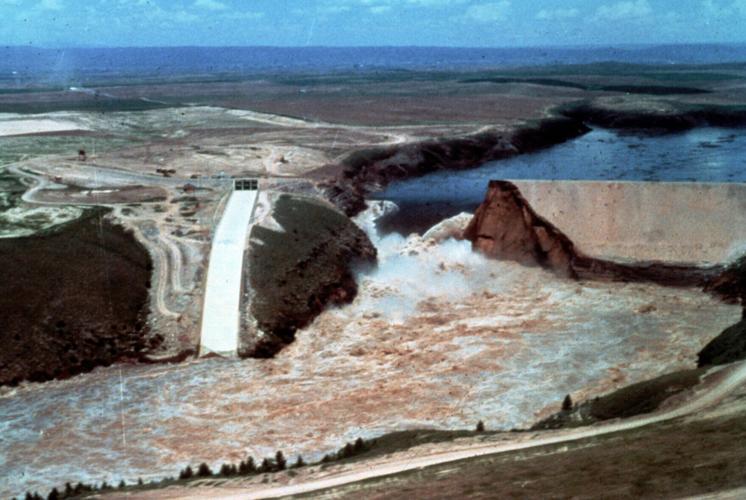
At 11:57 a.m. on June 5, 1976, the Teton Dam ceased to exist.
What followed in the next five hours was the worst man-made disaster in Idaho history — 80 billion gallons of water tearing through the Upper Snake River Valley, wiping out most of Wilford and Sugar City, flooding much of Rexburg, killing 11 people and leaving a trail of destruction that stretched all the way to American Falls.
Fifty years later, the communities that survived are pausing to remember. In Eastern Idaho, June 5, 1976, needs no further explanation. People simply call it “that day in June.”
A dam that wasn’t supposed to fail
The Teton Dam was the Bureau of Reclamation’s crowning jewel — a $55 million federal project, brand new, inspected and approved, its reservoir being filled for the very first time. Families in the region had driven guests up to see it. Teenagers from Madison High School visited the construction site regularly, drawn by the round-the-clock activity. Nobody believed it could fall.
Seepage was spotted around 7 a.m. that Saturday. By 8:30 a.m., the project construction engineer was on site. By 10 a.m., two D-9 Caterpillar bulldozers — 75,000-pound machines capable of shoving house-sized boulders — were grinding against a whirlpool that had formed on the upstream face of the dam. Boulders the size of refrigerators disappeared into the vortex as if they were pebbles tossed into a storm drain.
Jay Calderwood, the dam’s general excavation foreman, was one of the last men on the structure. He had helped build it from the first day. He watched it die in seconds.
“The dam peeling apart like a wound opening in slow motion,” author Richard Robison later wrote of the moment, “except it wasn’t slow at all. It was impossibly fast.”
Both dozer operators escaped with their lives. Their machines did not.
Nathaniel Gee, a dam safety engineer whose father’s sister lived in Rexburg and whose book “Failure and Fortitude” examines what caused the disaster, said cost-cutting measures during construction proved fatal. Engineers had devised a “key trench” design to save money — cutting a narrow trench into the volcanic rock and filling it with silt and clay rather than digging all the way down to solid bedrock. Under the pressure of a full reservoir, water found pathways through the fractured rock. The technical term is “piping.” The human term, as Robison wrote, is the beginning of the end.
Calderwood, interviewed a year after the disaster, never blamed his crew.
“As far as I know, everything was done the best it could be done,” he said. “I can vouch that the material had been put in there correctly.”
The warning that reached thousandsAs the dam collapsed, radio station owner Don Ellis raced to the overlook and began broadcasting the only warning most downstream residents would receive.
“Downstream people get out! Get out! Get out!” he shouted into his two-way radio.
Back at his Rexburg studio, his son Mitch kept the broadcast alive while managing a room filling with state police, sheriff’s deputies, civil defense officials and terrified citizens looking for word about their families. In the middle of it all, Mitch Ellis called United Press International in Boise and told them the dam was crumbling. That call put the story on every newsroom wire in the country.
The floodwaters silenced the station four hours later — depositing four and a half feet of water inside the studio and reducing the transmitter building to a bare concrete slab. Eleven days after the flood, with emergency equipment flown in by RCA at no charge and a mobile home dragged to the base of Ellis’ surviving radio tower by a local dealer, Don Ellis was back on the air.
“Some debts,” Robison wrote, “are measured in loyalty, not dollars.”
The families who ran
Nola Vance was at the Madison County Fairgrounds helping her children prepare a Hereford bull for 4-H judging when her 9-year-old daughter tugged her sleeve and said the dam had broken. Vance dismissed it — the dam was brand new. Then a man ran through the crowd shouting at everyone to leave.
She drove home, gathered her children and ran through her house collecting what mattered most — family photos, genealogy records, books of remembrance. Her husband Neil had already loaded the camper and was having the children stack hay bales against the garage door.
From a hillside above Sugar City, the family watched through binoculars as brown water rolled in at an estimated 15 mph, carrying houses, trailers and livestock. Neil Vance called out the names of each neighboring farm as the flood consumed them.
“Horror. Helplessness,” Robison wrote. “They were watching their life’s work — five years of fencing and planting and lambing and milking — about to be consumed by a force that no human effort could redirect.”
The Vance family prayed in an alfalfa field. The next day, their house was still standing — lashed to its foundation by a telephone cable the floodwaters had wound around the structure like a tourniquet.
The forgotten town
While cameras and relief workers flooded into Rexburg, the small farming community of Roberts was left largely on its own.
Elaine Robinson, the 35-year-old Relief Society president of the Roberts ward, corralled 500 people onto the only dry ground in town — an old Texaco station lot — and kept them alive for three days with no outside help, no running water, no sanitation and temperatures pushing 90 degrees. When a bread truck driver showed up on the second day, he gave her everything he had. When the Red Cross arrived on the third, Robinson had already been running a full feeding operation out of a school bus parked on the lot.
She ran the Roberts relief operation for three weeks, arriving each morning at 8 a.m. and leaving at 11 p.m.
Robison, who has spent years documenting survivor accounts in his ongoing “Teton Letters” series, calls her the Heroine of Roberts.
The scope of the damage
The flood didn’t stop at Rexburg. Floodwaters rolled south down the Snake River, overwhelming communities as far away as Blackfoot and not stopping until American Falls. In Blackfoot, a dike north of the golf course gave way early Monday morning, inundating the airport, Jensen Grove Park and dozens of businesses along the Riverside Plaza. The crest of the flood hit Blackfoot at 15.34 feet. The high-water mark inside the Plaza Twin Theaters — nine feet — wasn’t repainted for years.
In addition to the 11 people who lost their lives, the final damage estimates were staggering: an estimated 20,000 livestock killed, 400 to 500 homes damaged with a quarter a complete loss, and 100,000 acres of farmland inundated. Claims were paid out over 11 years, with a total payout of $322 million.
What the valley became
What followed the flood became as much a part of the region’s identity as the disaster itself. Thousands of volunteers poured in from across the country — some waking at 4 a.m. to board chartered buses, bringing their own food and tools, spending day and night shoveling mud. They came from Pocatello, Boise and many other Idaho communities — and anywhere else in America where news of the disaster had traveled.
“They hadn’t been asked,” Robison wrote of one group of teenagers he witnessed working the gutters. “They just appeared.”
Among the donations that moved Don Ellis most was a letter from a group of pre-teen girls in Indiana who enclosed a check for about $11.
“We hope this money helps your people back there,” the note read.
This year, the communities of the Upper Valley are marking the 50th anniversary with a week of events under the banner “Flood 50” — exhibits, walking tours, a river float, bus tours tracing the path of the floodwaters and a marathon run in the dam’s name. In Rexburg, the carousel at Porter Park — torn apart by the flood in 1976 and lovingly rebuilt by 1990 — kicked off the summer season on Friday.
The water is long gone. What it left behind — the rebuilt carousel, the restored farms, the stories people still tell 50 years later — turned out to be stronger than the dam ever was.

(0) comments
Welcome to the discussion.
Log In