

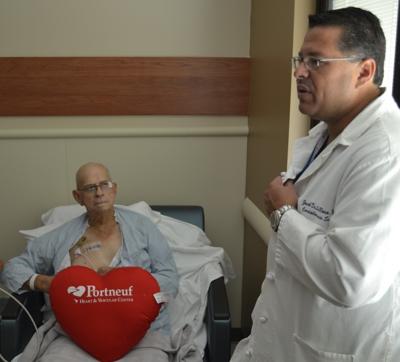
POCATELLO —Retired Malad cattle rancher Jim Goddard will be going to Arizona this winter just like he's done for the past 15 years. This time he'll have new valve in his 79-year-old heart.
The new value in Goddard's aorta was slipped into place through a small two-inch gap on the right side of his chest by Dr. Jacob DeLaRosa, cardiac surgeon at Portneuf Medical Center. The procedure that saved Goddard's life is relatively new in the U.S. and PMC is the only place in the Intermountain West where it is being done.
Sitting up in his hospital bed Thursday morning, Goddard said he was ready to go home.
“I think I've got the best doctor in Idaho,” Goddard said.
Dr. DeLaRosa thanked him, but was quick to point out it takes a skilled team to perform heart surgery.
“There's no place else in Idaho that does it that way,” DeLaRosa explained Thursday before meeting with his recovering patient.
Five days earlier Goddard had been on the operating table undergoing the three and one-half hour surgical procedure. Now the retired rancher was chomping at the bit to leave the hospital. And he can expect a speedy recovery.
“We used to split the chest completely open to get to the heart,” DeLaRosa said.
That invasive procedure left patients with what is known as “the zipper,” a long scar left down the center of the rib cage. Recovery time was measured in months before patients could do simple things like drive a car.
The procedure that DeLaRosa and his surgical team is now using at PMC shortens that recovery time substantially and opens the door to heart surgery for patients who may not have been candidates in the past because they may not have survived the old surgical method.
“In the past one of our only options was to send them home to die,” DeLaRosa said.
Dr. DeLaRosa came to PMC in 2004 and has been instrumental in staying abreast of surgical advances in the field of cardiac medicine. The method he used to replace the valve in Goddard's heart actually had been in use in Europe for some time and DeLaRosa's team began using it about three months ago.
The surgeon said the obvious advantages of the less invasive procedure are a reduction of infections, less patient discomfort and faster recovery times.
DeLaRosa showed a video of the procedure which he uses to help train members of his team. A small two-inch incision is made just above the third rib on the right side of a patient. A dry clamp is put in place to keep the access point open and a rib is cut to provide access to the heart. Tubes are inserted to drain the area and using just two fingers, the surgeon opens the aorta and inserts a new artificial valve. Sutures secure the value and close the opening. A titanium plate is screwed into place to bind the severed rib and the small incision is closed.
The heart starts pumping blood normally and patients like Goddard can expect to head home quickly.
“If I hadn't gone to the doctor when I did, I don't think I would have survived a month,” Goddard said.
The Malad native said he knew he had heart issues. He had undergone arterial repair in Utah and had a stint put in his aorta in previous years. But last winter while spending the colder months in Yuma, Arizona with is wife, Donna, Goddard began to experience pains in his neck and back.
A trip to his local doctor told the story.
“They gave me a stress test and I flunked it bad,” Goddard said. “It was a disaster.”
With the new valve replacement surgery behind him, Goddard feels pretty optimistic. He can almost feel the Arizona sun on his back this coming January and he's planning on “going down to the river to fish” with his wife.
And there's one more important event he his looking forward to celebrating. Next spring will be the 51st anniversary for the couple.
“I feel pretty lucky,” Goddard said.

(0) comments
Welcome to the discussion.
Log In