

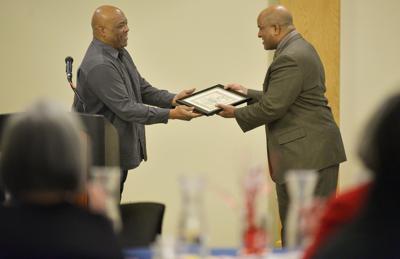

At the annual luncheon for the Pocatello chapter of the NAACP, hosted Saturday at Idaho State University, president Kenneth Monroe expressed plans to grow the organization into a more visible and involved part of the community.
The Pocatello chapter is one of just two branches of the NAACP in the entire state of Idaho, the second being in Boise. According to Monroe, this leads to him receiving frequent calls from throughout the region, with limited resources to respond to concerns.
“People really don’t know how many calls I get,” he said. “And people will say, ‘I called the NAACP, and they couldn’t do anything for me.’ That happens a lot. We don’t have the resources here. I want to change that.”
Monroe announced at the luncheon that the organization will be hosting a fundraiser gala March 16, which he hopes will have the added benefit of exposing people in the area to the organization.
“A lot of people don’t even know Pocatello has an NAACP chapter,” he said. “We’re hoping to be able to participate in more of the activities around here than we have been.”
One project the chapter has been working on is assisting the Bonneville Neighborhood Association in renovating Pocatello’s “Triangle area,” what was once an ethnically diverse neighborhood after World War II.
Monroe said he also hopes to be able to expand the educational opportunities offered by the NAACP, including scholarships for university students.
And ultimately, Monroe said, with the state’s ever-increasing population, now is the time to ensure the organization has a voice in the community.
“I’ll be honest with folks,” Monroe said. “We don’t have the same types of problems that the national office deals with. We don’t even have the same types of problems they deal with in Boise. But certainly if we become more diverse here, I can see where there would be a need to address concerns that may arise.”
Monroe said the increase in local population has not yet led to huge increases in minority populations. However, he said that could quickly change.
At a tri-state conference hosted in Boise, Monroe said he spoke with law enforcement officers about their training.
“For us that live in Idaho, when we’re stopped or we’re approached, we have a way that we know how to act,” he said. “When you pull somebody over from California, they don’t act like we do. I asked what training they had that was ongoing because if you never have to use it until that one time, they’ve forgot that training.”
Monroe added that he expressed similar concerns to the local law enforcement in Pocatello, to little avail.
“We presented them with information that we though would be pertinent to their training,” he said. “They discussed it and then dismissed it because it doesn’t come up all that often. Well, it doesn’t have to. It only needs to come up once, and then we say, ‘OK, we’ve got a problem.’”
According to Monroe, it’s important, perhaps now more than ever, that the NAACP be actively involved in the community and have the opportunity to offer their support and advice.
“We need to be an organization that’s included in the conversation,” he said. “We need to be sitting at the table with everyone else.”

(0) comments
Welcome to the discussion.
Log In