

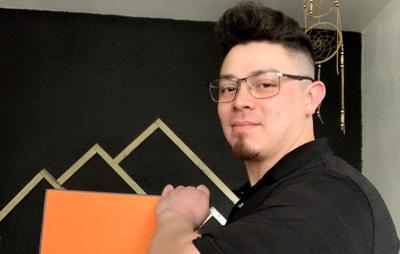

POCATELLO — Strengthening the relationship between the health care community and the Shoshone-Bannock Tribes was one of the primary areas of study for a Pocatello man set to join nearly 600 other students who will receive graduate degrees during Idaho State University’s spring commencement on Saturday.
For 34-year-old Joseph Chacon, obtaining a master’s degree in public health wasn’t always in the cards. He finished his undergraduate degree in university studies in 2020 after dealing with his own mental health struggles and watching many people close to him become incarcerated in the criminal justice system or combat addiction. He’ll be the first in his immediate family to obtain a graduate degree.
“Initially, I planned on being a physical therapist before I went into public health,” Chacon said. “I’ve had multiple family members who suffered, or still suffer, with addiction or have been incarcerated, which has been a common theme throughout my life.”
These life experiences pushed Chacon into a field that not only impacts him personally, but is also something that, to him at least, warrants or deserves further study.
Some helpful advice from his life partner, Taliesha, who noticed that he just didn’t seem as passionate about being a physical therapist as he did about helping others, particularly his fellow Shoshone-Bannock tribal members, led Chacon to the Idaho Area Health Education Centers, or AHEC, Program Office where he would become a career path intern.
Idaho AHEC works toward building up health-related relationships between health care professionals and underserved and vulnerable populations in Southeast Idaho.
While pursuing his graduate degree, Chacon worked with the Idaho AHEC and his tribal community to improve health conditions on the reservation and expand Indigenous knowledge. Being a Shoshone-Bannock tribal member, Chacon focused his research on rebuilding health-related relationships between health care professionals and the Shoshone-Bannock Tribes as well as other underserved populations in Southeast Idaho.
He worked on a paper about mental health treatment programs within the judicial system for both tribal and non-tribal communities.
“There was not a lot of research in Idaho about this topic,” Chacon said. “So I thought it presented a great opportunity to look at what was going on. Turns out that what I learned through reviewing state documents and peer-reviewed papers was that there are certain issues or laws that affect Native people differently, which create barriers in accessing mental health services in a different way for Native people.”
Chacon said his research focused on what’s called Public Law 280.
According to the Idaho Legislature, “Public Law 280 is a federal law that mandates certain states take jurisdiction from the federal government for criminal offenses against or by (Native Americans) on specifically defined land. The law includes transfer of jurisdiction for civil actions to which (Native Americans) are parties. The law also gives non-mandatory states the option to assume full or partial jurisdiction. Idaho adopted partial jurisdiction in 1963 without the consent of tribes in the state.”
Idaho is home to six federally recognized tribes with four reservations entirely within its boundaries and another that overlaps the Nevada border.
“This law was essentially an agreement between the state, federal government and the tribes, even though the tribes were never involved in the decision-making process,” Chacon said. “It shifted responsibility for certain essential health services from the federal government to the state of Idaho. This was done voluntarily in 1963.”
He continued, “Since that law has been enacted, it’s required that a person called a designated examiner be assigned to Native nations or reservations to assess and refer mental health services within the judicial system, specifically incarcerated people. But since that law has been enacted, there has never been a designated examiner appointed for the Shoshone-Bannock Tribes, which means they have not been able to access certain health services, including mental health treatment, which is supposed to be guaranteed to them.”
In a very simplistic sense, Chacon’s research focused on how Public Law 280 has created disparities in the public health sector for members of Native American tribes in comparison to non-tribal members, specifically when it comes to mental health and the judicial system.
Currently, Chacon is working with the Shoshone-Bannock Tribes on establishing public health infrastructure and tribal energy resources. In the future, he intends to obtain a doctoral degree in public health and one day open up his own non-profit that focuses on improving tribal public health access.
When Chacon walks across the stage on Saturday, he’ll join a total of 2,129 spring and summer 2024 graduates. Those who are graduating will be recognized at two ceremonies that will be held inside the ICCU Dome, formerly known as Holt Arena. The ceremonies will begin at 10 a.m. and 2 p.m. Those who are graduating include 1,462 undergraduates, 593 graduates and 77 Doctor of Pharmacy students.

(0) comments
Welcome to the discussion.
Log In