


Editor’s Note: This is the second in a two-part Idaho State Journal series on the academic challenges and achievements of student-athletes at Idaho State University. Part one ran in Saturday’s newspaper.
Brad Puckett, the man in charge of academic services for Idaho State athletes, has seen some of those athletes at the end of their rope.
“You see students like, ‘I’ve had it today,’” Puckett said. “They’re crying. ‘How am I going to get it all done?’ ‘You know, you don’t have to today. How are we going to refocus and focus on what we can do?’ We’re having those conversations.”
Kacey Spink, a sophomore forward on the ISU women’s basketball team and a mechanical engineering major, has been there and done that.
“Coming in as a freshman, I remember calling my mom, ‘I don’t know if I’ll make it,’” Spink said. Now, she gives this advice to the newcomers on her team: “Honestly, you can do it and everyone wants you to do it. Everyone wants you to succeed…. Sometimes it’s going to be hard, sometimes it’s going to be really hard, but just one day at a time you’ll get through it.”
Somehow, college athletes figure it all out — how to manage 20 hours a week of allotted practice time by the NCAA, travel and games in season, classes, labs, practicums, homework and if you really want to be a standout athlete, film sessions and extra work in the gym and on the field. And in the case of some athletes, like Idaho State basketball player Brayden Parker, you’re throwing in family responsibilities as well.
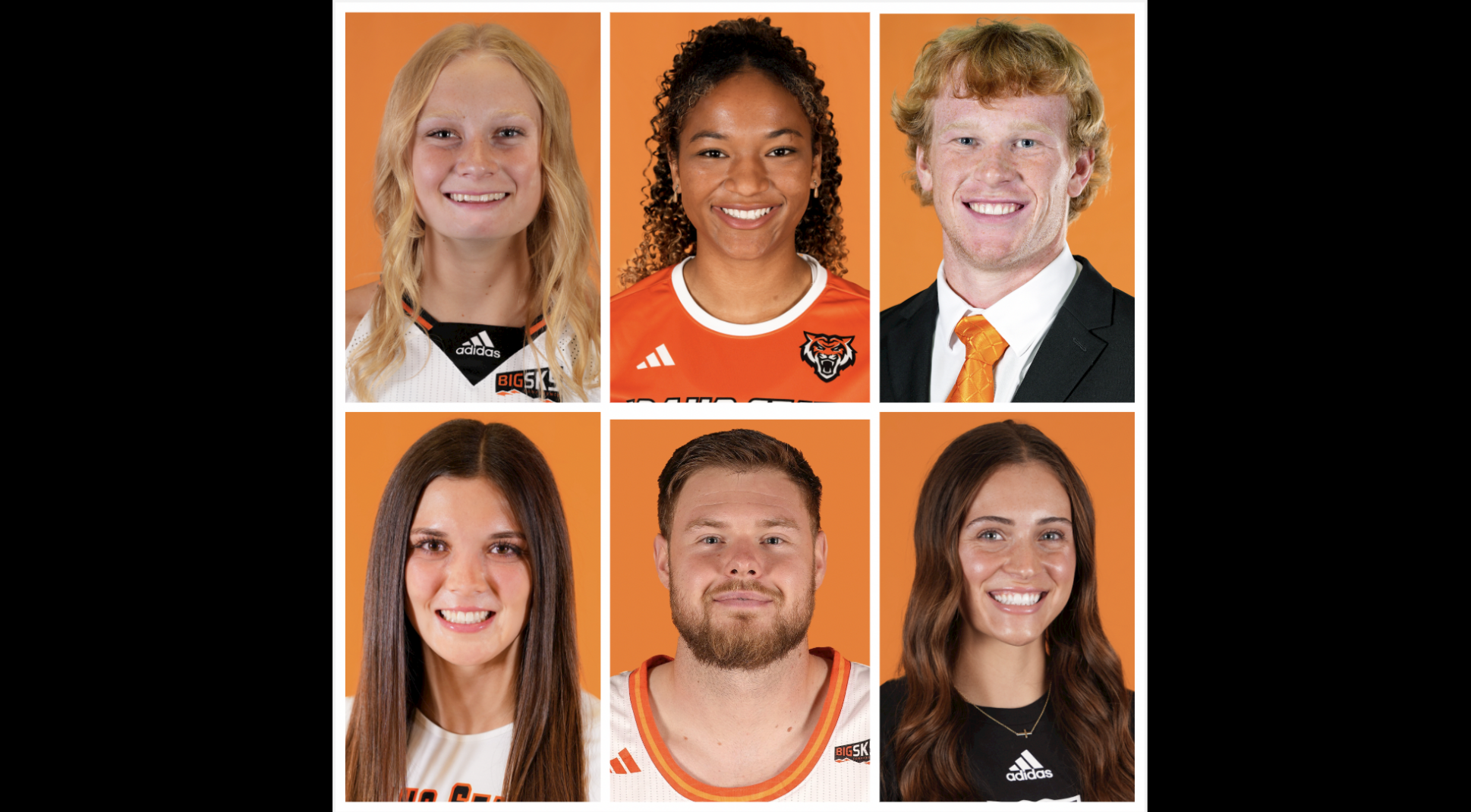
Here’s how six of Idaho State’s best student-athletes make it all work. The best ones really become experts in time management.
Kacey Spink, women’s basketballA starter who leads the women’s basketball team in rebounding and steals, Spink came to Idaho State from Spokane, Wash., in the fall of 2022 with a distinct advantage: Both her mother Kelley and father Scott were Division I athletes at Gonzaga and both majored in difficult disciplines. Her dad, who played basketball, was a mechanical engineer while her mother, a volleyball player, majored in exercise science.
“So both with harder majors and playing sports,” Spink said of her parents. “My whole life I’ve learned to manage both and that both are very important. And later in life, getting a good degree and finishing.”
Spink says the most challenging part of her dual experience at ISU is on the athletic side. Athletics is both physically and mentally demanding, she notes. In fact, she finds respite in her classes and doing homework.
“Yes, I do,” said Spink, a 5-foot-9 wing player. “It’s kind of funny — not many people would say that. I have like a math brain, so I like problem-solving and figuring out how to fix a problem.”
The most important lesson Spink learned in time management as a freshman is that when your team goes on a road trip, you still have to attend to your academic responsibilities.
“The thing about being on the road is that you just have to accept that you’re going to have to do homework,” said Spink, whose team is scheduled to play 17 games on the road this season, not including the season-ending Big Sky Conference Tournament in Boise. “If you try and put it off — ‘No, I’ll do it all when I get home’ — it usually doesn’t work out.
“So just going into the road knowing I’m going to take a couple of hours on this day or that day and do some homework or watch a lecture that I missed,” Spink added. “That’s the biggest thing I’ve had to learn from last year.”
As a mechanical engineering major, Spink knows that her core class work is going to get progressively more difficult each year. She’s trying to establish a good work ethic now for those upper level courses coming up.
“I’m just trying to learn my study habits and things now, when they are easier, to help me in the future when I have a huge project, or I have to write a paper at the end of my program,” Spink said. “So I’m trying to do all the little things now that will help me in the future — and not getting behind on those classes.”
Brayden Parker, men’s basketballNow in his sixth season in collegiate athletics thanks to the extra season granted by the NCAA for COVID, the Preston native has taken full advantage of his athletic and academic opportunities at ISU. The 6-foot-8 250-pound All-Big Sky Conference center has earned a bachelor’s degree in psychology, a master’s in athletic administration and is now working on a master’s degree in teaching. He wants to be a math and physical education teacher and a coach.
Oh, he also has a few other responsibilities not related to either basketball or his studies — he and wife Sadie, an elementary school teacher in Pocatello, welcomed daughter Fallon into the world in March.
“Becoming a father has been great,” Parker said. “I love being a father. But you’ve got to become more time disciplined. You’ve got to have time management.”
That time management has to include academics (Parker finished his last master’s degree with a 3.7 grade point average) and athletics. In addition to all the travel, formal practices and games, Parker takes his basketball craft seriously, and he has to find time to hit the weights and take extra shots.
“You have to go in at night to take shots, or in my case, go in the morning and shoot extra shots because that’s the best time for my family,” Parker said. “You have to find time to balance all those things.”
Parker’s wife Sadie understands all the demands on Brayden’s time that come with being a student-athlete.
“She’s a rock star, honestly,” Parker said of his wife, who played softball in college. “She is a full-time teacher. She loves her job, she loves her kiddos. She wants to be in education, she loves it. But she was a student-athlete also. She knows. It’s hard if you don’t know about sports, especially the schedule that we have, but my wife knows because she was a college athlete for four years.”
Parker says you can’t let your sport or your studies define who you are.
“I’m a big outdoors guy,” Parker said. “I go home and play with the dogs. I’ve got three puppies. It’s a good release for me, a good outlet. But you have to find something within the day to get your mind off of things.”
Ava Brown, softballNo Idaho State sports team has a more demanding schedule than women’s softball. The Bengals, who won the Big Sky Conference regular season championship last year despite having 17 games cancelled because of weather, play the first 30 games of their season this year on the road. They spent every weekend in February and will spend most weekends in March traveling.
For Brown, a sophomore outfielder from Merced, Calif., who hit .326 with six home runs last year, that means forgetting about the comforts of taking classes in person.
“What’s nice is a lot of my classes are online,” said Brown, an education major. “Not everything is pencil and paper anymore. We get a lot of our assignments online, and we take our computers with us, our textbooks with us. We’re doing homework on the bus, at the airport — so really any free time we have, we’re doing homework.”
As an education major, though, there’s only so much Brown can do online. One of her classes requires 50 hours of time in the classroom. So her average day, when she’s not on the road with the softball team, begins with two hours in a local school, observing and helping out with students. Then she comes back to campus to grab some lunch, followed by softball practice from 12:30 p.m. to 6 p.m.
Brown said she had no idea how demanding her role as a student-athlete was going to be when she first signed up for it.
“No, I didn’t,” she said. “I really had no idea what college softball was going to be like until I came here and it’s a grind for sure. But it’s super fun, and I wouldn’t want it any other way.”
Brown has also had to adjust to a new climate in Southeastern Idaho. She’d never seen snow before coming to ISU.
“Last year, before our opening weekend with Northern Colorado, we shoveled snow for six hours off our field,” Brown said. “My eyes got snow burned. I didn’t know eyes could get snow burned.”
Her biggest challenge once spring semester begins is staying motivated to do school work when the softball field beckons.
“I just want to go and play softball,” Brown said, “and I’m like, ‘Oh, I have to do my homework.’ It’s hard. You have to learn to balance it because softball takes up so much of our time now. But you’ve just got to stay motivated.”
Brown’s motivation springs from the fact that she’s wanted to be an elementary school teacher since she was in elementary school herself. And according to the academic plan laid out by her advisor, she’s going to graduate a semester early, which means she’ll be taking 19 credits next spring.
“Some of my teammates are in super hard majors — P.A. (physician’s assistant) majors, health sciences,” said Brown. “They have to load up their credits with a lot of science classes. I don’t know how they do it.”
Mary Za, soccerWhen you visit with ISU athletes, they will all tell you, without exception, that they couldn’t succeed academically without flexible professors. They allow the student-athletes to make up assignments and tests that they miss when they’re on team travel and they help them catch up on material they miss when they’re not in class.
“The professors here are amazing,” said Za, a sophomore forward on the soccer team from Fairfax, Va., and a finance major. “They love athletics and they are really just supportive of us and they’re understanding. They’ve just been awesome.”
As a person of color coming from the East Coast and a more urban area, Za has had to adjust to the different culture of Southeastern Idaho.
“Coming here, I was a little nervous just because I knew the demographics were a little different,” Za said. “Where I came from, I was from a little more metropolitan area. But honestly, it’s been fine. Everyone has been amazing here. But I do feel some sort of pressure just to be great here, just because there are not a lot of people like me. I just want to break the stereotypes and do the best I can.”
Za is working on starting an organization for Black student-athletes at Idaho State.
“I kind of wanted it to be a place where we connect and talk about our issues and also to motivate each other to excel, on and off the field,” Za said. “Because it gets so difficult to see yourself outside of being an athlete, especially as a Black student-athlete. You feel like you have so many expectations to live up to.”
Za works hard to define herself as more than just a student-athlete.
“I feel like I’m a jack of all trades,” she said. “I am a business person. I love business. But I also love soccer…. I do have different hobbies, so that is something I could explore. For example, I sing, I do performances.”
But Za, who was fourth on the team in scoring last year with four goals, doesn’t have any problem filling that student-athlete role, either.
“I guess the way I approach things, I’m a student-athlete so I take both of them with equal importance,” she said. “I don’t hold one over the other. I give my everything to school work and I give my everything to soccer.”
Jamie Streit, volleyballIt’s not surprising that among a group of achievers like this, there is a student-athlete who came to ISU already well ahead of the academic game. Streit, a 5-foot-9 second-team all-conference outside hitter for the Bengal volleyball team, came to ISU with 40 academic credits already in hand from her dual-enrollment courses in high school.
“I was able to knock off a lot of my gen eds (general education) credits early on,” said Streit, an elementary education major. “So when I was a freshman, there were classes that I was already taking, one that was counting toward my major, one toward my minor. So I was already in a little bit tougher classes.”
Streit, who plans to get a master’s degree in psychology and hopefully become a school psychologist, learned early on that college professors don’t instruct the same way that dual credit teachers did back at Pinedale, Wyo., High School.
“You definitely have to learn on your own,” Streit said, “versus the other teachers who were more structured and helped you every single step of the way. It definitely was a shift from that perspective. But I was definitely glad I had those community college credits transfer over so I had some college work (completed) and it made the transition a little easier.”
Like most of the athletes we interviewed, Streit says online courses are a saving grace for athletes who are on the road a lot.
“There are times when anybody will be doing Zoom calls — like zooming in for a class when they’re on the bus or watching a missed lecture,” Streit said. “It’s just taking that time, committing it to your studies. You have to stay on top of it if you want to succeed. We’re all held to a really high standard with our academics. Sometimes when you’re a freshman, you’ll have mandatory study hall. There are a lot of times when we’ll all do a mandatory study hall as a team — where we go and sit for a couple of hours and just work to make sure we hold each other accountable.”
Ask Streit what’s the most important thing she’s learned about being a student-athlete and she’ll tell you the same thing Puckett and Spink mentioned earlier: Believe you can do it.
“I guess it’s that belief in yourself, that self-confidence that you’re able to do it all,” Streit said. “It’s going to be overwhelming, it’s going to be hard, but it’s going to make you stronger and a better, well-rounded individual. Because if you’re able to handle athletics and all those demands, along with our schooling, you’re going to develop a lot of traits that are going to be helpful later in life.”
Hunter Hays, footballIf anybody knows about the demands on student-athletes at Idaho State, it’s the Hays family. Dad Josh was an All-American defensive lineman at ISU in the 1990s. Mom Tammy was an all-conference volleyball player at ISU during the same timeframe. And Hunter has thrown for 20 touchdowns and run for seven in the 28 games he’s played at quarterback for the Bengals since walking on from Cody, Wyo.
“I think in the beginning, as soon as I was born, I was saying I want to play college football,” Hunter said. “I want to play college football so bad. They always told me, ‘It’s not always easy. There are a lot of hard days. Some days you will wake up and just wish you were doing anything else.’ But there is so much good that comes with it that it’s definitely worth the experience.”
Soon, Hunter will be able to pass on his experiences to his sister Molly, who has signed to play for the Bengal basketball team beginning next fall. And what advice will he be giving Molly?
“The biggest thing I’ve been telling her is what my parents have been saying: It’s a bigger jump than you’re expecting,” Hays said. “I know everyone is telling you that, but it’s going to be another level you’re going to have to go in all aspects of your life.”
Hays, who will finish his athletic eligibility next fall, will also tell his sister to enjoy the ride.
“This is my fifth year at Idaho State and it just seems like yesterday that I was stepping on the campus for the first time,” Hays said. “Just enjoy the moment while you can. I can see the light at the end of the tunnel coming up real fast and it scares me a little bit. Just enjoy every moment.”
Hays, who is majoring in health sciences and psychology, has a goal of going to chiropractic school. He’ll graduate this spring with his undergraduate degree and is looking at maybe working on an MBA while he completes his last season of football next fall.
Each year he’s been on campus, Hays has watched the new freshmen come to terms with the demands of college athletics.
“First off, it’s just the physical effort you have to put in,” Hays said. “It’s totally different from high school. The workouts are way harder, the running is way harder, the practices are way harder and longer…. And then the school is a lot more rigorous. I think the biggest thing with schooling is it’s all on you. In high school the teachers are like, ‘Hey, make sure you get your homework in. You’ve got to do this.’ Once you get here, no one is helping you along.”
Not only do the freshmen student-athletes discover they aren’t the best athletes on campus, Hays said, but often that they aren’t the smartest students in the classroom anymore, either.
“A lot of kids will come in that had a 4.0 in high school and they’ve got three Cs and a D in the first semester and they’re like, ‘Oh my gosh, this is crazy,’” said Hays. “By the second semester, they know how to do it, they know what’s expected of them and it’s back to more of how they used to do school.”
Like Parker and Za, his time at Idaho State has also given Hays a special perspective on self-image.
“What my dad always says is that every college athlete was the best athlete at their high school,” Hays said. “So you kind of come in with that, ‘Oh, I’m a stud.’ And then you realize everybody is that guy. So I think it takes a toll on some guys because they are used to winning every rep, they’re used to taking first in conditioning and everything, and all of a sudden, they’re not and that takes a toll.”
Hays, who had to earn a scholarship as a walk-on, then battle for playing time at quarterback, doesn’t allow temporary failures on the field — or in the classroom — to define him.
“A lot of people come into college and that’s one of the mistakes they make,” Hays said. “‘Oh man, I threw three picks (interceptions) today and that’s what defines me.’ For me, it’s trying to find a different identity. And for me, that’s My Lord and Savior, Jesus Christ. I wake up every day and try to be the best Christian I can be. So I know when I’m done playing ball, when I’m done with school, I can put that hat on. That’s what defines me, not sports.”

(0) comments
Welcome to the discussion.
Log In