

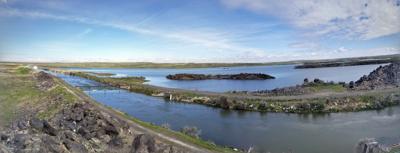

Idaho Power Co. officials worry a state program working to reverse declining Eastern Snake Plain Aquifer levels has grown to the point that it could adversely affect winter hydro-power generation.
For the past five years, Idaho has conducted a large-scale managed aquifer recharge program. This involves diverting Snake River surface water into strategically located unlined canals or adjacent spill basins, allowing it to seep into the aquifer.
The program aims to store surplus surface water in the aquifer until it can be put to good use during the peak irrigation season, also bolstering spring flows into the Snake River.
The state has steadily built up its recharge infrastructure, and Idaho water managers now have the ability to take flows in the Snake River just below Milner Dam, located near Burley, down to zero. Further downstream, springs restore flows in the river channel, but Idaho Power officials have noted significantly less water may be passing through the company’s power turbines when the winter recharge program is fully operational.
Effective Dec. 1, the Idaho Water Resource Board established a temporary minimum flow of 200 cubic feet per second below Milner, pending a permanent solution.
“The company has been and remains an advocate of managed recharge and the health and sustainability of the aquifer,” said Kresta Davis-Butts, Idaho Power’s resource planning and operations hydrology senior manager. “With that, the company is seeking a balance of recharge with the other benefits. One of the other benefits is hydro-power.”
Davis-Butts said Idaho Power hasn’t committed to 200 cfs as an appropriate minimum flow.
Though flows below Milner typically dry up during the summer, when irrigators are diverting, the median water volume that passes below Milner at this time of year has historically been 500 to 600 cfs, according to the company.
“One acre-foot of water coming down from the Upper Snake and moving through all of Idaho Power’s main-stem facilities generates approximately 1 megawatt-hour,” said Idaho Power spokesman Brad Bowlin. “An average Idaho home uses a little less than 1 MWh per month.”
Idaho Power is part of an Environmental Resource Technical Working Group, which was formed as part of a settlement with entities that filed protests when the state originally applied for its recharge water rights. The working group of protesters meets twice per year and makes recommendations to the Idaho Water Resource Board. The group last met Nov. 6.
“In January and February of 2019, we had zero flows below Milner,” Davis-Butts said. “From our perspective, that is not a balanced approach.”
Wes Hipke, recharge program manager with the Idaho Department of Water Resources, said the working group plans to review the issue and may make a future recommendation to the board.
Hipke said the department has the legal right to take flows below Milner to zero and has finally built up its program to the point that reaching zero flows during winter is a possibility. Hipke said the city of Twin Falls has also been supportive of maintaining some level of winter flows below Milner in the interest of preserving water quality.
“If I can’t use all of the water I have available, I’m going to need more build-out (of recharge infrastructure),” Hipke said. “I’m going to need more capacity in the wet years to make up for what’s lost in these other times.”
Lynn Tominaga, executive director of Idaho Ground Water Appropriators Inc., emphasized that stabilizing the aquifer is vital to the state’s agricultural industry and overall economy.
“We’ve got to stabilize the ESPA. That’s the goal of all this,” Tominaga said. “Anything that reduces that means the recovery of the aquifer will be slower and take longer to accomplish.”
Heading forward, Hipke is certain water management in the state will require making more tough choices as demands increase on a finite resource. Davis-Butts believes finding the right balance to meet competing needs will be a key to success.
“We would just seek an opportunity to collaborate and coordinate with the Water Resource Board,” she said. “I want to reemphasize the company has historically, today and moving forward supported the Water Resource Board’s efforts in recharge and creating a sustainable plan for the hydro system, both groundwater and surface water.”

(0) comments
Welcome to the discussion.
Log In