

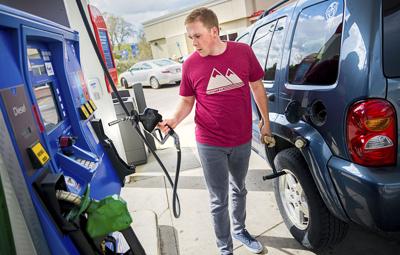

Get ready for a little bit more pain at the pump this summer.
Crude oil prices are at the highest level in more than three years and are expected to keep climbing, pushing up gasoline prices along the way.
The U.S. daily national average for regular gasoline is now $2.81 per gallon. That’s up from about $2.38 per gallon a year ago, according to Oil Price Information Service.
And across the U.S., 16 percent of gas stations are charging more than $3 per gallon, according to AAA. Some of those stations are in Idaho, where on Monday the average cost of gasoline was $3.09, which is 31 cents more than a month ago and 53 cents more than a year ago, AAA said.
Since Jan. 1, gas prices in Idaho have increased by 56 cents.
Idaho gas prices are currently ranked the eighth highest in the United States. Other western states in the top 10 include California (2), Washington (3), Nevada (5), Oregon (6) and Utah (7).
“This will be the most expensive driving season since 2014,” said Tom Kloza, global head of energy analysis for Oil Price Information Service.
Several factors have helped drive oil prices higher. A wave of global economic growth has driven up demand for oil. At the same time, production cutbacks initiated by OPEC last year have helped whittle down oil supplies.
In the U.S., oil supplies were running 1.1 million barrels lower at the start of this summer’s driving season, which runs from April through September, than a year ago, according to the U.S. Energy Information Administration.
That has amplified the typical increase in gas prices seen this time of year. Pump prices normally rise as demand increases from families going on vacation and taking to the highways on road trips. Already, U.S. consumer demand for gasoline hit a record high for the month of April, according to the EIA.
It should come as no surprise that four of the top 10 destinations for summer travelers in the U.S. are in the western states, which is seeing some of the highest gas prices in the country. These four travel spots are Seattle, Los Angeles, Las Vegas and Salt Lake City, AAA said.
Drivers in Western states such as California, Oregon, Washington and Nevada, as well as Alaska and Hawaii, are paying the most at the pump, according to AAA. The average retail price in those states ranges from $3.09 to $3.61 per gallon.
Average retail gasoline prices are lowest in a swath of states in the South and Southeast, including Louisiana and Alabama. These two states have the cheapest gas in the country at $2.54 and $2.56 per gallon, respectively, according to AAA.
Still, prices remain well off from 2008, when crude oil prices jumped above $130 per barrel and average retail gas prices surged to an all-time high of $4.11 per gallon.
“People forget very, very quickly,” Kloza said, noting that the average U.S. gasoline price remains well below the $3.60 per gallon it was five years ago.
“We’re seeing a higher price environment ... but I don’t think we’re going to look at really apocalyptic numbers,” he said.
The EIA projects that the U.S. retail price for regular gasoline will average $2.74 per gallon this summer, up from an average of $2.41 per gallon a year earlier. Gas prices tend to rise each spring through Memorial Day and slowly decline as the summer goes along.
For all of 2018, the agency expects that the national retail price for all grades of gasoline will average $2.76 a gallon. That would translate into an additional $190 spent on fuel by the average U.S. household this year compared to last, the agency said.
“At the higher income levels, this won’t really have much of an effect,” said Behravesh. “But it’s a bigger deal for lower-income families, because a bigger share of their budgets goes to things like gasoline.”
To help budget for the increase in gas prices this summer, AAA has multiple recommendations.
For one, summer travelers are advised to plan ahead and be flexible with travel dates.
“A simple adjustment of just a few weeks could yield significant savings on hotels and airfare,” a news release from AAA said.
Travelers should also make sure their vehicle is in top working order.
“Try to group the priorities for your trip into ‘A,’ ‘B’ and ‘C’ categories so that you can set clear budget priorities,” said Matthew Conde, public affairs director for AAA Idaho. “Be prepared to let go of a few of the ‘C’ activities where needed. Another option is to consolidate your trips and whittle down some expenses before you hit the road. That could help free up funds for more unique travel experiences.”

(0) comments
Welcome to the discussion.
Log In