

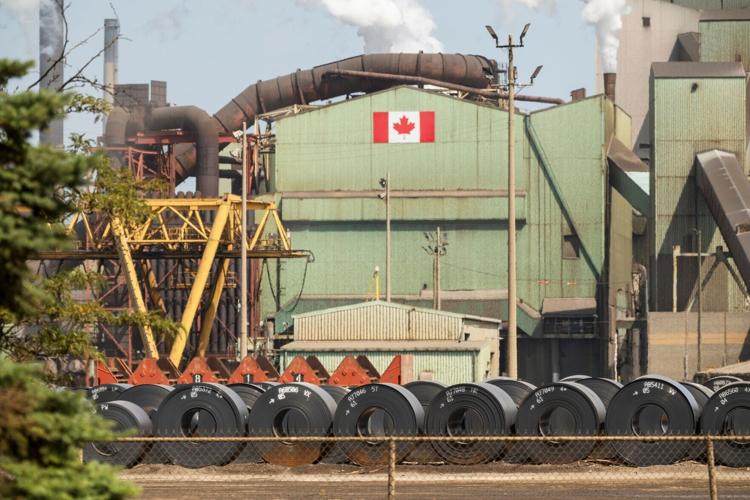





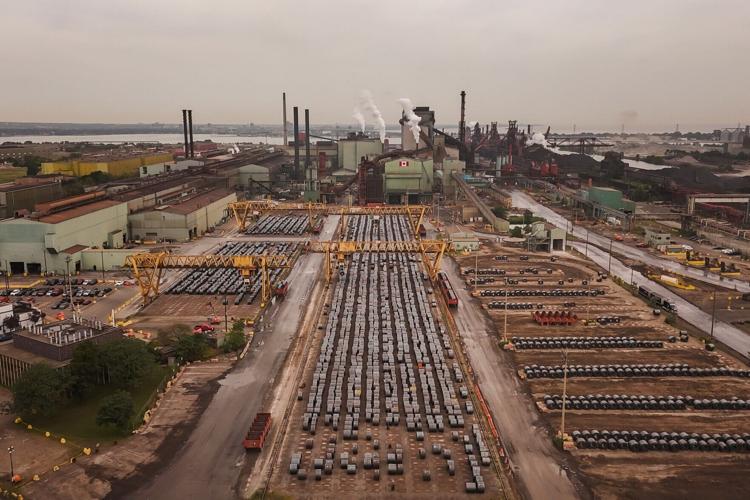

BOISE — An ongoing trade dispute between the United States and Canada has seen a number of goods, including dairy products, steel and electronics, the subject of tariffs due to take effect next month. Though the duties would apply to the nation at large, the impact could be more pronounced for Idaho as the state’s northern neighbor is also its largest foreign trading partner.
The tensions arose as trade talks between the two nations were suspended and met with the United States imposing tariffs as high as 50 percent across $27.6 billion of Canadian goods. After U.S. tariffs took effect on Aug. 22, Canada announced “counter tariffs” between 15 percent and 50 percent to align with the rates imposed by the United States on corresponding goods. In total, the countermeasure impacts $27.6 billion in imports from the U.S., according to the Canadian Department of Finance.
If such tariffs were to go into effect, it would have significant ramifications for Idaho. In 2025, Canada was the state’s largest export market with $1.8 billion in goods, or 39 percent of the state’s total good exports, going to Canada, according to the Office of the United States Trade Representative.
According to Census Bureau data, animal feed and industry residues ($86 million), softwood lumber ($86 million) and fertilizers ($56 million) are among Idaho’s top imported goods.
“We annually export $1.8 billion in goods to Canada,” Zions Bank Economist Robert Spendlove said, “and then we import $1.2 billion in goods from Canada. It’s a really strong trading relationship.”
With a quarter of these exports being agricultural, the Canadian market is of particular importance to the state’s agricultural industry and is a key driver of local economies in the state.
According to export data from the U.S. Census Bureau’s Foreign Trade Division, Idaho food and agricultural exports have totaled $256 million through June, with live cattle being the largest contributor to this value at $119 million. As for exports across the whole year, Canada has received $444 million and $455 million in commodities in 2024 and 2025, respectively.
Spendlove noted if tariffs from both sides went into and remained in effect for the long-term, it would upend a decades-long trading relationship that could not be easily maneuvered around. Both sides would have to alter their import and export patterns and work to fill a gap, potentially with a country of much greater geographical distance.
In north Idaho, the connection goes beyond trade with the flow of water and travelers also being impacted by the relationship.
Sen. Jim Woodward, R-Sagle, who was raised in Bonners Ferry — which sits just south of the U.S.-Canada border — described interactions from across the border as being a “daily occurrence,” with tourism being particularly beneficial for Boundary County.
Outside of travel, the increased tension is particularly notable for the region as larger negotiations with Canada are ongoing, Woodward added.
The Columbia River Treaty is among these negotiations and is of particular importance for Idaho as rivers in the state, including a major tributary in the Snake River, flow toward the Columbia River.
This bears out clearest in north Idaho as the treaty dictates the amount of generated power distributed between Canada and the United States. For Idaho, the amount of power diverted to Canada through the treaty directly impacts the supply of low-cost hydropower that can be sold to residents.
Though an in-principle deal for a revised treaty was reached in July 2024, negotiations have stalled since March 2025 when British Columbia’s Energy Ministry announced the United States had paused negotiations.
In a matter specific to Boundary County, the International Kootenay Lake Board of Control manages the water levels of both Kootenay Lake and the Kootenai River. With the agricultural activity in the region being marked by fields with dikes, the water level has a direct impact on the ability grow crops, Woodward said.
Though just over a week remains before Canada’s responsive tariffs take effect, their lasting for even a short period could place upward pressure on consumer prices when, according to this week’s Personal Consumption Expenditures Price Index, annual inflation in the United States hit 3.7 percent in July.
Importers may elect to eat the cost of tariffs for a short time, but costs eventually pass through to retailers and consumers, further worsening inflation. Whether tariffs present a one-time inflationary impact or a lasting one remains the subject of economic debate.
When turning to history, the trade war in the lead up to the Great Depression presents on analog for the employment of wide-reaching tariffs, and Spendlove said the outcomes are “both bad.”
“Either we see higher inflation,” Spendlove said. “Or we see decreased economic activity.”

(0) comments
Welcome to the discussion.
Log In