

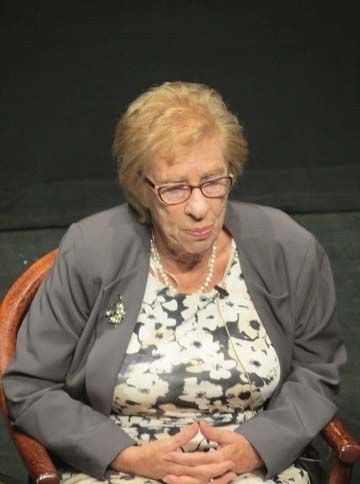
IDAHO FALLS — Eva Schloss met her famous stepsister, Anne Frank, years before their families were united by the marriage of Schloss’ mother, Elfriede Geiringer, to Frank’s father, Otto Frank. And while the girls were friends, Schloss said they didn’t have much in common.
The two girls were just 11 years old when they met in Amsterdam. Schloss’s family had fled Austria after the German occupation in 1938.
“I was kind of a tomboy and Anne was a sophisticated young lady,” Schloss said. “She was even interested in boys.”
The girls played together and contemplated the future for two years before the Nazis invaded Amsterdam.
“The Germans came in behind our lines with paratroopers,” Schloss said.
Austrian-born, Schloss said she grew up skiing with her father, a shoemaker who had inherited the family business from his father.
“It was a wonderful life growing up in Austria,” Schloss said. “Then the Nazis marched in.”
Schloss told her story to a group of about 250 people at Colonial Theater last month.
After surviving confinement at Auschwitz, and losing her beloved father and brother, Schloss said she came out of the experience angry and hateful. Her book, “Schloss’s Story” follows her journey from the German death camps to her current life in London, England.
Schloss has authored three books since 1986, along with “Schloss’s Story” she wrote “The Promise” and “After Auschwitz.”
She said the books helped her come to peace with the travesty that befell her family.
“The Holocaust could have been avoided if any country would have just taken in some Jews, a million here, a million there, but no one would take us, and I was angry,” Schloss said. “In the beginning, I don’t think Hitler wanted to kill Jews; he just wanted to get rid of us.”
Idaho Falls Mayor Rebecca Casper read a proclamation from Gov. C.L. “Butch” Otter declaring Aug. 27 Holocaust Education Day in Idaho, and the city followed suit.
The event was presented by the Idaho Falls Arts Council and the Idaho Falls Humanities Council and sponsored by Chabad Jewish Center, Chabad Lubavitch of Idaho, City of Idaho Falls, City Club, Hilton Garden Inn, Melaleuca, and the Neuber Foundation.
Casper said education is key to prevent history from repeating itself.
“What we learn we can share,” Casper said. “To stand next to such a woman of such strength, such integrity is a great honor.”
Idaho Falls City Councilman Ed Marohn and Rabi Mendel Lifshitz joined Schloss and the mayor on stage during the presentation.
Schloss said the Austrians were not in favor of joining Adolf Hitler and his Nazis, but when the German troops marched in, her world changed forever.
“As soon as the Nazis came in, the Swastikas and the German flags went up everywhere,” Schloss said.
Following the German occupation of Austria, Schloss was no longer allowed to play with her best friend, a Catholic girl. The girl’s mother slammed the door in her face and told Schloss to not come back, and her brother was beaten at school while the teachers watched.
Her father was prepared to flee Austria and he escaped to Holland where he worked to secure visas for the rest of his family.
“It was very dangerous for him, and I missed my father horribly,” Schloss said.
In 1940, two years after the Nazi annexation of Austria, Schloss, her mother and brother joined her father in Amsterdam, and that’s when she met Anne.
Then the Nazis marched into Amsterdam as well.
“At first it wasn’t too bad,” Schloss said. “They enacted a curfew and the game Monopoly had just came out. We had lots of cozy nights playing the game at home in the evenings.”
Jews in Amsterdam were not allowed to socialize with Christians and public schools were segregated, then children started disappearing.
Soon the Jewish population was required to display the infamous gold Star of David identifying them as Jews. Schloss said 10,000 Jewish boys and men were marched off to the death camps.
In 1942, an additional 10,000 young Jewish people were taken from their homes to work in German factories to support the war.
Schloss’s family was sent into hiding, Schloss went with her mother, and her brother and father left together.
“Everyone expected that the war would last only a few months,” Schloss said. “We went to a place where wonderful people were brave enough to take in Jews.”
Over the next two years, Schloss and her mother were hidden away in six different locations.
Her brother, a talented artist, hid his painting under floorboards in the house where he and her father were hiding,
After the war ended, Schloss and her mother traveled to the home and retrieved the art, which is now included in the Anne Frank House, a traveling exhibit in Austria.
In 1944, the family, running low on money, was betrayed by a Dutch nurse and arrested.
Schloss and Elfriede were taken to Nazi headquarters where they endured beatings and threats before being shipped to a holding camp north of Holland, and then on the death camp, Auschwitz.
The women lived in a barracks with about 500 other Jewish prisoners.
“They gave us two buckets, one for water and one for the toilet, and that was for 80 people,” Schloss said.
Her mother had given her a coat and hat, and the detainees were able to select one garment and two shoes — not necessarily a pair of shoes though. Their heads were shaved, water and food was scarce and Schloss and her mother watched and waited in the lice infested camp as hundreds of prisoners were marched off to the gas chambers.
In October of 1944, the Germans leveled the gas chambers because they did not want to leave them behind. Ten thousand people were marched out of the death camp. Then one day, the Germans left.
“We went outside and it was really quiet, they were gone,” Schloss said. “The gates were opened and we could have left, but we stayed there.”
Russian soldiers showed up days later and they brought field kitchens with them.
“They made us this wonderful cabbage soup,” Schloss said. “Food became an obsession and in my house, it still is, not a scrap is wasted.”
Schloss said many people died from overeating after being starved for years.
She and Elfriede set out to find her father and brother, and they met Otto Frank along the way.
Once rescued, Schloss and her mother went to Belgium, and while they were grateful to be alive, life was still difficult.
“I survived because I thought someday, things would return to the way they were, but it couldn’t,” Schloss said. “We had no money, no home, no business, everything had been destroyed and I was angry.”
Otto told them that both her father and brother had been marched off to the death camps. He also learned that Anne and her sister, Margot Frank, had died of typhus days before U.S. troops liberated the concentration camp where they were both held.
“He was just 57 years old and he lost his whole family,” Schloss said. “At least my mother and I still had each other.”
On one visit, Otto unwrapped Anne’s diary, it was wrapped in cloth and Otto handled it like a precious, fragile artifact.
“At first, he had no intention of publishing it,” Schloss said. “But a historian encouraged him to.”
Schloss said she was miserable following the war, but Otto encouraged her. She got an apprenticeship with a photographer in London, where she met her husband, Zvi Schloss. He proposed, but she didn’t accept right away. She was worried about her mother in Belgium.
“He said he was an Israeli and I said I was Dutch, and both were lies,” Schloss joked.
But when she returned to Belgium, she learned that her mother and Otto had fallen in love and planned to marry.
“It made sense that they would fall in love,” Schloss said. “They had another 27 happy years together.”
Schloss returned to London and accepted the marriage proposal.
She is now 85 years old and she’s been married to Zvi Schloss for 63 years. They have three daughters together.
“Otto has always been their grandfather,” Schloss said.
Before the presentation last week, a member of the audience presented her with a first edition of “The Diary of Anne Frank.”
“This is very beautiful and very special, but I’m not going to keep it,” Schloss said. “I’m going to present it to the Anne Frank House.”
Schloss also founded the Anne Frank Trust UK in London.
Morohn asked Schloss what her response to Holocaust deniers would be and she said it has never come up.
“They have never denied it to me,” Schloss said. “They wouldn’t dare.”

(1) comment
we can watch the leader of the country or whats on your mind, anne frank
whats on your tv
we can vote for hitler but not to watch the leader of our country
wengerocracy is on my mind
whats in a name
all you need for fame
what good is fame
you need to be more famous than anne frank for all the right reasons you need to do good and make the entire world know who you are and become more known than Anne frank or hitler
can you become more famous than hitler for doing good?
Welcome to the discussion.
Log In