

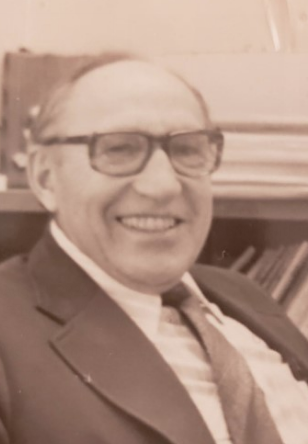

Lionel Bowser was just a little boy in the late 1920s when he rode a horse down Main Street Pocatello and helped drive a herd of cattle from his family’s dairy in the Ross Park area to its new location in Tyhee.
As a young adult, he answered his nation’s call amid one of its darkest hours and put his college plans on hold — enlisting as an officer in the U.S. Marine Corps during World War II and serving in the Pacific theater. Upon returning to his hometown, Lionel finished his studies and devoted himself to local education as a teacher and administrator. He also laid the foundation for the area’s proud sporting tradition.
Lionel died on Aug. 5. He would have turned 99 on Sept. 25. His life was filled with firsts.
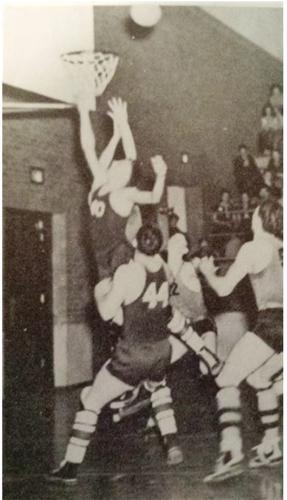
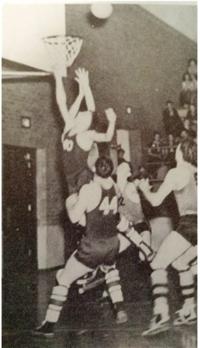
Raised on the community’s first commercial dairy farm, Lionel played in the first basketball game at the historic Pocatello High School gymnasium, now called The Pit. He went on to become the school’s first vice principal and served as athletic director during Pocatello High’s sports heyday.
He’s also credited by friends, family and former students with establishing a persisting culture of achievement and good humor at Highland High School as its first principal, serving in that capacity from 1963 through 1984.
A proud member of the disappearing Greatest Generation, Lionel served during WWII as a lieutenant with K Company of the 3rd Battalion, 5th Marine Regiment — 1st Marine Division, which was prominently featured in the acclaimed miniseries “The Pacific.”
“A lot of history died with him,” said Carol Mahar, of Pocatello, who is the oldest of his five children. “He knew the history of World War II and Pocatello forwards and backwards.”
His son, Bryan Bowser, of Idaho Falls, believes members of his father’s generation returned to their communities after war to become outstanding leaders and strong influencers, laying the foundation for the nation’s future success.
“These guys came back from the war and they were great leaders,” said Bryan, who attributed much of their success to their military and officer training. “They knew how to manage and run a school and run things. ... They never wanted to take credit for what they did.”
Like most Marines, Bryan said his father seldom spoke about his time at war, though in his later years he’d speak generally about WWII to local high school classes and veterans groups.
Lionel attended Tyhee Elementary, Franklin Junior High and graduated from Pocatello High School, where he was senior class president, in 1941. He attended Brigham Young University on a basketball scholarship for a few months before the bombing of Pearl Harbor on Dec. 7, 1941, when Lionel was compelled to hitchhike to Salt Lake City, where he enlisted in the military.
“The first desk I ran into was the Marines, so I enlisted,” Lionel told the Journal for a profile story that ran in March of 2015. “It was very rewarding. I was fortunate to get through it all unharmed. Once a Marine always a Marine.”
Bryan admits he learned much about what his father’s wartime experience must have been like by watching “The Pacific,” a 2010 miniseries that included Tom Hanks and Steven Spielberg on its team of producers. It was focused on enlisted soldiers and was based on books by Robert Leckie, John Basilone and Eugene Sledge, who served in Lionel’s platoon.
Bryan recalls joining his father on a trip to Denver for a Marine Corps reunion, where the miniseries employed a historian to record the stories from many of the attendees. Bryan said Romus Burgin, who served as a sergeant under his father, played an especially significant role as a consultant for the miniseries.
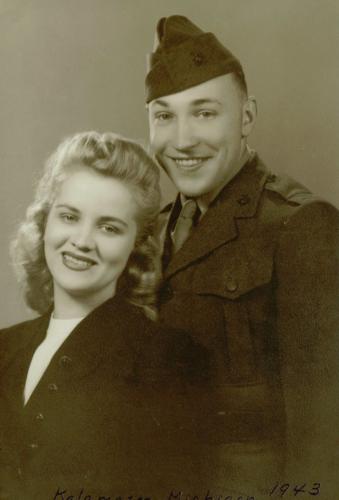
Lionel’s college experience made him eligible for the V-12 Marine officers’ training program. He married his high school sweetheart, Bryanetta Proctor, on July 1, 1943 and left to join the Marines the next day. His training took him to Kalamazoo, Michigan, Parris Island, South Carolina, and Quantico, Virginia.
Lionel entered the Pacific theater late in the conflict — after his cohorts had already stormed several islands — joining them in Guam.
“It’s pretty hard when all of the soldiers known more about the real battle than you do,” Bryan said.
Lionel then went to Okinawa, Japan, months after the conclusion of the famed 82-day Battle of Okinawa. The Japanese soldiers were using civilians as human shields when he arrived. Lionel helped to round up the civilians and move them to protective compounds.
“The Japanese were sending civilians out in front of them. Of course, the Marines were shooting anything that moved. That became a big problem,” Lionel told the Journal in 2015.
After Okinawa, the military was preparing for an invasion of Japan, and Lionel’s platoon was assigned to be part of the first wave into Tokyo Bay. The U.S. dropped the first atom bomb on Hiroshima on Aug. 6, 1945 before that invasion could go forward.
Bryan said Tokyo Bay was heavily fortified, and it likely would have been a suicide mission for his father’s platoon.
“Thousands and thousands of American lives were saved by the dropping of the atomic bomb,” Bryan said. “He’d never have made it.”
Following the surrender of Japan, he led his platoon into Peking, China, helping Chinese nationalists find Japanese soldiers there and repatriate them to Japan. He also got to meet Chinese rulers Madam and Chiang Kai-shek, who later fled when communists took over in 1949.
Lionel was encouraged to make the Marines a career but chose to be honorably discharged on July 10, 1946. He originally intended on entering the dry cleaning industry, but both he and his new wife continued with their educations. Lionel got a degree from Idaho State College and started teaching government at Pocatello High in 1955. He was also the athletic director over the school’s powerhouse sports program.
“In 1959, when I was 5 years old, the (Pocatello High) football team finished undefeated. Dad and I went into the locker room to celebrate,” Bryan recalled. “The team grabbed him and the coaches and carried them off to the showers with their clothes on. He came back soaked and I was crying, not realizing what was going on until I saw the huge smile on his face.”
Bryan said several accomplished teachers followed his father to Highland, but the best athletes stayed at Pocatello High. The school had a live ram as its mascot and boasted a strong agricultural programs, fielding competitive rodeo teams in the early years. The sports teams lagged behind, however.
Bryan believes the athletes who struggled to be competitive in their sports throughout the 1960s laid the foundation for the school to hoist many championship banners from the 1970s and beyond. He recalled Highland made one of its first significant athletic achievements in track, when it had the state’s fastest mile runner.
“My dad would not miss that state track meet for all of the world. Highland hadn’t won anything,” Bryan said. “When the kid came from behind on a muddy track to win, we were more wet from our tears than the rain.”
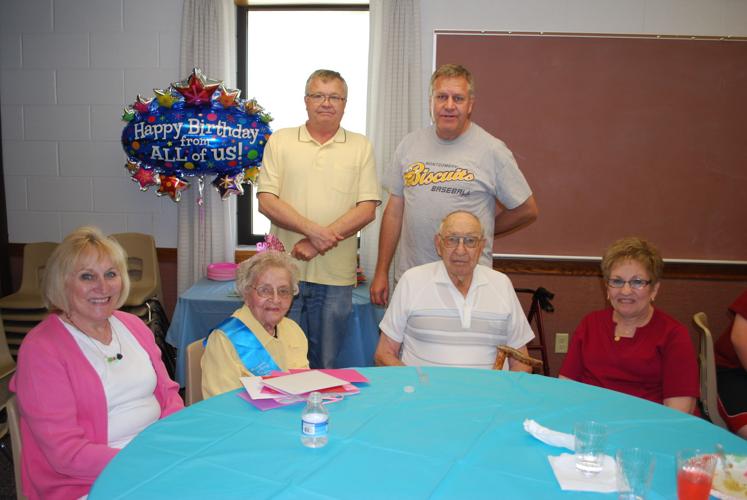
Lionel was preceded in death by his wife of 73 years and they had five children: Carol Mahar, Becky Hopkins, Bryan Bowser, Rick Bowser and Mark Bowser. They also leave behind 14 grandchildren and 21 great-grandchildren.
“My dad always made life fun whether it was work or play or solving problems,” Carol said. “He made everything joyful.”
Jim Koetter worked closely with Lionel as a head football coach early in Highland’s history, a head track coach and an assistant basketball coach. Koetter’s two sons have also coached at Highland. Koetter admired Lionel’s enthusiasm for both sports and education.
“He had a high opinion of the value of the athletic program in the school system,” said Koetter, who was a Highland business teacher.
Indeed, Lionel was inducted into both the Idaho Educator’s Hall of Fame and the Idaho High School Athletic Association Hall of Fame.
After learning the recent news that Highland’s first principal had died, several students posted their fond memories on social media. Former student Bill Lasley recounted how after he broke a rule, the principal let him choose between notifying his parents and paddling him. That student regretted his decision to be paddled — not because of the discomfort but rather because he’d disappointed Lionel.
Another former student recalled being scared when she got in trouble and had to go see the principal. She wrote how Lionel laughed uncontrollably after she finished telling him what she’d done and then simply said she could go.
Other students lovingly referenced their nickname for Lionel, Mickey Mouse: A fellow teacher often called him Mick and a group of students took the sobriquet a step further. There were also stories posted about his successful efforts to keep students in school.
“He was very big on creating really good atmospheres,” Bryan said.

(0) comments
Welcome to the discussion.
Log In