

POCATELLO — Any time something comes out of a landfill instead of going into it, it’s a good thing, said former Chubbuck Mayor Steve England.
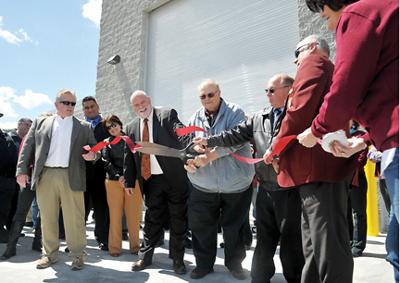
England was one of about 60 local officials and residents who came out for a special ribbon-cutting ceremony marking the opening of the Gas-to-Energy Plant at the Bannock County Landfill on Tuesday.
The plant is one of only three in the state that converts methane gas from trash to energy. The project meets EPA guidelines and removes air-polluting gas from the landfill while generating revenue for the county.
Compliance manager Therese Marchetti said the plant has been up and running since April 14.
Marchetti said the plant is consuming 304 cubic feet of methane per minute and by the end of the month will have produced enough energy to power 700 homes.
According to Commissioner Howard Manwaring, during the next 15 years, the plant will earn $10 to $20 million for the county.
“The federal government is going to require large landfills like this one to get rid of the methane gas,” Manwaring said. “We’re getting ahead of the game.”
Commissioner Steve Hadley said the construction of the plant cost $4.5 million and was funded through landfill fees.
Marchetti said 32 methane wells are at the landfill. Gas is being pumped from 19 wells on a portion of the landfill that was closed in 1993. The county plans to install a second generator in five years.
Public works director Dan Copeland said the gas is piped to a clarifier then to the generator.
Copeland said the generator is a V-20 350 cc Cat motor, the third largest produced by the company. The generator creates 800 kilowatts per minute, and energy production will increase throughout the summer.
The plant will add one new mechanic to the county payroll, and the crew has been cross-trained to maintain the plant.
Engineer Chanc Meyer said the methane wells are 3-foot holes drilled into the trash. A pipe is positioned in the center and the hole is layered with rock and clay.
Project engineer Stephen Freiburger said all energy being generated at the plant is sold to Idaho Power Co. and the Bannock County landfill buys power back. Meters at the site track the amount of energy being produced and consumed.
Freiburger said it’s cleaner to buy the power back than use what the plant produces on-site, and Meyer added that it would require additional infrastructure to power the site with electricity generated at the plant.
Emissions from the process, which include methane and carbon dioxide, are burned off and only exhaust is released into the air.
Freiburger said the system is monitored and a worker is on call 24 hours a day.
The generator is water-cooled, and a venting system functions sort of like a car grill.
The Pocatello Chiefs were on hand for the ribbon-cutting and Mark Lupo with Idaho Power emceed the commemoration on behalf of the Pocatello Chubbuck Chamber of Commerce.
“We’ve been watching this,” Lupo said. “Something is coming out of the landfill, not going in. This has been a huge accomplishment.”
Commissioner Karl E. Anderson recalled the old county landfill on Hiline Road, where he said he and other residents traded trash.
“What’s happened here has been phenomenal,” Anderson said. “We should all be very appreciative of this project.”

(0) comments
Welcome to the discussion.
Log In