

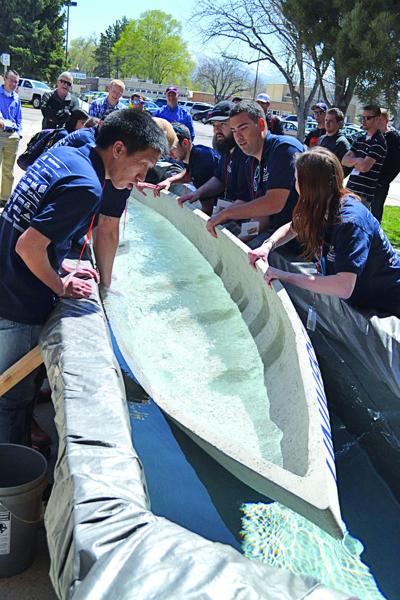

Concrete is not supposed to float, but don't tell that to the throng of engineering students from throughout the Pacific Northwest who were on the campus of Idaho State University Friday. It was their job to make it happen.
Of course the variety of concrete used in the canoes designed and built by the college students wouldn't be something you'd use in your driveway.
“Our concrete has to float on its own,” said team captain for the University of British Columbia, Canada, Bradley Ho.
The only team in the competition from Canada, the UBC team of 10, will put its boat to the test in a series of races to be held at Jensen's Grove in Blackfoot today.
“We're going to spend the whole day racing in different heats,” Ho said.
The Canadians will be competing with teams and canoes built by Saint Martin University, Boise State University, the University of Alaska, Portland State, University of Idaho, Washington State University, the University of Washington, University of Portland and Seattle University.
All the teams set up three of the phases of their competition Friday. They included a design paper, a presentation and a “swamp test” to make sure the vessels floated with 50 pounds of sand on board.
The Canadian canoe named “Voyageur” passed the test completely.
Although 10 students made the trip from B.C. to Pocatello, Ho and his assistant captain, Anthony McGill, said it took 35 engineering students to perfect the project.
“We completely designed a new hull shape to fit within the requirements,” Ho said.
McGill grabbed a piece of the concrete they created from the university’s display, and it was obvious by its weight that it was not made of the standard gravel and cement.
The aggregate used in the Canadian canoe was a ceramic product made from recycled glass, and it was reinforced with a carbon fiber mesh.
“Last year, we used chicken wire, and this is a big upgrade,” McGill said.
The UBC engineering effort to compete with concrete canoes is only in its second year, but the team has qualified to compete in the Canadian National Concrete Canoe Competition to be held in Toronto in May.
Ho said the engineering students spent a lot of time with organization and fundraising efforts to get their program off the ground last year. Major sponsors include McElhanney, the oldest engineering firm in western Canada, and LeFarge Cement.
“They gave us a blank slate,” Ho said.
The contributions from the companies also allowed the team the luxury of making the trip to Idaho State University for this week’s competition as well as the trip to the Canadian Nationals.
“It takes a lot of technical skills and soft skills to do this,” Ho said.
He said his experience as team captain has given him new insight into leadership and he ability to talk to people and work as a team.
“It feels like a really collaborative effort,” Ho said.
Ho and McGill are both going to graduate this year, and Ho is hoping to land an engineering job in California. McGill has already lined up a job with McElhanney in Vancouver.
The pair of Canadians said it’s great to be able to meet engineers from other universities and compare notes.
“It’s a friendship forged in concrete,” Ho quipped.
But there will be a competitive spirit today when the teams from different universities race their concrete canoes.
“We expect a top three finish,” Ho said.

(0) comments
Welcome to the discussion.
Log In