

Editor’s Note: This is part of an ongoing series of stories chronicling the Charlotte Fire recovery efforts. Look for more stories every Monday in the Journal.
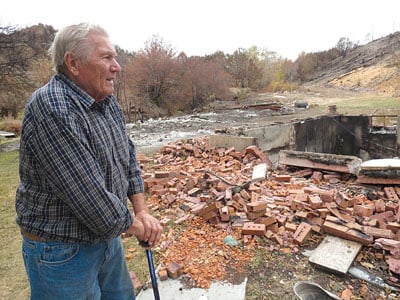
POCATELLO — Bob Tripp said he and his wife, LaRae, whose Gibson Jack home was lost in the Charlotte Fire, don’t plan to rebuild.
“Because I don’t want to build,” Tripp said from the home he is now living in. “(Maybe) if I was 63 instead of 83 (years old).”
Tripp built his family home 55 years ago on a piece of property that is adjacent to the home his late mother-in-law lived in. In fact, the two homes share a common entry drive. Tripp and his wife purchased the mother-in-law’s home after she passed away and were renting it out.
The Charlotte wildfire, when it tore through that area on June 28, burned Tripp’s home, several out buildings and a large shop on the other side of the mother-in-law’s old house. But that house was spared and it’s where Tripp and his wife are now living.
Not only does Tripp not want to rebuild his former home at his age, but he also believes that with today’s requirements he wouldn’t even be allowed to build on that spot.
“Even with grandfather rights, I don’t think they would let me build there because I am within 50 feet of the creek,” Tripp said, adding that current laws don’t allow a home to be built within 300 feet of a creek.
But Tripp says he may be forced to look into the possibility of building on the property. He said his insurance company gave him just $110,000 for the home he lost in the fire, and that they would give him more than $220,000 if he were to rebuild.
He says the insurance company told him the land the home was on is worth $60,000 and that is the reason he was paid $110,000.
Tripp disputes the idea that the land the home was on is now worth $60,000. He says if the land cannot be built on, then it isn’t even worth $5,000.
He is filing suit over that and some other disputes, such as the large shop that burned, for which he received $19,000 and estimates it would cost him at least $100,000 to replace.
Tripp believes he currently stands to lose more than $200,000 based on what he is being compensated for and its true value. Also figured into the equation are some irreplaceable assets lost in the fire, such as a gun collection and coin collection.
“I had probably over a $100,000 coin collection,” he said. “I had one gun that was worth $7,000 or $8,000.”
He said the guns are a twisted, melted mess worth nothing, and the coins nearly completely melted from the heat of the fire. He said the coin collection is now worth just the melt value of the precious metals.
Tripp and his wife were home on June 28, the day the Charlotte fire erupted, and were watching television that afternoon when their program was interrupted with news of the fire.
“Of course, we have two boys that live up above us,” Tripp said. “So, we jumped in the car to go up and check on their places.”
When they returned to their home just a short time later, deputies from the Bannock County Sheriff’s Office were telling residents they needed to evacuate and stopped by the Tripp home.
“At that time, all we could do was smell smoke,” Tripp said. “I said we will leave as soon as we see smoke or fire.”
Just a few minutes later, the blaze came over the ridge to the south of their property.
“It wasn’t too long and as far up the canyon as we could see and as far down the canyon, there were flames 40, 50 feet in the air,” Tripp said. “It was a little bit scary.”
So, they left fairly abruptly. Too abruptly Tripp says, because he believes with the tanker of water he had on the property, he probably could have saved his home.
On the property, surrounding the spot where his home once stood, remains numerous thriving trees and foliage, a sign to him that his home was likely hit by burning embers or ash floating through the air. That’s something he believes he could have doused, saving his home.
Tripp admits that when he and his wife left, they didn’t worry about grabbing anything because they did not believe their home was going to burn. He says it was 4 p.m. when they left their property and it was several hours later when it caught fire and burned.
“We lost all of our — everything we had,” Tripp said. “With a bucket of water I could have saved my house.”
Lost in the blaze was all of their possessions, all their memories, many valuables, and a pet cockatiel. It was a bird given to them by their daughter a few years ago.
“We didn’t take it with us because we figured we’d be back,” Tripp said.
As he looks over the property where the burned remains of his home still rest, Tripp points to those thriving trees, specifically two or three pine trees that were relatively close to the home.
“My wife was always worried that those trees were going to burn the house down,” he chuckled. “The only thing left is those green trees.”
Editor’s Note
If you are on the road to recovery from the Charlotte fire, getting ready to rebuild or even choosing not to rebuild, we would like to hear your story of recovery. Contact Jimmy Hancock at the Idaho State Journal at 239-3137, or via e-mail at jhancock@journalnet.com.

(0) comments
Welcome to the discussion.
Log In