

A red woven blanket once came to the rescue of Brigham Young University-Idaho student Walker Woodbury’s great-great-great-uncle Arthur Parker along the burgeoning American frontier in 1856.
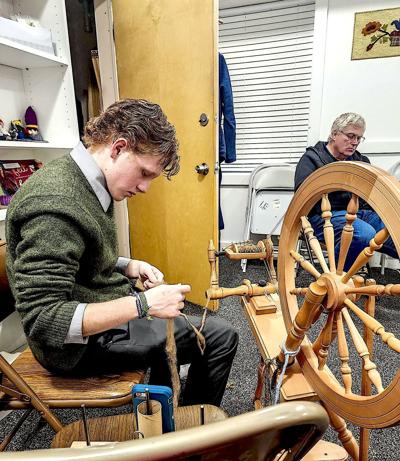
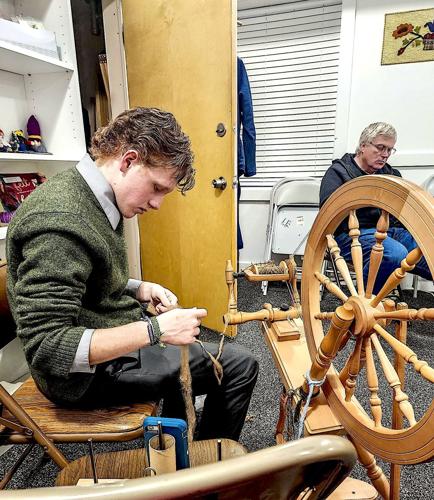
Fast forward to 2025, and it appears that weaving flows through Walker descendants’ blood as Woodbury carries on his family’s tradition of handiwork relying on bobbins, looms, spinning wheels and treadles.
He tells of how his fourth great-grandparents, Church of Jesus Christ of Latter-day Saints converts from England, Robert and Anne Parker, trekked across the country in July 1856 when Arthur vanished. The Parkers didn’t realize he was missing until three days after they hurriedly set up camp due to a severe rainstorm. Two days of searching failed to find the boy, and the company was forced to continue on.
Terribly worried about little Arthur, Robert Walker headed back the direction the handcart company had just traveled.
“Anne sent Robert out to look,” Woodbury said. “She gave him one of her red shawls. She basically told him, ‘If you find him alive, wave the shawl over your head. If you find him dead, wrap him up and bring him back.”
About four days later, Robert returned with little Arthur who had been cared for by a couple who found him cold, hungry and frightened.
“Arthur told me how the big dogs stood around him that first night and barked, but they didn’t touch him,” Robert Parker is quoted as saying in the story written by Lula Parker Betenson in a story entitled “Butch Cassidy, My Brother.”
Incidentally, Woodbury is also related to Cassidy, who is his first cousin, four times removed.
“It’s more of a cool fact than anything, but the connection is there,” he said.
After retrieving Arthur, Robert Parker spent several days catching up with the handcart company.
“(I carried) little Arthur most of the time — poor tired little tyke,” he’s quoted as saying.
It’s a story that resonated with Woodbury, 19, throughout his life, and is one that motivated him to start weaving.
Weaving is apparently genetic, and Woodbury can feel Anne Parker watching over him as he works the spinning wheel, loom and bobbin.
“It’s kind of a little pluck,” he said. “(It’s like she’s saying) ‘I know what you’re doing.’ It’s quite an interesting feeling. This has been something people have been doing for centuries, and I’m continuing that.”
While at BYU-Idaho, Woodbury has been taking general studies course for an AA in science. While here, he’s also joined fiber arts groups where he’s honed his weaving skills.
Fiber optic skills should become a part of Science, Technology, Engineering, and Math (STEM) courses, Woodbury said.
“There are mathematical, scientific, and transferability principles to fiber optics,” he said. “There’s lots of algebra. There’s just a balance with increasing, decreasing in making swatches, and making sure you have the right dyes and concentrations of chemistry.”
Woodbury washes and cards wool that he later runs through the spinning wheel’s bobbin that transforms it into yarn. While working with the yarn and the bobbin, he also works with the treadle and likens doing so to playing a musical instrument.
Woodbury’s mother taught him how to crochet, and he later honed those skills by watching YouTube videos. Woodbury’s father once found him working on a crochet project one evening.
“My dad was just staring at me super late at night,” he said. “After I finished the row, he said, ‘You have really steady hands. You could be a surgeon.’”
Woodbury plans to use his steady hands to teach American Sign Language after graduating with a degree in sign language from the Greeley, Colorado-based University of Northern Colorado.
Shortly after he was born, Woodbury developed bilateral cholesteatoma that damaged the majority of the hearing in his left ear. Surgeons later repaired the damage and eventually fitted Woodbury with a cochlear implant. Today, he can hear fairly well, but once in a while asks someone to repeat themselves.
He’s not sure when he’ll attend UNC but plans to enroll in the near future. For now, he’s finishing up his AA at BYU-Idaho. At the school he’s one of its few openly gay students. Woodbury has a boyfriend who was recently baptized into the church.
“I haven’t run into a lot of problems,” he said. “The people I associate with are really awesome and open-minded.”
Woodbury’s parents have been supportive and just want him to be happy. He thinks animosity toward homosexuals is lessening.
“I’m not a super flamboyant-in-your-face gay,” he said.
Woodbury also serves on the BYU-Idaho intramural cheer team and works as a waiter at a local restaurant.
One who spent his childhood living in 17 different states from Utah to Virginia, Woodbury moved with his family to Rigby about three years ago.
He has a unique accent that’s difficult to nail down.
“There’s a different accent here,” he said. “I’ve just picked up on that more deep country accent.”
When not at work, Woodbury hones his fiber arts skills and is designing his own crochet and knitting patterns for clothing. He greatly enjoys making things for other people.
“It’s really rewarding to have someone think something you made is super awesome,” he said. “With all the consumerism that’s rampant nowadays, it’s ‘buy, buy, buy’ mode. I wouldn’t say fiber is cheap, but it’s what goes into it. You’re preparing the wool, spinning it and making something that will last. It’s not something you will buy for 40 bucks and is not very good material.”
Instead, weaving connects people, Woodbury said.
“It’s something for someone, and it brings joy and happiness for whatever reason. It’s joy and Christlike love to people,” he said.
As for that red woven blanket from Anne Parker, Woodbury isn’t sure whatever happened to the comforter.
“I don’t know, but it’s a really cool story,” he said. “It’s one that’s been shared a bunch of times. It’s pretty important to my family.”


(0) comments
Welcome to the discussion.
Log In