

The American Rescue Plan Act, or ARPA, was passed in 2021, allocating $1.9 trillion in a wide-reaching 10-part plan to restarting our economy and recovering from the COVID-19 pandemic.
Currently, the main remaining ARPA funds are the $350 billion allocated for state and local governments’ projects. Though this portion is only 18 percent of the total ARPA funds, its effects will be felt for generations.
As with nearly all federal government grants, there are limitations of what the funds can be used for, lots of paperwork, and firm deadlines, all administered by the U.S. Department of the Treasury.
Originally, the types of projects the state and local governments could use ARPA funds for were limited to pandemic affected services — raising pay for essential workers, disaster relief, surface transportation, investments in infrastructure (water, sewer and broadband) and funding Community Development Block Grants, or CDBGs.
Fortunately, a bit of mission creep happened at the Treasury. It expanded the list to allow using funds for providing matches on transportation infrastructure projects and for any projects that are eligible for the CDBG program. That last one kicked the door wide open to allow almost anything that would improve a community. Of course, there are fine print details on project eligibility, but these are the general guidelines.
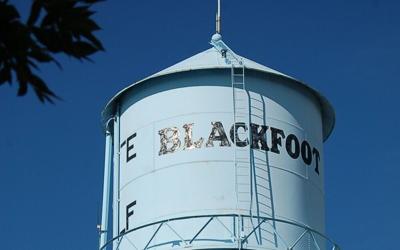
As to deadlines, there are two main ones: all funds must be obligated by Dec. 31, 2024, and all funds need to be spent by Dec. 31, 2026. Recently the Treasury redefined “obligated” to mean contracts need to be signed by that date. In government timing, these deadlines are fast approaching and many finance directors are starting to panic as they juggle their many projects. All appears calm in Blackfoot, however. They have already completed two of their three water and sewer projects and are bidding on the final project.
ARPA funds are distributed based on population; Blackfoot received a little over $2.5 million. They chose to use these funds to remedy chronic storm water flooding in the Champions Gate subdivision, install radio meters on all water meters and to upgrade downtown’s sewer system.
The Champions Gate project involved a subdivision near open space areas that store snow well. The developers installed swells to handle temporary extra storm waters or sudden snow melts. However, new homeowners didn’t understand the system and filled in the swells with landscaping, removing their protection from flooding. With ARPA funds the city put in an infiltrator system to replace the swells system and the seasonal flooding problem seems to be solved. That cost $322,738.
The next project to be completed was purchasing radio meters to better understand water usage in real time. These meters are easily wired to the existing water meters, after which they report water usage to the city water department every 15 minutes. This way the city can pinpoint where broken pipes or unusual water activity is happening and quickly fix any problems, lessening loss of valuable water. Due to supply chain woes the meters have been slowly arriving, but they are all here now and are being installed. This cost was $600,000.
Contrary to the impression that Idaho has limitless water with all our rivers and snowy mountains, rapid recent population growth has made the city nervous about supplying sufficient water without exceeding their junior water rights. Currently, it is nearly impossible to buy more water rights, so conservation measures are the only route forward if more water is needed.
Eventually they want to have this water data available online so residents can monitor their own usage and make their own water usage decisions.
Knowing exactly how water is used will help design those measures, if they are needed. Eventually, they want to have this water data available online so residents can monitor their own usage and make their own water usage decisions.
The remaining ARPA funds, about $1.6 million, are for solving the aging sewer pipe problems in the downtown area. Some of the original clay pipes have dissolved, leaving only compacted earthen “pipes”. There are also places where the pipe cameras can’t get through, meaning there is some kind of blockage from either breaking or shifting pipes or invading tree roots.
The first phase of the sewer project is to spot repair breakages in 10 known locations and replace about 300 linear feet of 8-inch pipe in areas where the ground shifted and the pipes are no longer aligned.
Last year, the city awarded a bid to do phase one, but when the contractor found out that he had to also contend with narrow alleyways and other utility and service lines — something he would have learned at the pre-bid walk through he didn’t attend — he wanted to submit change orders to charge extra. The city said no and nullified the bid award.
This time, the city has required all potential contractors to attend the pre-bid walk. They held that walk through recently, and unfortunately only one construction company attended. This doesn’t bode well for receiving a low bid. When that bid is received this month, the city’s team will decide if it can be accepted or if rebidding is necessary. Third time’s a charm?
The hope is to have phase one done this summer and to have some remaining ARPA money to start phase two. The second stage involves using a Cure in Place Process (CIPP) to line the earthen pipelines. Once the injected liquid resin cures there will be new solid pipes again — all without having to disturb the street asphalt. CIPP isn’t a cheap process, but it is cheaper than replacing asphalt with the traditional replacement process.
Perhaps Blackfoot’s Treasurer Grahm Anderson will have some fall heartburn after all. It could be a tight timeline to finish phase one, bid phase two and get a contract signed before the end of this year. However, Anderson is confident that they will have enough time.

(0) comments
Welcome to the discussion.
Log In