

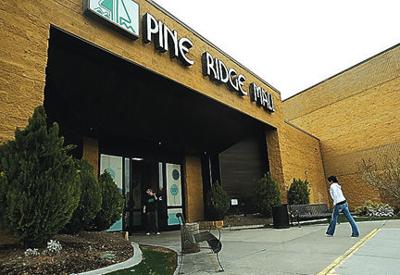
They were the days of big hair and jean jackets, food court flirting and hanging out with friends. For many locals, memories fill the halls of the local mall.
Tyler Allen would take her spending money to Aladdin’s Castle, feeding the flashing arcade games while the sweet scent of Mrs. Powell’s cinnamon rolls tempted the teen and her friends.
Andy Piantanida remembers flipping through one vinyl record after another while his parents shopped nearby. Hanging out with friends one day, Laura Soto caught the eye of a handsome stranger as she was walking toward Dillard’s.
“He turned and followed,” Soto said. “We sat on opposite benches, just looking at each other. Finally my sister went over and talked to him for a minute and gave him my number. He called constantly for a few weeks before I finally talked to him.”
The romance that began at the mall eventually led to marriage and three children.
“The mall was so exciting back then,” Soto said.
Today, the sense of nostalgia at the Pine Ridge Mall in Chubbuck floats thick in the air, through shuttered storefronts.
Dillard’s, Aladdin’s Castle and Mrs. Powell’s are now gone. On an average afternoon, women in yoga pants and exercising seniors briskly walk the halls passing empty retail spaces. Kids tumble through the play area, and the florescent ceiling lights illuminate wandering shoppers as they dance around purchasing decisions.
Major anchor stores have come and gone over the years, and metal grates cover a dozen dark, empty shops. With Sears’ expansive floor space sitting empty, the Pine Ridge Mall’s vacancy rate is at 85.14 percent.
“There were so many stores and a few places to eat at,” Soto said. “I would love to see it come back to life.”
However, those halcyon days might be a permanent part of the past as malls across the America make way for a new future.
Empty stores echo across America
Retail mall vacancies rose in the fourth quarter, mostly due to the closure of several Sears stores, according to real estate research firm Reis Inc. Sears dealt a heavy blow to malls when, in December, it doubled the number of stores it planned to close: 253 are on the chopping block. The Sears at Pine Ridge shuttered its doors in September, a victim of sinking corporate profits.
The average American mall is more than 8 percent empty. In the pre-recession glory days, more than 94 percent of malls were thriving. Today, only 80 percent of malls fall into that healthy category, meaning 300 of these massive properties are now viewed by economists as “unhealthy.”
There are only about 1,500 enclosed malls across the U.S. to begin with. All of this is according to CoStar Group, a data provider for the real estate industry.
The Pine Ridge Mall sits alongside many others on an ever-growing list of malls with especially high vacancy rates — 3.4 percent of the enclosed mall industry.
“There were a lot of great memories there,” Allen said of the Pine Ridge Mall. “I wish it was the mall it used to be.”
Diversify or decline
With millions of dollars on the line, analysts across the country are taking a stab at how to incubate retail rebirth. So far, the data says that success comes with lifestyle-based experience shopping with high-quality, high-end stores.
Malls with high-end tenants such as Nordstrom’s and Apple are outperforming the malls that are anchored by a Sears or a J.C. Penney in terms of sales per square foot and value, according to Green Street Advisor’s 2015 U.S. Mall Outlook. At the ritziest malls in affluent neighborhoods anchored by stores such as Nordstrom’s, Bloomingdale’s and Neiman Marcus, sales per square foot have gone up — from $900 per square foot in 2013 to about $945 per square foot now. Apple’s retail stores generate almost $5,000 per square foot. In contrast, J.C. Penney’s sales per square foot per year have slid from a high of $248 in 2007 to a low of $147 in 2013, according to the report from Green Street.
The Pine Ridge Mall’s major anchors each claimed gains in the fourth quarter, with the exception of Shopko, which is privately owned and does not publish quarterly earnings.
Income and the Internet’s role
Green Street’s report goes on to say that this trend toward the upscale could be a result of simple income inequality — people in more affluent neighborhoods have more disposable income to spend at the mall.
In Bannock County, where the Pine Ridge Mall is located, people do not have a lot of disposable money. The county sits near the bottom of the list when it comes to per capita income.
People in the Pocatello area make, on average, almost $7,000 per year less than everyone else in Idaho. That disparity is stark when compared to the rest of the United States.
Bannock County’s per capita income is $30,936 per year, which is $13,839 less than the national average. Locals in and around Idaho Falls fare better with a $38,616 per capita income, according to the Idaho Department of Labor.
Making sure that money stays in our area is another challenge altogether.
With Idaho Falls shopping being only an hour away for most in Bannock County, some choose to just make the drive and spend their dollars there.
“I don’t even go to the (Pine Ridge) mall now,” Allen said. “I go to Shopko for prescriptions and that’s it. I will travel to Idaho Falls.”
The management of the Grand Teton Mall in Idaho Falls refused to discuss that establishment’s vacancy rate or other business details.
The most recent study on retail leakage in our area was done in 2012 by Idaho State University’s Bengal Solutions, a research arm of the College of Business.
“Due to the weaknesses in Pocatello’s retail environments, specifically in clothing and electronics, Pocatello is vulnerable to significant retail leakage to neighboring communities,” the 2012 study said. “Pocatello has per-capita retail sales of $13,593 versus Idaho Falls with $27,285 — a discrepancy of 49 percent. Household incomes are approximately 20 percent higher in Idaho Falls, which could account for nearly half of the difference in retail spending. The other half is likely due to the retail dollars spent by shoppers from Pocatello and other communities surrounding Idaho Falls.”
That data might be because there are just more retail jobs in Idaho Falls.
More recent numbers from the Idaho Department of Labor show a drop in retail jobs in Pocatello and Chubbuck. Bannock County lost 248 retail jobs in the past decade. Bingham County gained 483 retail jobs in that same time frame. While individual stores might collect data on the zip codes associated with their shopper’s cards (telling retailers where their customers come from) regional economic development authorities and the Idaho Department of Labor do not have access to that information.
According to Kolton Woodburry, a Bengal Solutions spokesperson, the university group has called the Pine Ridge Mall and offered its consulting and analysis services. However, that call has not been returned.
When it comes to the decline of the mall, analytical fingers point at not only income inequality and retail leakage, but also the advent of online shopping.
“Online, people are finding it easier to compare products and options side by side,” said Dan Cravens, a regional economist for the Idaho Department of Labor. “It has become easier than going to the stores.”
In the glory days of the mall, rows of nearby stores served as galleries for new products, talking points for teens and easy comparisons for the savvy shopper. Today, many of those functions have moved online.
The apparel and fashion industry provide a prime example. Mall staples Aéropostale, Abercrombie & Fitch and American Eagle Outfitters all rode roller coaster drops in sales over the past year, each losing at least $2.2 billion. Teens rendered the biggest gut shot to Aéropostale, dropping its year-over-year-sales by 7.4 percent.
“I think we are going to see declines in certain types of retail,” Cravens said, mentioning apparel as one area facing challenges.
Part of this decline in fashion retail is because fewer teens are working now — only 6.7 percent of high-schoolers now versus 19.2 percent in 2000 according to research firm eMarketer — meaning they just don’t have the cash to spend at the mall.
When they do get money, teens are spending it online. Research firm Piper Jaffray found that 82 percent of teen males and 78 percent of teen females shop online.
“Malls were based off two things,” Cravens said. “They kind of made where you shop a community gathering place. And they provided a lot of variety and lots of different options so you could compare. But the Internet gives you unlimited options to compare — and a place for teens to socialize.”
The big picture
But blaming the American mall’s decline on teen shoppers doesn’t paint the whole picture.
If shoppers of all ages are considered, the data says that online sales are not completely guilty when it comes to mall deterioration. While half of shoppers worldwide told eMarketer that they preferred shopping online, only 29 percent had made their last purchase online.
When it comes to small-town retail, the most recent reports beckon a bright future. Reis reports that, while still troubling, vacancy rates are shrinking. Construction during the fourth quarter was the highest it’s been since 2011. However, Reis’ best news for malls like Pine Ridge is that net absorption was the highest it’s been since 2007. This means that existing malls are filling their empty space at an increasingly rapid rate. Reis reported that net absorption exceeded construction by roughly 2.5 million square feet during the quarter.
“This indicates that there is some semblance of demand for existing inventory and not simply the addition of pre-leased space in the market,” Reis representatives said in a press release. “[Regional] malls continue to be the out-performers during the retail market recovery.”
Looking toward the future
When it comes to the Pine Ridge Mall, local economic development advocates believe the new ownership will create an environment where growth is possible. The mall was purchased by real estate investors Farmer Holding Corp. in 2013.
Farmer paid $9.05 million for the Chubbuck mall complex after it was put on the auction block by former owner General Growth Properties.
Covington Realty Partners, a Chicago-based real estate investment company, also has an ownership stake in the mall. Sales per square foot among mall real estate investment groups are up 36 percent since 2010, according to Green Street.
Currently, the Chubbuck mall has five national businesses taking a serious look at its quiet corridors. According to General Manager Nicole Merrill, some retailers are also looking at the old Sears location as well as a few storefronts near it.
Who these retailers are is still a matter of speculation, with mall representatives declining comment until the contracts are a done deal.
“The new owners will generate more activity there, which will generate more traffic, which will generate more retail,” said John Regetz, executive director of Bannock Development.
Today, more than 20,000 cars drive back and forth in front of the mall daily. Behind the mall on Hawthorne Road, that daily average total is 9,700, according to data collected by the Bannock Transportation Planning Organization.
“For the local families and community, Pine Ridge Mall is the Chubbuck/Pocatello connection to family entertainment and retail,” Merrill said. “Unlike our local competition, Pine Ridge Mall provides a year-round, climate-controlled shopping experience with four department stores and the market’s only stadium seating theater.”
In the coming months, the mall will be installing LED lighting.
While the Pine Ridge Mall might not go back to the way it was in the 1990s, management is looking forward to an era of reinvigoration.
“As the shopping center continues to solidify its tenant mix and redevelop its vacant space,” Merrill said, “Pine Ridge Mall will enhance its position as the hub for community activity and retail.”

(13) comments
Malls have a lifespan, especially when no money (i.e. updating) is put into them. Look to the south as an example. The Cottonwood Mall in Utah was vibrant, but died and was demolished within the last few years. The downtown Crossroads and ZCMI Center died a slow death before being demolished and replaced with the new City Creek Center (which in turn is killing the Gateway Mall).
Time to think outside the box. Can the auditorium district purchase the old Sears space and convert it into the event center? Seems like money would be saved and used to transform it into a great facility. I believe the proposed events center and the current Sears space are roughly the same size.
Another idea for the Sears space - indoor recreation center (i.e. indoor ice rink).
Bottom line, though, is that people need to spend dollars locally. There's nothing wrong with driving up to Idaho Falls or down to Salt Lake on occasion. However, if you're purchasing items which can be found locally, you're doing a disservice to your community. Dollars are tracked, and retailers will follow the money. Increased local spending will lead to new retailers.
Get a Barnes and Noble, a place for the teens to hang out (video games,etc) and a couple good food spots. My 3 teens and their friends try to love the mall - they go out and hit Zumies and the pretzel place, but there is nothing else there!
We are not Utah or California. Lower the prices. Get the mall like it used to be. Get clothing stores in that has clothes to fit all sizes of people. Not just the skinny people. Get stores in the mall that people can actually afford to shop in. Not everyone in Pocatello and Chubbuck's economy can afford the does in the mall. We're not rich like Utah or California
I remember when the mall used to host things like the gem show, or have a petting zoo come in for families to enjoy. Or school choirs coming in to perform. On sale days, the mall would be packed with racks of things on sale and full of people. Today, it's like a ghost town. Empty stores, nothing interesting to look at, and very little in the way of activities besides shopping. BORING.
westwood, pocatello are gone and this one will be gone also . They are lucky to have what they have. IF 50 miles, Utah x number miles equals good shopping, restaurants makes for a good weekend. Where do you want to shop? Basics yes. Nice things, not here.
I heard the owners make it difficult to rent and charge far too much for space. Most people I have spoke with say it is cheaper to build their own building then rent at the mall. I feel our mall should be thriving and improving. Heaven knows it could use an update. I have seen malls in Utah stuffed full on a school day at 1 in the afternoon. Don't tell me malls are dying. If the owners would put a little effort and care into what they owner and have competitive rents prices they would be having to expand and perhaps add another floor. As for the older people walking laps around the mall, I noticed that all of them are very nice and one shop occasionally offered beverages before the rest of the stores opened. I personally try to respect when others make a point to be healthy.
Sorry to break the news to you, yes, malls had their hay day in the 1980's. Business Insider says "About 15% of U.S. malls will fail or be converted into non-retail space within the next 10 years, according to Green Street Advisors, a real estate and REIT analytics firm. That's an increase from less than two years ago, when the firm predicted 10% of malls would fail or be converted."
"The risk of failure for a mall increases dramatically once you see anchor closures," said Cedric Lachance, managing director of Green Street Advisors. "Their health is very important ... and most of them are highly likely to continue closing stores."
The Journal isn't making this up, sadly it is a national trend, a shift in the retail landscape. Yes, with commons fees in malls that get passed on to the businesses leasing space, it becomes very expensive. It is the same in most condos in towns, there is a commons fee that at times outweighs the benefits of owning a condo and it happens with Homeowners fees.
So yes, you are correct on the rent rates at malls but sadly the trend says that my grand kids won't enjoy what we had in prior years of the mall. It was our Facebook of the day.
I am already old and I don't go to some ones place of business to get my exercise. I go to the proper places to do that !!!! I go the stores to do my shopping [smile]
A look at Pocatello on Google Maps adds a dimension to the story that is outside Sarah Glenn's very thorough consideration of Ridgeway Mall, and related statistics about Pocatello's prosperity..
When I left Pocatello in 1967, there was not only a drive-in theatre where Pine Ridge Mall sits now, there were lots of UPRR facilities on the triangle of bare ground stretching north of Halliday to Gould Street, and extensive railway yards to the south of Halliday. I am guessing that a lot of railroad jobs are nothing more than nostalgic memories. A look at the aerial photo circa 1992, of the hump and rail marshalling yards that ran parallel to South Second, suggest to me that there were more jobs on the railroad then, though the UPRR shops had gone.
Where the NOP park now provides welcome leisure space, there was industrial park in 1967 (though I don't know the extent of its occupancy - my dim recollection is that Thiokol was one occupant).
How many jobs in transport and manufacturing have been lost? Where did these jobs go? What has replaced them, in Pocatello? Anything of significance?
The "mall walkers" are there before most of the businesses even open and when they do they often purchase things so give the old people who want to stay healthy a break! Sorry you're offended by old people walking in the mall you can only hope that one day when you're old, and yes that will happen, that there is a warm, safe place to walk.
I for one did no appreciate the people using it for a exercise facility :) Its was a shopping mall not a place for old people to over take for their daily exercising area !!!
I loved Pine Ridge Mall in its hay day. It bustled and had a life of its own. Today, it is sad to see the empty stores, vacant common area's, and quiet, tomblike feeling occasionally disturbed by an elderly mall walker.
When it is less expensive (less overhead) for a business to outright purchase land and construct its own retail store nearby, why pay more to lease a space in the mall?
Many businesses were "run out" of the mall by ever increasing overhead. Some leases penalized the business by demanding more in rent if the business thrived, but they were not lowered when the mall failed to draw in consumers. Increases disguised as energy audits ushered some out the door.
Another big issue is the attitude and indignation of vocal locals when lucrative national chains selling very popular, but non-church approved, items want to locate in the mall. It is a mall people, not a church!
The mall is a direct reflection of the region it is located in. I chuckle when I see a good old down home tack and feed supply business in a space formerly occupied by Macy's. But I guess that's better than sitting empty or even worse......open; stocked; manned; and still empty like the others. For reasons I care not to opine about the citizens of Pocatello do not support local retail business or happenings.
Downtown? Have been there lately? Good luck with that.
The Mall is dead! Long live the Mall!
Trends are powerful things, you can't beat 'em. Like tidal waves, they come, change the dynamic, then recede.
The Pine Ridge Mall was built on land that had been a Drive-In Theater. Remember them? In some parts of our country, Drive-Ins are making a nostalgic come-back.
In other, more visionary areas, the death of the Mall becomes the re-birth of their original shopping area: Their long ignored downtown. People kick their Amazon habit - for awhile, at least - and head to shop where their grandparents did.
Some of these revitalized downtowns are attracting the same national merchants that fled the local Mall.
We are blessed with a mostly-intact "Old Town."
With some vision, our Old Town could reign again as the place to spend our shopping time. Stranger things have happened.
Been to a Drive-In Theater lately?
Welcome to the discussion.
Log In