

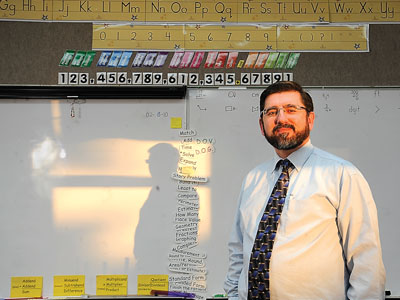
POCATELLO — A local charter school planning to expand its instruction through high school is investigating the possibility of moving into the vacant Bonneville Elementary School building.
The Academy at Roosevelt Center, now located at 240 E. Maple St., currently offers classes from kindergarten through eighth grade and has its enrollment capped at 280 students. The cap would increase to 400 students with the addition of ninth-through 12th-grade classes.
A subcommittee of the academy’s school board has been investigating options for the expansion, including the Bonneville building, located at 320 N. Eighth Ave. The board will hear a presentation from the subcommittee during a public meeting at the academy that starts at 5:30 p.m. Thursday. Joel Lovstedt, administrator for the Academy at Roosevelt Center, is hopeful that the board will render a decision during the meeting, but he said members may opt to request additional information.
Lovstedt said the academy hopes to offer high school grades starting in the 2011-2012 school year.
“Our goal is to expand. The question is where,” Lovstedt said.
The school, which opened in the fall of 2006, has more demand for seats than capacity and hosts an annual lottery to determine enrollment. The public lottery for the 2010-2011 school year will be at 9 a.m. on March 12.
Lovstedt said the academy has been exploring options for expansion, including the possibility of building a new facility, for several months. He said a new building on a new parcel of land would cost about $5 million.
Though he didn’t have estimates available on moving into Bonneville, he said the plan would likely be to buy the building from School District 25. Moving into Bonneville would present the academy with some amenities it couldn’t otherwise afford if it chose to build from scratch, including a spacious gymnasium with a hardwood floor and a stage, Lovstedt said.
“I believe Bonneville is a good choice. I don’t have all the information to say for sure that it’s the best choice,” Lovstedt said. “We want something that’s really going to help our program be good for the kids.”
Lovstedt also likes the Bonneville building’s proximity to Idaho State University, which would facilitate partnerships, and Interstate 15.
“When I drive around that building I think that could be a very nice looking building on the outside and inside,” Lovstedt said. “The more you look into it, you say, ‘That could be a very nice place.’”
The closure of Bonneville has been a sore spot among surrounding neighbors, who considered the school to have been the heart of their neighborhood and liked that it was within walking distance for students.
The Bonneville building was built in 1923, and additions were completed in 1940 and 1956. At one point, it served as the location of Franklin Junior High School.
Bonneville Elementary School was closed in 2003 while $20,000 in structural repairs were made on the building’s foundation. Once the repairs were made, the school was never reopened due to falling enrollment and financial considerations, explained Bart Reed, director of business for School District 25.
Reed said the building is still structurally sound.
“I think it would be a great facility for the charter district if they chose to do that,” Reed said.
Charter schools are state funded but don’t share in the proceeds of local bond elections. Their purpose is to improve student learning while encouraging the use of innovative teaching methods. The academy practices a philosophy called the Harbor Method — it strives to offer a safe harbor for children to pursue their education.
“Our school is a character development school where we offer the same curriculum that’s required by the state of Idaho, but things are done through the filter of character development,” Lovstedt said. “We believe when children feel safe at school then accelerated learning can take place.”
Lovstedt said test scores have been good at the academy — he noted charter schools that under-perform must simply close their doors — and the student body has met goals of state standardized testing.
“It’s really an interesting mix (of students). It’s a real broad socioeconomic mix,” Lovstedt said. “We draw from all ends of town. We do have a higher than normal percentage of students with special needs.”

(0) comments
Welcome to the discussion.
Log In