



POCATELLO — Pocatello-Chubbuck School District 25 has accepted a $36 million insurance settlement for the Highland High School rebuild — an amount more than $11 million above initial expectations.

Deanna Judy
School District 25 Board of Trustees Chair Deanna Judy announced the settlement in a recent Facebook post, describing the increased amount as “a blessing for our students, staff and community.” The district’s former insurance provider, Idaho Counties Risk Management Program, provided the settlement.
“While the initial insurance offer following the fire was $25 million, after the true scope and cost of rebuilding became clear, the final settlement totals more than $36 million,” Judy said in the post.
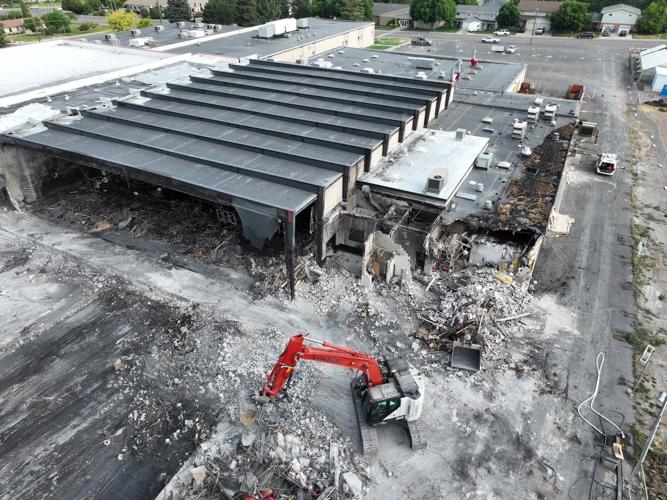
The settlement marks a significant milestone for the district as construction on the approximately $65 million project continues into its ninth month. The district broke ground in March following the April 2023 fire that destroyed Highland’s entire D Wing, approximately 75,000 square feet of space.
“Reaching resolution on the insurance settlement for Highland High School brings important closure to a challenging chapter and allows us to fully focus on what matters most — moving forward for our learners and our community,” School District 25 spokesperson Courtney Fisher told the Idaho State Journal.
Phase I of the Highland rebuild includes the upper and lower gym levels, locker rooms, a weight room, a commons area and six newly constructed classrooms. School District 25 expects completion in January 2027, according to its Rebuilding Highland website.

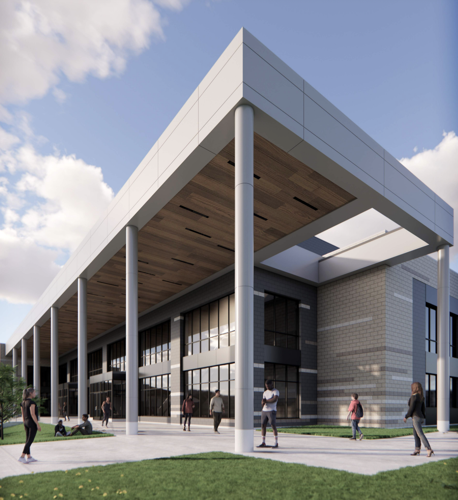
An illustration showing what the gym entrance at the renovated and rebuilt Highland High School will look like.
Phase II, set for completion in fall 2027, will include a 900-plus-seat auditorium and drama spaces designed to support both students and community events.
“Completing Phase I of the Highland High School project nine months ahead of schedule is a milestone worth celebrating,” Fisher said. “In just one year, learners will walk into new classrooms, a gym, commons and cafeteria space, a weight room, and an indoor track that support both learning and well-being. We are proud of the progress made and remain committed to seeing Phase II completed in fall 2027.”
A third phase will add improvements throughout the campus after the district completes the rebuild, including additional parking, traffic flow enhancements, a parent drop-off area, relocated tennis courts and a bus drop-off area.
“This milestone allows us to move forward confidently with a project that will serve generations to come,” Judy’s post said.
The $65 million Highland High School rebuild project includes approximately $58 million for phases one and two of the reconstruction, plus an estimated $7 million for phase three improvements, Jonathan Balls, the district’s director of business operations, told the Idaho State Journal in a recent interview.
The district will use three primary funding sources to pay for the Highland rebuild project — approximately $26 million from insurance proceeds and interest, approximately $34 million in state funding through House Bill 521 and interest, and $5 million from the district’s capital improvement fund, according to a Nov. 11 memo Balls sent to Superintendent Douglas Howell.
The $36 million settlement from ICRMP represents the total insurance payout covering more than just the rebuild itself, Balls said.
Further, a Dec. 16 memo Balls and Howell prepared for the school board ahead of its decision to accept the settlement breaks down the payout into six categories of expenses the district has either already paid or will need to pay.
The largest portion — $26.5 million — covers building replacement and code upgrades. Balls told the Journal this amount covers the rebuild itself and work required to prepare the school’s remnants for continued instruction while the rebuild commenced — immediate post-fire expenses and ongoing operational costs separate from the actual reconstruction project.
“A lot of that $11 million has been spent in those different categories,” Balls said. “The mitigation and emergency services that were spent to get the building up to code so students could return for the 2023-24 school year.”
The settlement breakdown includes approximately $3.5 million for immediate post-fire work to make the building safe and functional. Balls said that included about $450,000 for a sprinkler system installation the fire department required.

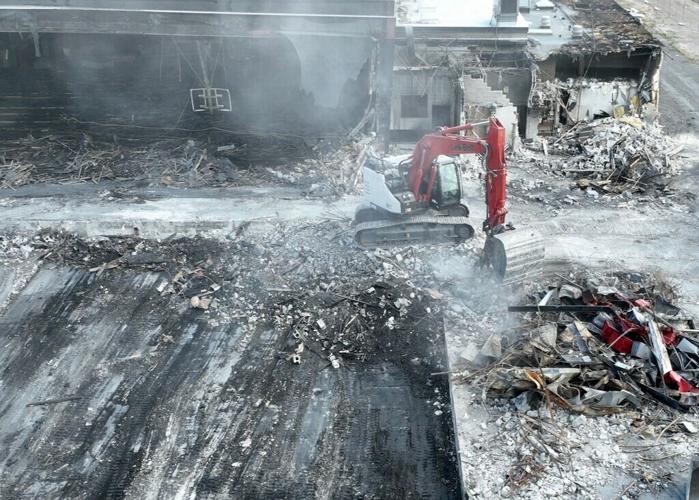
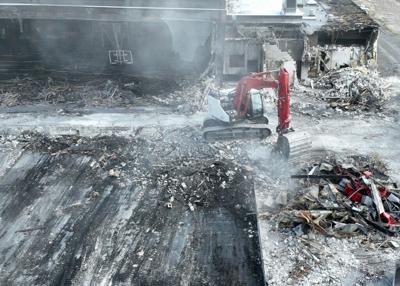
Demolition crews work to tear down Highland High School’s D Wing, which was gutted by an April 21 fire in this August 2023 photo.
The $11 million above the anticipated $25 million in the settlement also includes about $431,000 for demolition and debris removal, $181,000 for asbestos removal and approximately $4.8 million for replacing contents and equipment, the Dec. 16 memo states.
The district has already spent about $3.9 million on rental costs at temporary off-site locations where Highland programs have operated following the fire — Calvary Chapel and the Princeton building — as well as items used at those sites, according to Balls and the Dec. 16 memo.
After subtracting a $2,500 deductible, the total settlement amounts to $36,157,678, the Dec. 16 memo states. The district has also earned approximately $1.3 million in interest from insurance payments, which it will use for Highland improvements.
The insurance settlement includes several provisions that favor the district.
ICRMP agreed to pay approximately $738,000 for replacement costs on content and equipment the district has not yet replaced, even though such payments typically require proof of purchase, the Dec. 16 memo states. The insurance company also agreed to pay in advance for projected shipping, freight and installation costs on items the district won’t purchase until it completes the rebuild itself.
ICRMP also extended the claim timeline from the standard two years to three years, a measure that increased the settlement by about $230,000, which covered continued rental costs at the temporary locations while the district conducted public input surveys and pursued a bond election before ultimately moving forward with the rebuild design following the passage of HB521, according to Balls and the Dec. 16 memo.
In her Facebook post, Judy said necessary and thoughtful decisions drove the project’s delays.
“After the bond attempt and while awaiting imminent state legislation, we knew this project had to be done right,” Judy wrote. “Insurance funds alone were not sufficient, and without a stable funding source, rushing forward would have shortchanged future students.”
Judy added that Highland High School was originally built for a much smaller enrollment and at a time when women’s athletics and modern program needs were not considered.
“For example: Only three bathroom stalls existed in the women’s locker room, no locker rooms were available for visiting teams, band and choir spaces were the size of a middle school’s facilities, the auditorium and cafeteria were severely undersized for today’s student body,” Judy wrote in the post.
“Rebuilding a school that merely met minimum needs would have been a disservice,” she added. “Our goal has always been to create a facility that supports current students, future growth and modern educational and athletic programs.”


(0) comments
Welcome to the discussion.
Log In