

A friend and I were in a discussion one day about the need, or not, to preserve habitat.
At one point, to “prove” that humans in this country were not having the impact that conservationists were saying, he stated a “fact” that went something like this: if we took all the people in this nation and gave them each a half-acre of ground to live on, we would barely fill the state of Texas.
That is actually true at this point in the population of the country. Texas has about 171 million acres, and there are 342 million citizens. So, not allowing for roads, shopping and business centers, sidewalks, farms, ranches, mining, oil extraction, timber production, airports, manufacturing, parks, recreation facilities and all the other things that our society needs to function, we could do this very thing and each have our own half-acre.
I personally would insist on being on the outer edge, though, and would feel very sorry for a person in the middle, where it would be 400 miles in any direction to get to the rest of the country or the coast. He or she would have to get permission from 166,400 neighbors in order to get to an edge.
The argument made no sense at all since that isn’t the way that we actually live on the land. It is a phony statistic. Like most phony statistics, it does contain an element of truth, but the reasoning about what it means is faulty to the extreme.
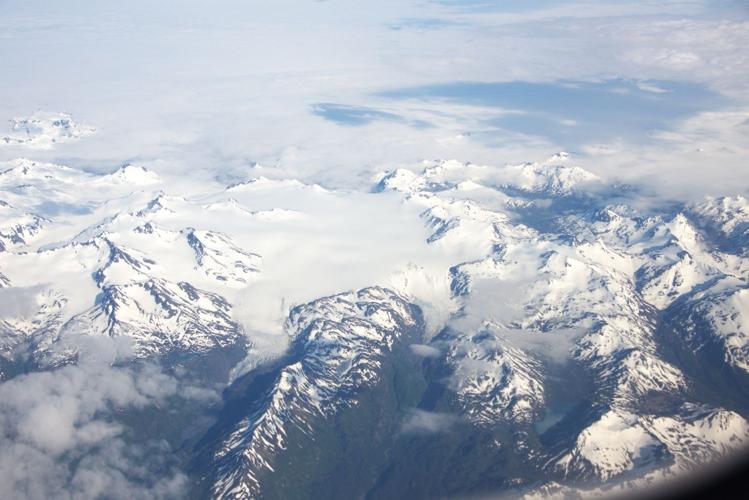
This is but one example of the faulty reasoning often used when people discuss nature and our impact upon it. I was reminded of this as I flew from Seattle to Anchorage last week. I intentionally chose a window seat on the east-facing side of the airliner so I could photograph the vast uninhabited coastline. For miles inland, snow-covered terrain stretched out in a vast wilderness. As I marveled at this immense chunk of empty land, I realized just how easy it would be for someone to use it as part of a phony statistic to point out just how much wild land is left on this continent.
For this land to be included in any calculation of true wilderness would be disingenuous, though. It is a large enough area to sway an argument with someone who is unaware of what the area is actually comprised of — snow, glaciers, and rock.
It is uninhabited because it is not just remote, but unlivable, and not just by people. Neither wildlife nor plants can live there in any significant numbers because the area is just too reminiscent to the recent end of the Ice Age (13,000 years ago). Even with a warming planet, it may take thousands of years before this vast interior becomes anything close to habitat for wildlife or of interest to even a burgeoning human population.
What it shows us is that “statistics”, while essential to science of any sort, can still be used to lie, confound and distort truth or attempts to find it. When used dishonestly or by people who do not understand what they are saying, statistical comparisons are at best junk science and at worst outright lies.
In these days of AI, political rancor, intense pressure from greedy individuals and public land grabs, it will behoove us all to carefully examine claims made by either side and to look for how we are being manipulated with “data” that really isn’t.

(0) comments
Welcome to the discussion.
Log In